
Location and structure of the orefield
At 1,500 square kilometres, the North Pennine Orefield is the second-largest area of lead and zinc mineralisation in the British Isles, only the geologically similar orefield in the Irish Midlands is larger. It occupies the area from Teesdale at its southern limit through Weardale and Allendale north to just beyond the line of Hadrian’s Wall, and from the Pennine scarp in Cumbria at its western limit across to the Durham Coalfields in the east.
From at least the 12th century up to the very end of the 20th century, the North Pennine Orefield had been a rich source of zinc, lead, barium, iron and copper providing an estimated 10,000,000 tonnes of these metal ores. In its heyday, between the eighteenth and nineteenth centuries when Great Britain was the biggest producer of lead and zinc in the world, it was GB’s largest producer.
Map of the North Pennine Orefield


The structure and origins of the North Pennine Orefield
A search for an explanation for the presence of the orefield here takes us back 400 million years or so to the Devonian and the closure of the Iapetus Ocean. Trans-tensional forces exerted then on the basement rocks of the colliding Laurentian and Avalonian plates engendered deep and widespread faulting permitting the intrusion of massive concentrations of granitic magma. This magma cooled to form most of the region’s plutons in the Lake District and Dumfrieshire to the west, and Cheviot and Weardale in the east. There are five Weardale plutons, the Weardale Granite at the centre, the Tynehead and Scordale plutons in the west, and the Rowlands Gill and Cornsay plutons in the east – together they make up the North Pennine batholith.
Each of the plutons roughly conical in volume, steep sided, and deep seated (9-12 km) and the Weardale and Cornsay plutons appear to be connected at depth.
Following Dunhams work in 1934, researchers into the structure and origin of the orefield recognised the zoned distribution of mineralisation here and suggested a direct link to an underlying pluton that could have provided the minerals and heat for mineral deposition. Gravity surveys in the 1950’s and 60’s along with a borehole at Rookhope proved the pluton at 390m under Carboniferous sedimentary rock and it was first assumed that the granite emplacement and associated mineralisation had occurred in the late Carboniferous as a consequence of the tectonic activity known as the Variscan Orogeny which built the Pyrenees.
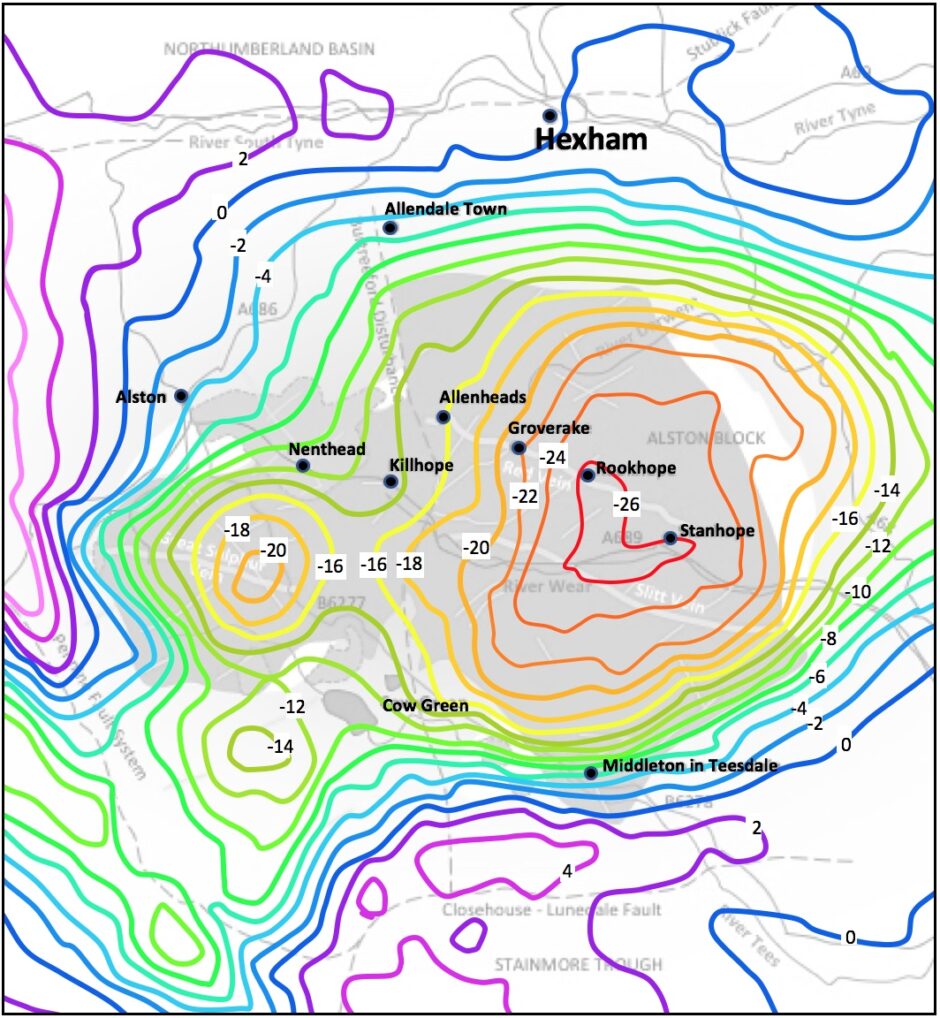
However, in 1961 Durham reported that the the top of the Weardale pluton had been subjected to weathering and that an erosional unconformity separated it and the Carboniferous strata above. This ruled out emplacement in the Variscan.

Nevertheless, Variscan north-south shortening, in conjunction with the buoyancy of the plutons relative to the surrounding sedimentary rocks, was important because it caused movement in the pre-existing faults that produced the region’s series of structural highs and basins. Thus, the presence of the Weardale pluton under the Alston Block contributed to the uplift of the block over the Northumberland Trough to the north, the Eden Valley to the West and the Stainmore Trough to the south with major movement along the Stublick Fault, the Pennine Fault and the Stainmore Depression.
A recent study of the orefield, published in 2021 by Dempsey, Holdsworth, Selby, Bird and Young and Le Cornu, assigns the period of mineralisation in the Alston Block to the early Permian (c290ma) coeval with the emplacement of the Whin Sill. While recognising that north-south shortening was instrumental in the uplift of the whole block, they report no evidence for it within the block itself. Instead, they note the signs of early Permian east-west compression and north-south shortening in the presence and pattern of the abundant conjugate faults that cut across the Carboniferous rocks at angles of about 120o and 60o in which metal sulphides are concentrated in the north east trending faults while barytes and fluorspar are concentrated more in the east-west faults.
Regarding the source of the ore field’s minerals, some earlier researchers recognised strong parallels between the zinc-lead North Pennine Orefield and the zinc-lead Irish Midland Orefield and suggested that seawater was instrumental as both a source and transport of mineral constituents.
Mineralisation in the Irish Midland Orefield is thought to have resulted from the circulation and mixing of two distinct fluids in magmatically powered hydrothermal systems in fractured limestones.
The theory suggests that one of the fluids was a sulphur-poor, partially evaporated seawater at 130oC to 280oC that circulated through the basement rocks and extracted their metals and sulphur. The second fluid was a cooler but more saline-rich seawater with a high concentration of both bromide and bacterially produced sulphur ions.
When the two fluids mixed in the faults and fractures of the limestone, metal and sulphur ions combined to form the metal sulphides that ultimately replaced much of the carbonate wall-rock.

However, Dempsey, Holdsworth, Selby, Bird and Young and Le Cornu argue that seawater did not have a part to play in the mineralisation of the NPO. They propose that the sulphide mineralisation here is genetically linked to the same mantle magma that produced the Whin Sill. They have determined that the deep Burtreeford Disturbance may have had a central part to play in this mineralisation in that it ‘may correspond to a deep-seated Caledonian structure in the basement that acted as a conduit for ascending metalliferous fluids…’. Further, they believe their findings accord with Robinson’s 2021 paper (cited in The Whin Sill section of this website) that argues for the Whin Sill magma having been fed at the sill’s centre close to the Burtreeford Disturbance rather than at its periphery via ‘feeder’ dykes. They also link fluorine mineralisation with the intrusion of the Whin Sill and the high temperature (>250oC) leaching of metals from the surrounding sedimentary rocks.

One interesting characteristic of the mineral veins of the North Pennines is that they are thin, poor and run at shallow angles in softer rocks such as shale or mudstone and they are much wider, richer and steeper in the harder rocks like limestone or sandstone.
Limestone, abundant in the Carboniferous series, was easily dissolved by acid fluids and this dissolution led to the creation of sometimes vast, semi-horizontal cavities that were often filled with mineral deposits. The miners called these mineralised expanses ‘flats’ and prized them because they provided some of the richest sources of ore.
Mining
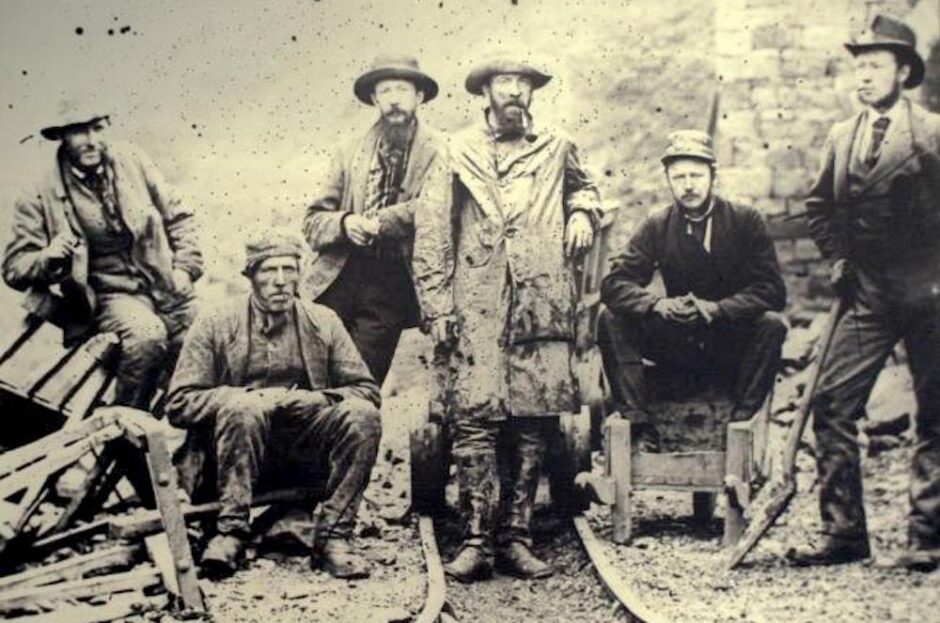
The importance of the North Pennine Orefield was much greater than the large amount of valuable minerals which it produced.
It provided employment for thousands of families, albeit under harsh and often toxic conditions, and it stimulated and applied the mechanisation of the Industrial Revolution to the traditional methods of separating ore concentrate from the mined rock.
The development of the ore-field also coincided with and contributed to the great advances in geology pioneering a new understanding of ore deposits and prospecting which was to revolutionise the development of metal mining in other parts of the world.

At its peak, more than 200 mines were in operation in the ore-field producing an estimated 4 million tonnes of lead, 0.75 million tonnes of zinc, as well as at least 170 tonnes of silver as a by-product of lead ore. Substantial quantities of iron ore were also mined along with at least 2 million tonnes of fluorspar. Between 1873 and 1969, the Settlingstones Mine ,situated north-west of Hexham, was the largest producer of witherite in the world.
Latterly, and well into the twentieth century, barium minerals and fluorspar were produced – the Groverake Mine continuing to produce fluorspar and small quantities of metals until 1999.
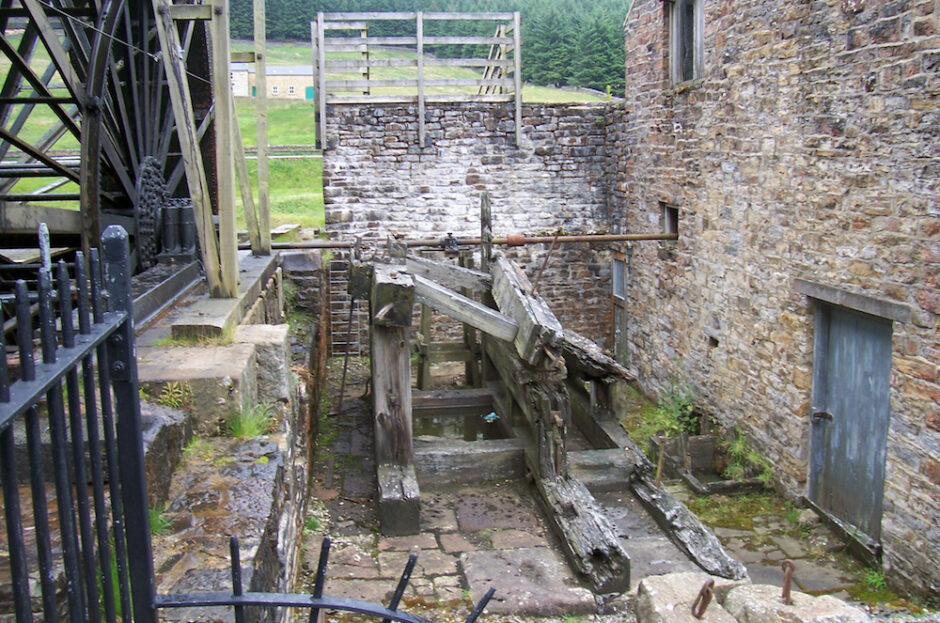
Aa has been said, the North Pennine Orefield, like others, used the principles of industrialisation to greatly increase productivity.
The basic techniques remained largely unchanged from time immemorial but now they were greatly speeded up through the application of water power which was abundant because of the local rainfall and topography.
This can be seen clearly at the open air museum at the Killhope Mine in upper Weardale where much of the machinery has been restored.
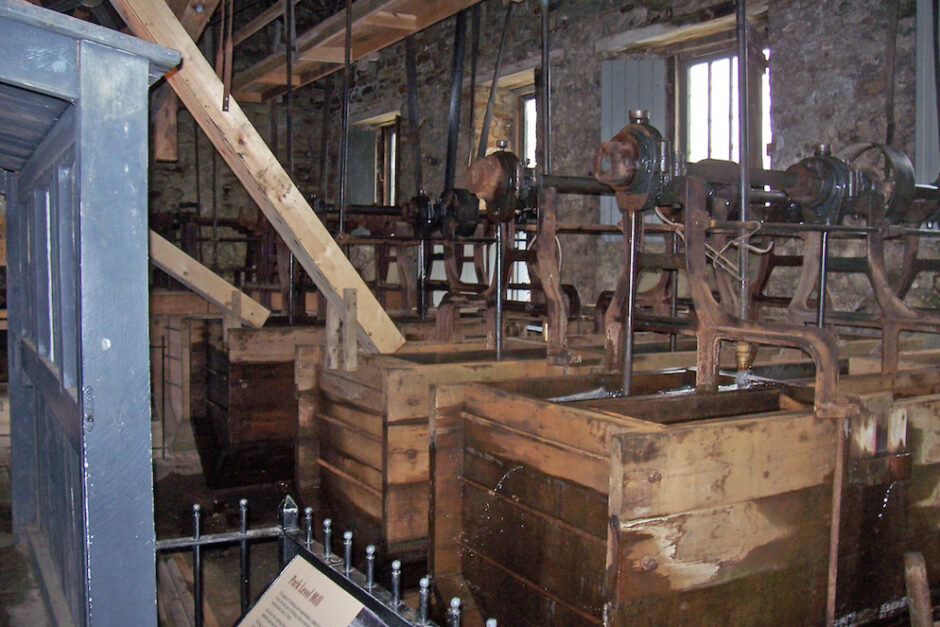
The process of concentrating the ore to prepare it for smelting was essentially the same as in gold panning. The raw rock was crushed to a fine powder and then washed with a shaking motion (buddling) so that the lighter material was washed out leaving the heavier ore minerals behind. This was repeated until the very finest material had been concentrated.

The smelting process continued to use the age-old calcining and carbon reduction process but on a much larger scale. The exhaust fumes from the mills were channelled sometimes for miles through underground flues to chimneys erected on the moorland hills above. This served two purposes. It carried the very poisonous fumes away from human habitation, and it enabled valuable minor metals such as silver and cadmium to condense out on the walls of the flues. These metals were recovered by the unfortunate employees whose job it was to crawl through the flues to collect it, their lives being severely foreshortened by lead and cadmium poisoning.

Lead and zinc mining declined in the later nineteenth century as more easily accessible deposits were discovered outside Britain. The cost of ever deeper mining and the consequent need for more pumping to keep the mines dry, rendered the North Pennine Orefield uneconomic. By the mid twentieth century, production of metals had ceased except as a by product of those mines which continued working barium minerals and fluorspar.
More recently, between 2012 and 2015, Minco Mining Limited, based at Navan in the Irish Midland Orefield, carried out exploratory drilling in a 3.5 x 2.5 km area near Nenthead. Twenty-five holes tested the Great Limestone and six holes tested more basal rocks.
They reported finding a significant amount of ore in stratiform ‘flats’ adjacent to the flats that were mined in the past. However, a fall in the price of zinc soon after the drilling resulted in the postponement of plans for extraction. In 2016, Minco reaffirmed its continuing interest in the area so that it seems likely that, given a rise in the value of zinc, the North Pennines Orefield would, once again, become productive.
The minerals
In its time, mining the North Pennine Orefield unearthed a great variety of mineral species, many of them hitherto unknown. Some minerals such as witherite which are rare worldwide, were abundant here and the newly discovered mineral, alstonite received its name from the place where it was first found. New minerals are still being discovered, the most recent being brianyoungite in 1993 and the science of mineralogy has made significant advances because of discoveries here.
Fluorite
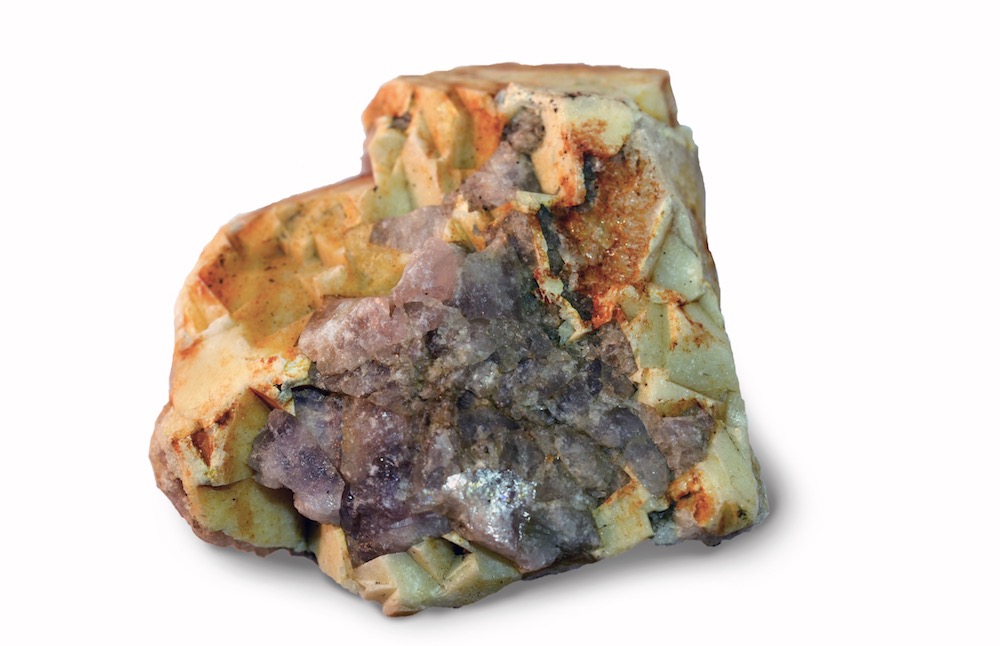

Principle minerals deposited include:
Calcite CaCO3
Fluorspar CaF
Barytes BaSO4
Barytocalcite BaCa(CO3)2
Witherite BaCO3
Quartz SiO2
Galena PbS
Cerussite PbCO3
Zinc Blende (sphalerite) ZnS
Siderite FeCO3
Goethite (Ferric hydroxide)
Pyrite FeS2
Galena

Barytes

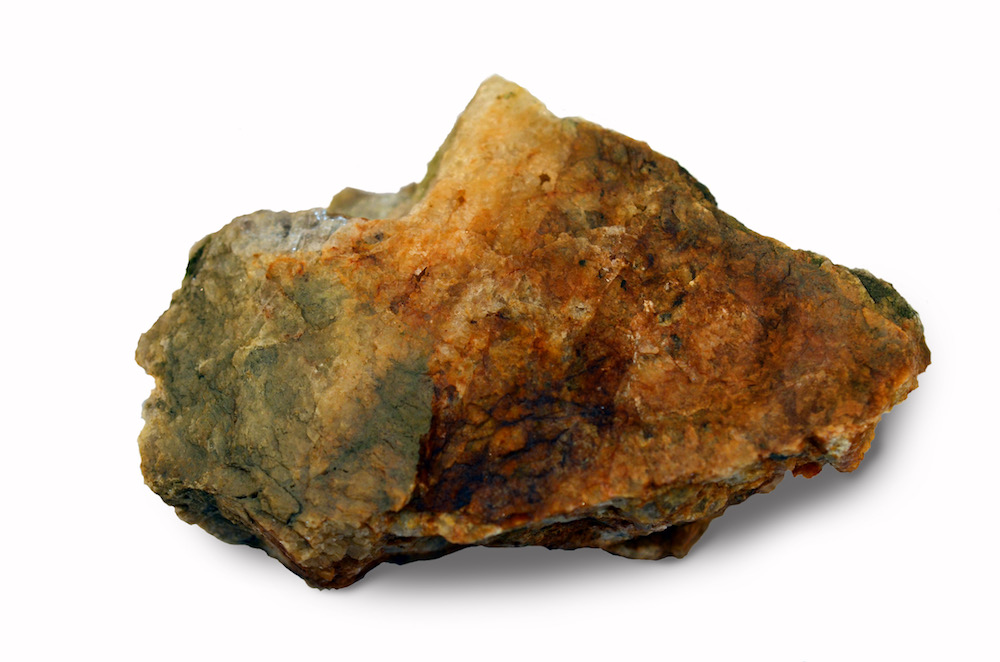
Siderite

A longer list of the more infrequent, in some cases rare, minerals is included below to illustrate the mineralogical riches of the orefield and its importance for the development of the science of mineralogy. The asterisked minerals, brochantite and chalcanthite, are composed of hydrated copper sulphate. These two minerals are highly soluble so it is very surprising to find them in the wet mines of the North Pennines.
Alstonite (BaCa)(CO3)
Anglesite PbSO4
Annabergite Ni3(AsO4)2·8H2O
Arsenopyrite FeAsS
Aurichalcite (Zn,Cu)5(CO3)2(OH)6
Azurite Cu3(CO3)2(OH)2
Bismuthinite Bi2S3
Bournonite PbCuSbS3
Brochantite* Cu4SO4(OH)6
Brianyoungite Zn3(CO3,SO4)(OH)4
Cassiterite SnO2
Chalcanthite* CuSO4·5H2O
Chalcocite Cu2S
Chalcopyrite CuFeS
Cinnabar HgS
Cobaltite CoAsS
Covellite CuS
Cuprite Cu2O
Erythrite Co3(AsO4)2· 8H2O
Greenockite CdS
Leadhillite Pb4SO4(CO3)(2OH)2
Malachite Cu2CO3(OH)2
Millerite NiS
Molybdenite MoS2
Monazite (Ce,La,Nd,Th)PO4
Niccolite Nias
Pyromorphite Pb5(PO4)3Cl
Pyrrhotite FeS
Skutterudite (Fe,Ni,Co)As3
Smithsonite ZnCO3
Strontianite
References
E. D. Dempsey, R. E. Holdsworth, D. Selby, A. Bird, B. Young and C. Le Cornu, A revised age, structural model and origin for the North Pennine Orefield in the Alston Block, northern England: intrusion (Whin Sill) -related base metal (Cu–Pb–Zn–F) mineralization, Journal of the Geological Society, 2021
B. Young ,2016, A Geological Outline of the Northern Pennines, OREsome Geology Report No. 2
S. M. Archibald and S. J. Piercey, 2015, Current Perspectives on Zinc Deposits, Irish association for Economic Geology
G.S. Kimble, B. Young ,D. Millward and Q.G. Crowley, 2010, The North Pennine batholith (Weardale Granite) of Northern England: new data on its age and form, Proceedings of the Yorkshire Geological Society, Vol.58, Part 2, pp.107–128
D. G. JonesJ. A. PlantT. B. Colman 1994, The Genesis of the Pennine Mineralization of Northern England and Its Relationship to Mineralization in Central Ireland, Springer Berlin Heidelberg
P. Stone, D. Millward, B. Young, J.W. Merritt, , S.M. Clarke, M. McCormac and D.J.D. Lawrence, 2010, British Regional Geology: Northern England. Fifth edition. Keyworth, Nottingham: British Geological Survey
Minco Mining Ltd. The North Pennine Orefield, https://www.buchansresources.com/england-north-pennines