
The Great Whin Sill outcropping above the Tyne Bottom Limestone Formation
Location 1. High Force
Upper Teesdale marks the southern limit of the tholeiitic quartz-dolerite sheets and dykes that make up the Great Whin Sill, intruded around 295 million years ago.
Here and in nearby West Allendale, the sill reaches its maximum known thickness of around 70 metres. It is spectacularly on display at High Force near Middleton-in-Teesdale, a powerful waterfall that has been the subject of sketches and paintings by J.M.W. Turner and photographs of countless tourists to the region.
High Force can be viewed from the Pennine Way that leads along the southern bank of the High Force Gorge but we decide to get the close-up view afforded by access along the northern bank via the private footpath owned by the Raby Estate. This footpath is open all year round from 9am until evening time.
Map and key for the Great Whin Sill at High Force


We park the car in the public car park next to The High Force Hotel, pay our £1.50 fee (50 pence for children aged 5-15) and walk down the woodland path to the base of the falls. From here, we get a clear view of the River Tees surging between the sheer walls of black whinstone and plunging the 22 metres down to the pool below. It is dynamic, noisy and very impressive. The hard Whin Sill lies on top of the softer sedimentary rocks of the Tyne Bottom Limestone Formation, the topmost section of which has been metamorphosed whilst the bottom portion of the sill in contact with this sandstone has been chilled so that it contains patches of dark, mafic glass.
The turbulence of the falling water gradually removes the softer rock at the base of the falls so that it can no longer support the weight of the whinstone above and the face collapses. The continuation of this process results in the slow, progressive movement of the falls upstream thus lengthening the gorge.
Petrology and petrography of the Great Whin Sill at High Force
Medium-grained whinstone at High Force

Prepared specimen viewed in plain reflected light (47mm across)


The rock contains plagioclase, pyroxene, iron-titanium oxides with apatite and secondary amphiboles and biotite. Section viewed in plane polarised light (FoV 4.6 x 3.0 mm)


Section viewed with crossed polarising filters (FoV 2.3 x 1.5 mm)
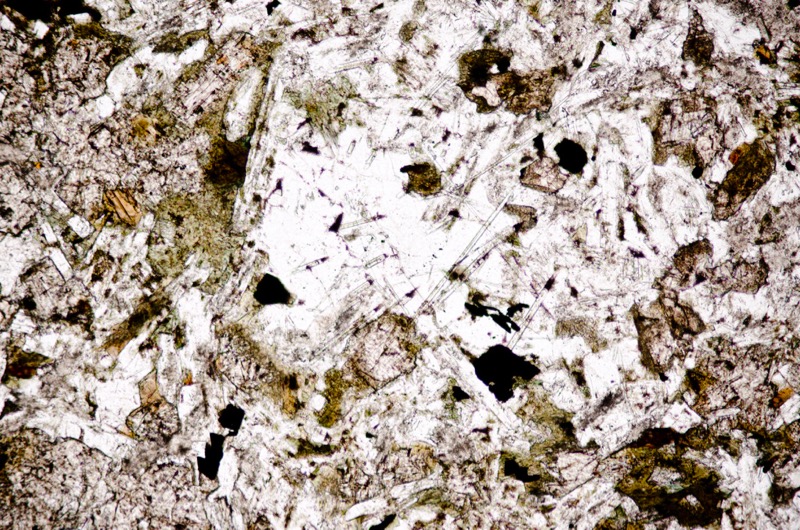
Section viewed in plane polarised light (FoV 2.3 x 1.5 mm)


Section viewed in plane polarised light (FoV 1.2 x 0.8 mm)

The abundant clinopyroxene occurs as colourless to light pink-brown columnar, simply twinned phenocrysts up to 1 mm long and also as fragments and granular crystals in the groundmass.

Section viewed in plane polarised light (FoV 1.2 x 0.8 mm)


Section viewed with crossed polarising filters (FoV 1.2 x 0.8 mm)
There is much amphibole and some biotite in the rock, most if not all, occurring as secondary alteration products of the pyroxene.

Section viewed in plane polarised light (FoV 0.5 x 0.3 mm)


Section viewed in plane polarised light (FoV 2.3 x 1.5 mm)

Fine-grained whinstone at High Force
The specimen shown below is fine-grained whinstone chilled by contact with the host limestone. The rock is highly oxidised and carbonatised so that it is stained brown with iron oxides and the pyroxene has been altered to carbonates and a little biotite that occurs in tiny poorly formed flakes.

Prepared specimen viewed in reflected light (30mm across)


Section viewed with crossed polarising filters (FoV 0.5 x 0.3 mm)

Section viewed in plane polarised light (FoV 4.6 x 3.0 mm)

Location 2. High Force Quarry

There are two large quarries in the vicinity of High Force; Force Garth, a working quarry, and High Force Quarry which is now disused. We head for the disused quarry in the hope of finding some of the dolerite pegmatite that has been reported to occur here and also to sample the hydrothermal minerals that have been deposited in the vertical joints of the rock.
Access into the quarry is straightforward with space to park and an easy walk in without fences or locked gates.
The exposed whinstone here displays rough columnar jointing and much iron staining. In places there have been rockfalls and, as always in these situations, we remember to take care.
Petrology and petrography of the Great Whin Sill at High Force Quarry
Dolerite pegmatite

The green arrow indicates the location of the pegmatite
We find some pegmatite conveniently close to ground level in the small inner quarry, near the entrance at NY878290. It appears in what looks like a small narrowing, vein that is about 15cm at it’s widest point although its true structure is more likely to be a lenticular pocket that lies sub-horizontally. These pockets of pegmatite aren’t common and tend to occur in higher parts of the sill.

Pegmatites bear large crystals not because magma cooled slowly allowing its constituent ions enough time to migrate through the viscous melt to form concentrations that would build large mineral structures, but because the ions were concentrated in low-viscosity fluids that allowed their relatively rapid migration and accumulation.
The ion-rich fluids themselves were a consequence of the prior crystallisation of the bulk of the rock.
Chlorine, carbon dioxide and water are just some of the volatile substances contained in magma that do not solidify at high temperatures. instead, they become more and more concentrated as crystallisation of the less volatile material progresses. There comes a point when the remaining melt cannot contain the volatiles any longer and they separate out to form an ion-rich, super-heated fluid that can collect in pockets within the cooling rock. These eventually cool and solidify and form pods of rock that are chemically and visually quite different from the related rock that surrounds them.
Our sample of pegmatite contains prominent augite crystals, strongly zoned plagioclase with cores that are the more calcium-rich, spectacular granophyric quartz-alkali feldspar intergrowths along with crystals of pure quartz, impressive trellis-like crystals of iron-titanium oxide and accessory apatite.

Prepared specimen viewed in plain reflected light (48mm across)


Section viewed with crossed polarising filters (24mm across)

Section viewed with crossed polarising filters (FoV 2.3 x 1.5 mm)

Section viewed in plane polarised light (FoV 2.3 x 1.5 mm)


Section viewed with crossed polarising filters (FoV 4.6 x 3.0mm)
Hydrothermal mineral deposits at High Force Quarry
At the edge of a great pile of rock that has fallen from a section of the main quarry face, a section that looks all too close to further collapse, we find a specimen of medium-grained whinstone with a 4mm layer of white hydrothermal minerals adhering to its planar, joint-face. Mineral veins in whinstone can be composed simply of white calcite and quartz although wollasonite, pectolite, stevensite, galena, sphalerite, baryte and brassy sulphides have all been reported.
Our sample is mostly calcite and quartz with a pockets of radiating length slow crystals that we identify as pectolite on account of their high first order colours – wollastonite is similar in appearance but it is length fast and has interference colours that range only to first order orange. It’s interesting to see the alteration in the rock from the mineral deposit-dolerite contact surface to the fresher looking rock 25mm within. Pyroxenes are progressively replaced with carbonates until, close to the contact, the whole rock becomes chloritic. Carbonate minerals tend to form the contact layer adjacent to the dolerite followed by a mix of carbonates and quartz with some pectolite. The quartz is speckled with opaques and, in places, shows undulating extinction under crossed polarising filters.

Prepared specimen viewed in plain reflected light (50mm across)


Section viewed with crossed polarising filters (20mm across)

Section viewed in plane polarised light (20mm across)


Section viewed in plane polarised light (FoV 2.3 x 1.5 mm)


Section viewed with crossed polarising filters (FoV 2.3 x 1.5 mm)

Prepared specimen viewed in plain reflected light (53mm across)


Quartz in the thicker, bottom left portion of the section is showing first order interference colours

Section viewed in plane polarised light (FoV 1.2 x 0.8 mm)


Section viewed with crossed polarising filters (FoV 2.3 x 1.5 mm)

Section viewed in plane polarised light (FoV 1.2 x 0.8 mm)

References
British Geological Survey Online geology map http://mapapps.bgs.ac.uk/geologyofbritain/home.html
Stone, P, Millward, D, Young, B, Merritt, J W, Clarke, S M, McCormac, M and Lawrence, D J D. 2010, British regional geology: Northern England. Fifth edition. Keyworth, Nottingham: British Geological Survey.
Lawrence, D.J.D., Vye, C.L. and Young, B. 2004. Durham Geodiversity Audit. Durham: Durham County Council
Clark,D.N. 1992. The Petrography, Mineralogy and Geochemistry of the Great Whin Sill, Middleton-In-Teesdale,
N.E. England.
Randall, B.A.O. 1989. Dolerite-pegmatites from the Whin Sill near Barrasford, Northumberland. Proceedings of the Yorkshire Geological Society, Vol. 47, Part 3, Pp. 249-265
Holmes A, Harwood H.F., The Age and Composition of the Whin Sill and the Related Dikes of the North of England. Geological Magazine No. 122. September, 1928. Vol. XXI.