
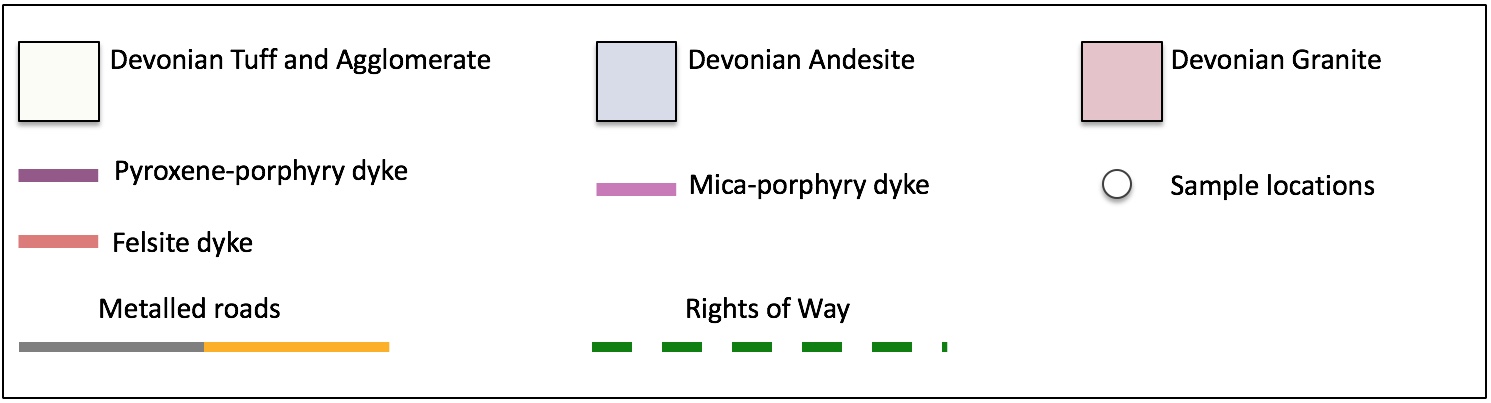
Map showing the excursion route, locations and igneous rock types

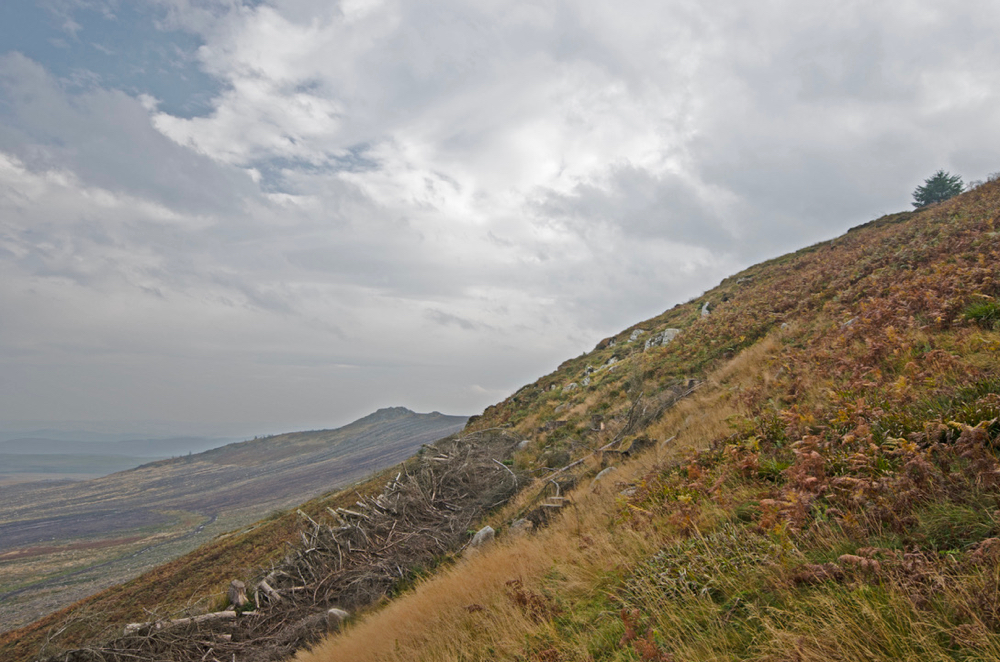
From the summit we head north-east over very rough ground, down through recently felled forestry for a ‘quick’ visit to Kitty Crags. The trek down is hard-going and fairly unpleasant and the return to the summit is, of course, even more arduous.
The rock here is less mafic than that at the summit, conforming more to coarser-grained, granular ‘Central Belt’ monzo-granite type.
‘Central Belt’ specimen

Prepared hand specimen viewed in reflected light measuring 44mm across.

This section measures 44mm across.

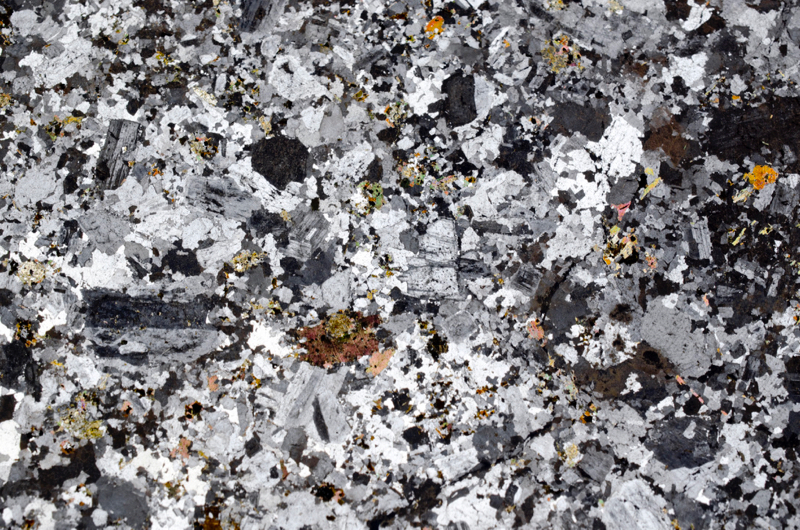
Section viewed with crossed polarising filters (22mm across)

Section viewed in plane polarised light (FoV 2.3 x 1.5 mm)
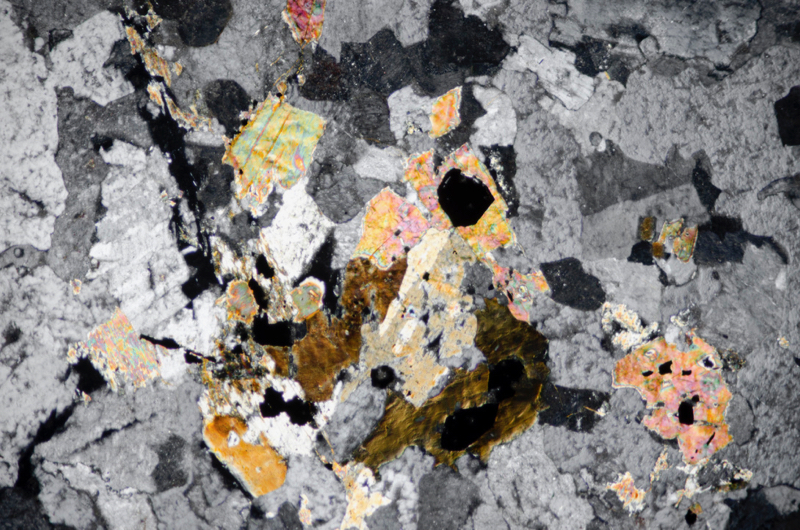

An altered pyroxene and a biotite crystal lie at the edge of the plagioclase mass. Section viewed with crossed polarising filters (FoV 2.3 x 1.5 mm)
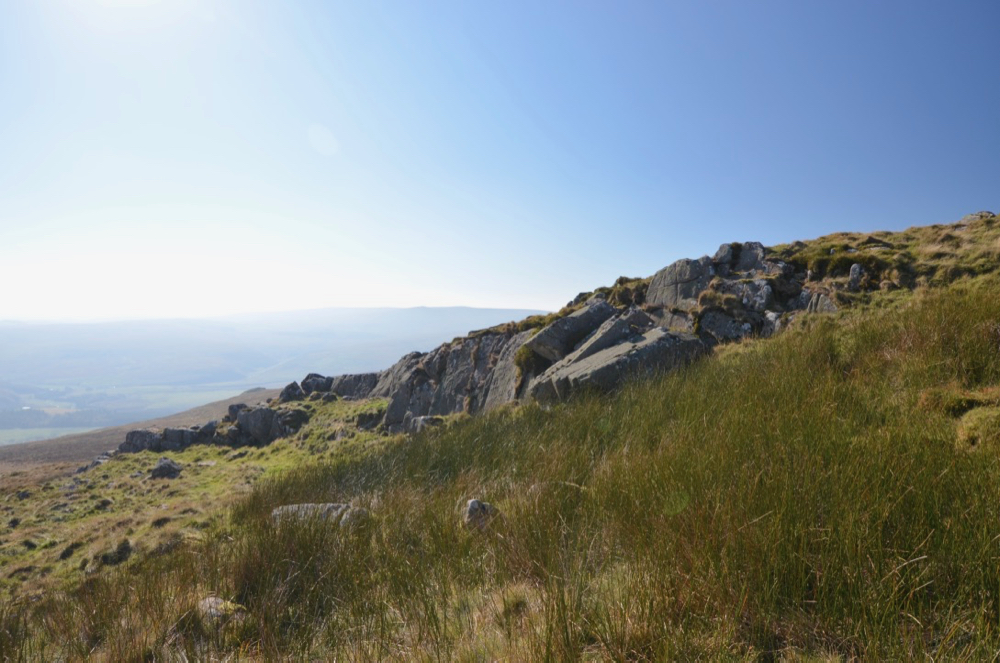
From the summit, we follow the track back eastwards to the exposures and boulders that we passed earlier to the north of Long Crag.
The rock is a granular variety of the ‘Central Belt’ type, similar to that at Kitty Crags.
Specimen 1
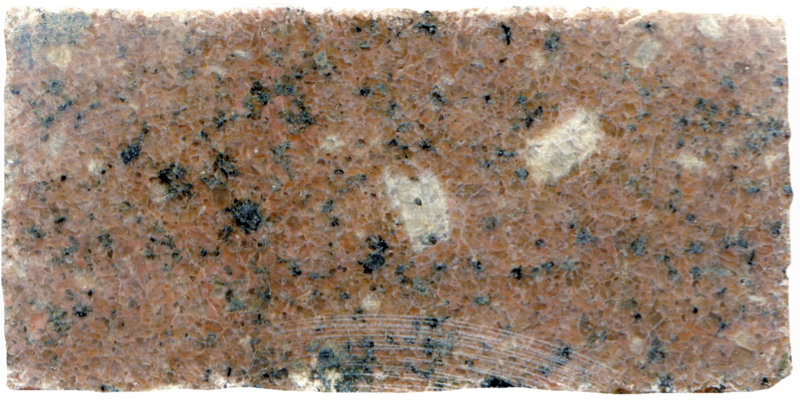
Prepared specimen viewed in plain reflected light (45mm across)
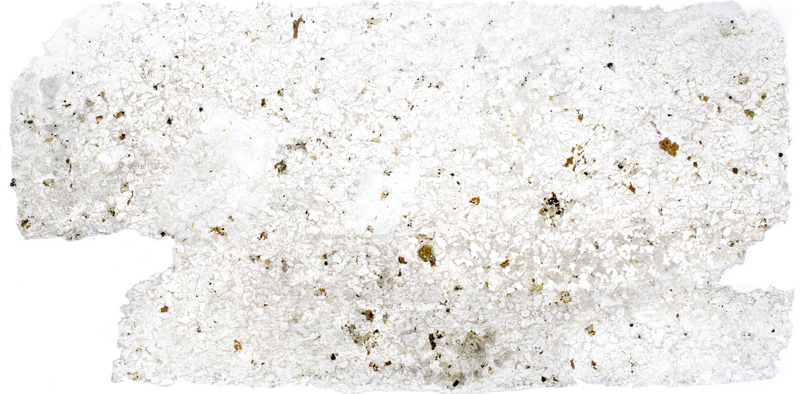
This section measures 45mm across.


Section viewed in plane polarised light (FoV 4.6 x 3.0mm)


Section viewed with crossed polarising filters (FoV 4.6 x 3.0mm)

Long Crag lies on a north-south axis from NT967178.
On this part of the hill, Jhingran, Robson and Al-Hafdh all record a change in the rock to a more mafic character. As we head down from the exposure to the north of Long Crag, Al-Hafdh suggests we will meet a band of porphyritic, quite mafic ‘Dunmoor’ granodiorite that is porphyritic. Jhingran and Robson classify the whole of Long Crag as ‘Marginal’.
The samples we take suggest that Al-Hafdh has a point. The rock appears to be more akin to the ‘Central Belt’ type that the ‘Marginal,’ but our classification may be misleading, masking the unity of the two. In any case, this is a porphyritic rock, with plagioclase, biotite and pyroxene phenocrysts in a fine-grained matrix that contains the same minerals together with quartz, potassium feldspar and opaque iron-titanium oxides.
Specimen 2. Medium-grained porphyritic, coarsely granophyric ‘Central Belt’ rock

Prepared specimen viewed in plain reflected light

This section measures 45mm across.


Section viewed with crossed polarising filters and Benford plate (17mm across)
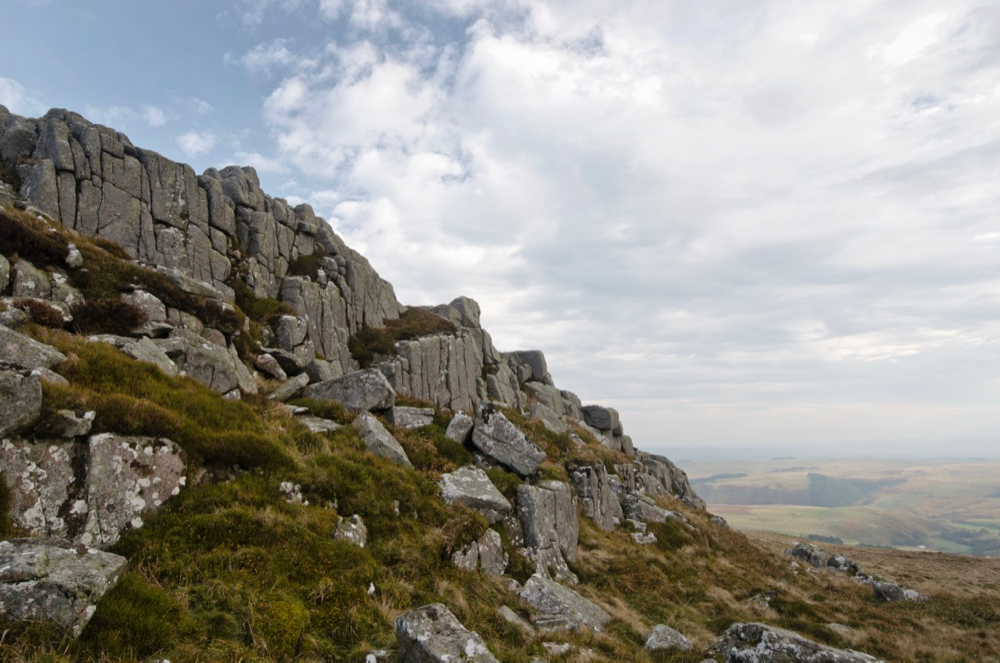
The rock shows typical granite jointing.
Specimen 3. Medium-grained porphyritic, coarsely granophyric ‘Central Belt’ rock
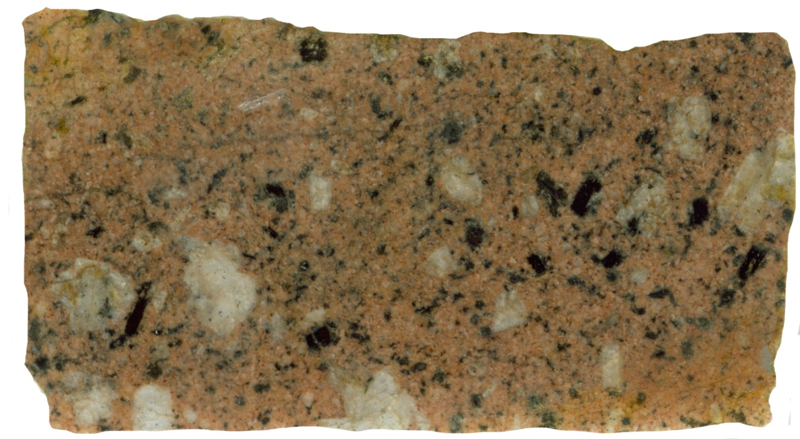
Prepared specimen viewed in plain reflected light
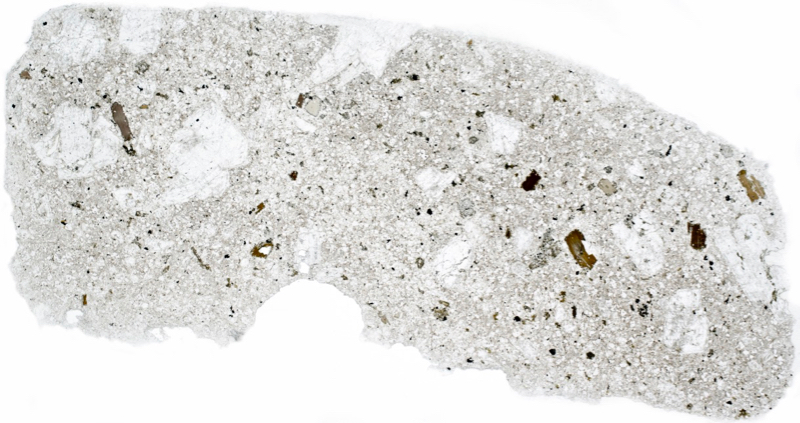
This section measures 45mm across.

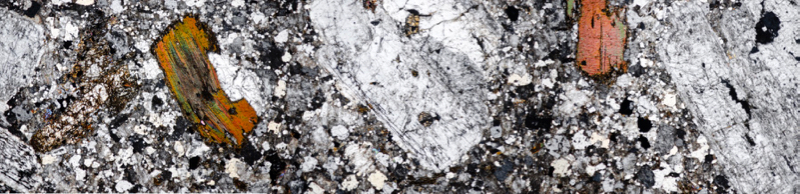
Section viewed with crossed polarising filters and Benford plate (13mm across)
This is an area that Jhingran and Robson agree is well into the ‘Marginal’ band that runs around the south-eastern periphery of the pluton. Al-Hadfh suggests there is a transition here between his ‘Dunmoor’ type and the ‘Marginal type’.
Typically, we find rocks that seem to support both accounts, Most of the the rocks we examine appear to be the dark, dioritic, more-granular ‘Marginal’ type but some of them are red and porphyritic (or fine-grained with mafic inclusions) conforming to Al Hafdh’s description of his ‘Dunmoor’ type.
The BGS have mapped numerous porphyry dykes in this area and it is possible that these are the red rocks in the area.
This is also the vicinity for the BGS mapped andesite inlier. We search but we fail to find it.
Specimen 1. Porphyritic ‘Marginal’
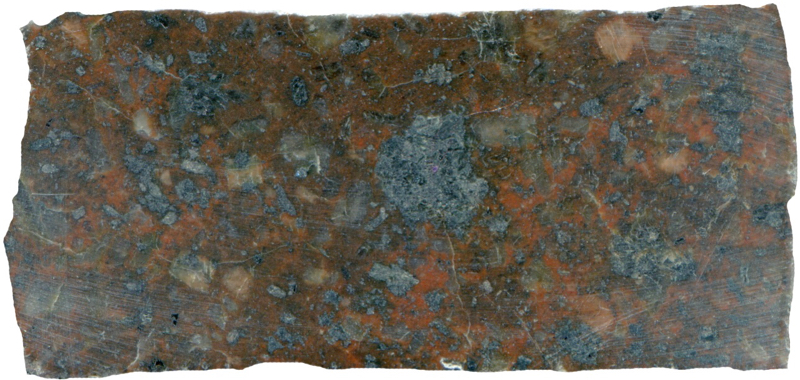
Prepared specimen viewed in plain reflected light (45mm across)

This section measures 45mm across.
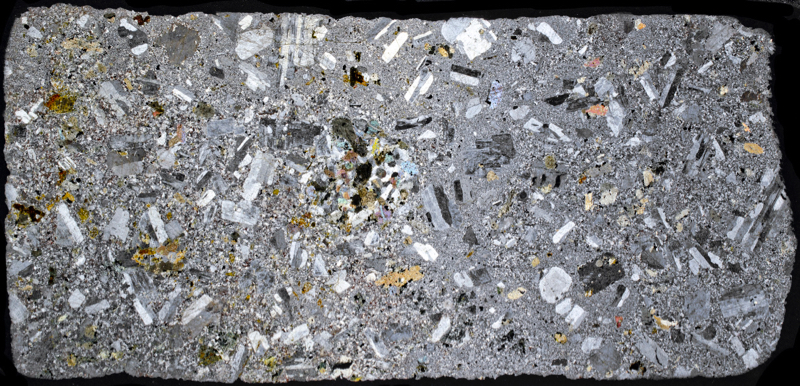

The large, boss-like exposure at NT967174, is more of the granular variety of the ‘Marginal’ quartz monzonite, one sample showing signs of fracture and veining suggesting movement and ingress of hydrothermal fluids that may be associated with movement of magma.
Specimen 2. Granular ‘Marginal’ with veining

Prepared specimen viewed in plain reflected light (41mm across)
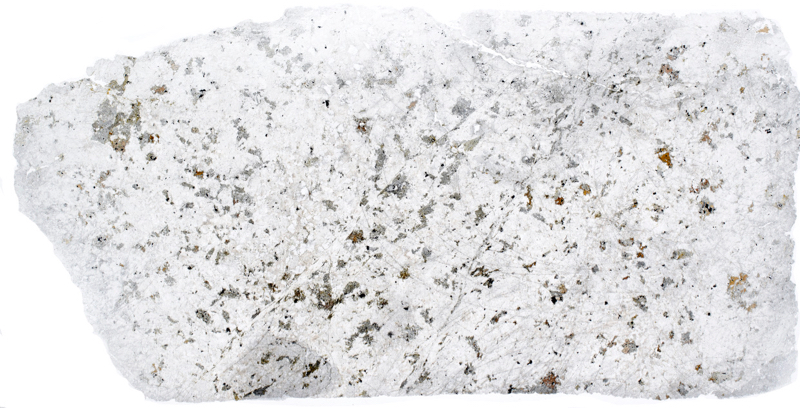
This section measures 41mm across.
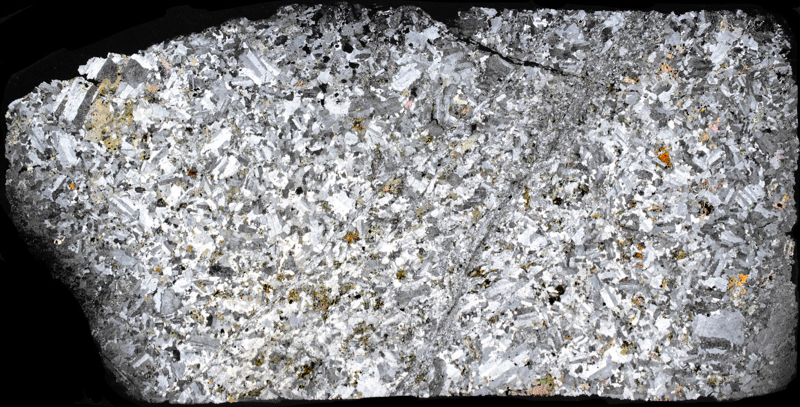
Specimen 3. Granular ‘Marginal’

Prepared specimen viewed in plain reflected light (45mm across)

This section measures 45mm across.

A short distance to the east of the previous granular samples, the rock is porphyritic with a very fine-grained, red matrix with small phenocrysts that surrounds large crystals and clumps of crystals that appear to be from other rock.
Specimen 4. Red, fine-grained porphyritic rock with xenocrysts and microliths
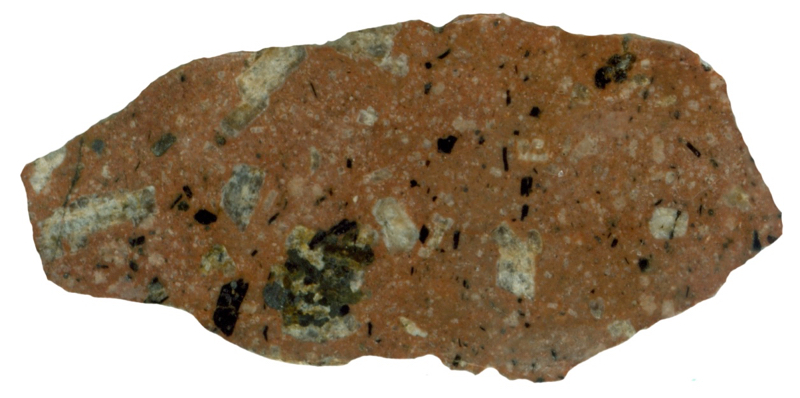
Prepared specimen viewed in plain reflected light

This section measures 45mm across.


Section viewed with crossed polarising filters (15mm across)
There are three distinct sizes of crystals here – a very fine-grained groundmass, small phenocrysts in this groundmass and the much larger crystals and clumps of crystals that appear to be debris detached from other rock.

In this area red rocks are interspersed with the dark-grey ‘Marginal’ rocks. Some are the ‘Central Belt’ sort while others are simply weathered ‘marginal ‘ rocks that have taken on a red hue towards their surface faces due to weathering.

Specimen 1
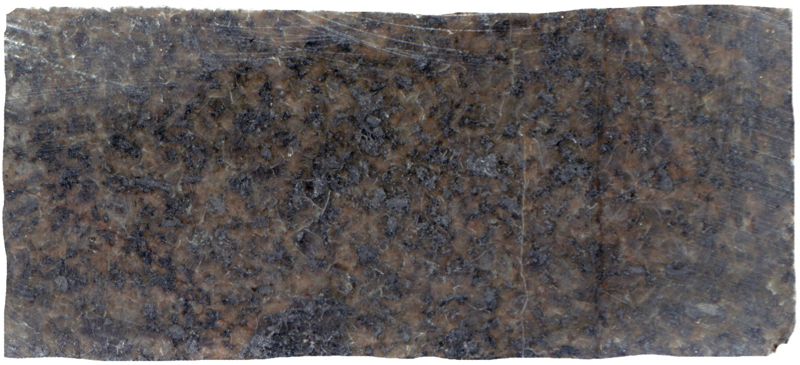
Prepared specimen viewed in plain reflected light (45mm across)

This section measures 45mm across.
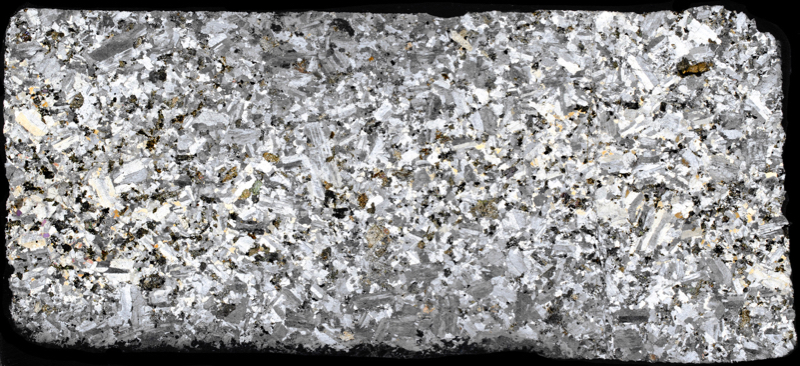
Specimen 2. Very altered rock with epidote veining

Prepared specimen viewed in plain reflected light (45mm across)

This section measures 45mm across.

It appears that hydrothermal fluids have caused widespread alteration and re-crystallisation of minerals in the rock.
Return to car
From Cat Crag we head down over rough ground to rejoin the path back to Greenside Farm and the car.
References
Al-Hafdh N.M. 1985. The Alteration Petrology of the Cheviot Granite. Thesis submitted for PhD. at Newcastle University.
Robson D.A. 1976 A Guide to the Geology of the Cheviot Hills Transactions of the Natural History Society of Northumbria, Newcastle Upon Tyne Vo. 43, No. 1.
British Geological Survey Online geology map http://mapapps.bgs.ac.uk/geologyofbritain/home.html