
Map showing the excursion route, locations and igneous rock types


This excursion is an extension of the Breamish Valley – Ainsey Burn excursion, hence the use of the same map together with a set of location numbers that continues on from those given earlier. The whole route is a circular one returning to Hartside via High Cantle instead of the three mile road walk from Low Bleakhope.
Our aim on this section is to investigate Coldlaw Cairn, a rocky outcrop that appears to have been ignored by geologists – at least we haven’t come across a description of the type of rock found here or seen records of samples and thin sections. The maps of Robson and Al Hafdh suggest it is the coarser-grained ‘Standrop’ type of granitic rock – but we want to make sure. We also want to visit Shielcleugh Edge to verify Al Hadft’s record of a contact between his ‘Standrop’ and ‘Dunmoor’ types and we will also be looking to verify his record of contact between the ‘Dunmoor’ and ‘Marginal’ types at a location near Rig Cairn on High Cantle. Both reported contacts are important for establishing the sequence of events in his version of the origin of the Cheviot pluton and the distribution of granite types on his map.

At NT920162, just NW of location 2 on the Breamish Valley – Ainsey Burn excursion, we take the track that leads from High Bleakhope up onto the hillside below Shielcleugh Edge. Below to our left, the river flows along the line of the Breamish fault.
The OS maps show the track terminating at NT912172. There is a gate here but through it, the track continues up and around to Coldlaw Cairn . The rocky summit is a good place to enjoy some food and take in the views of the long flank of Cheviot to the north and below to the west, the head of the Breamish, King’s Seat and the Scottish Borders beyond.

A boulder field constitutes most of the rock at Coldlaw Cairn (NT914180) but granite bedrock rises out of it. It is a grey, relatively coarse-grained rock, well jointed in places, with prominent feldspar phenocrysts and dark crystals of biotite and pyroxene: the ‘Standrop’ type of Central Belt granitic rock.

Prepared specimen in ordinary reflected light (44mm)


Viewed with crossed polarising filters (FoV 4.6 x 3.0 mm)
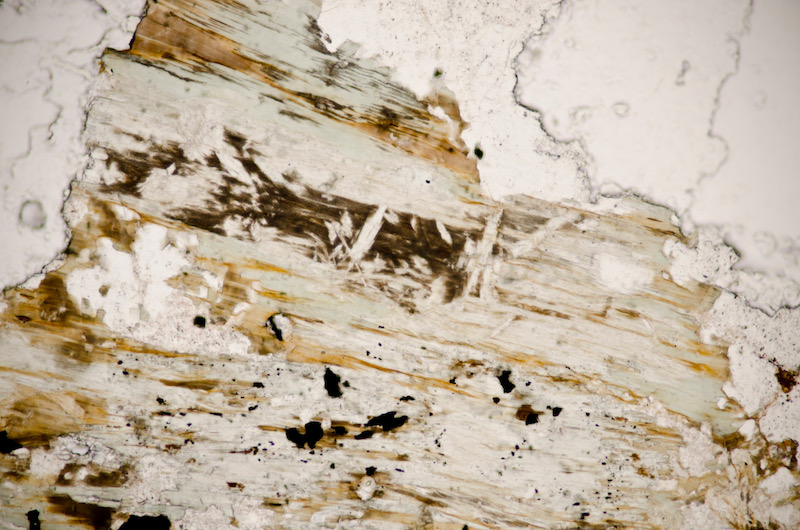
Viewed in plane polarised light (FoV 1.2 x 0.8 mm)


Viewed with crossed polarising filters (FoV 0.5 x 0.3 mm)
From Coldlaw Cairn we retrace our steps along the track across the hillside below Shielcleugh Edge. At NT916166 we leave the track and head directly up the hill to the low-lying but prominent outcrop at NT918166. The rock here is finer-grained than that on Coldlaw Cairn and much pinker in colour. Al Hafdh records this as his ‘Dunmoor’ variety that he considered to be an earlier intrusion than the ‘Standrop’ type. He also records the contact between these two types as well as the discovery of ‘Standrop’ chilled against ‘Dunmoor’ a little higher up the hill at NT918168 and NT920167.

Specimen 1
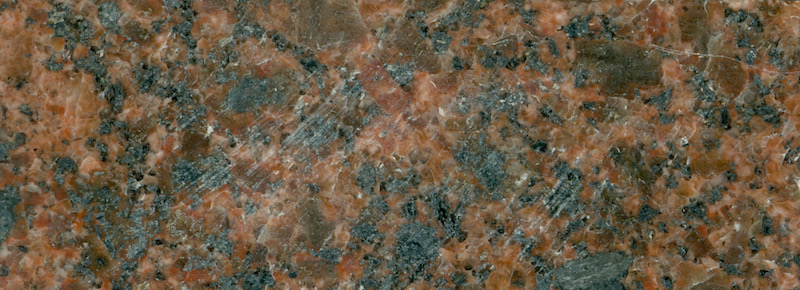
Prepared specimen in ordinary reflected light (50mm across)

Higher up the hill at NT918169, there are no outcrops of bedrock, only boulders. Amongst them we do find specimens that preserve contact between different types of granitic rock. One is much redder and finer-grained than the other that looks like the ‘Standrop’ type, but it is impossible for us to determine if the redder rock was part of the pluton or if it is later dyke material. In any case, thin sections show that it is the redder, finer-grained rock that is chilled against the ‘Standrop’ type.
If the redder material is from a dyke, the chilling effect would be as we would expect. However, if our specimen is a junction between the ‘Standrop’ and ‘Dunmoor’ types, the chilling of the redder ‘Dunmoor’ against the ‘Standrop’ type indicates that it was injected later, not earlier than the ‘Standrop’ magma – the opposite of Al Hafdh’s account of events.
Of course, he may have collected a specimen with the coarser rock chilled against the finer, but the fact that the rock here is loose material with no outcropping bedrock would call into question the significance of such a find in relation to his mapping and theory.

Specimen 2
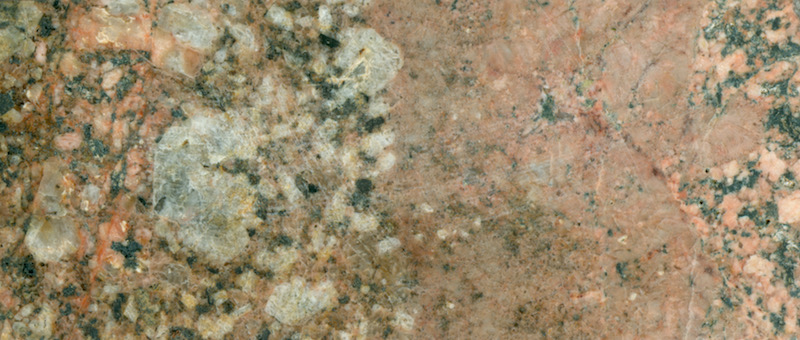
Prepared specimen in ordinary reflected light (48mm across)
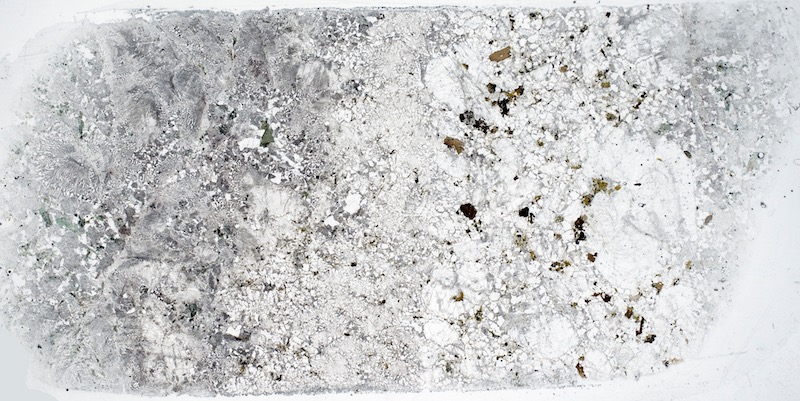


Specimen 3
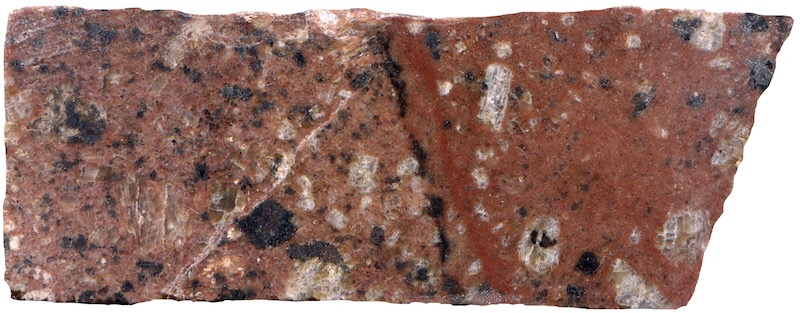
Prepared specimen in ordinary reflected light (50 mm across)


Section viewed with crossed polarising filters (25 mm across)

Section viewed with crossed polarising filters
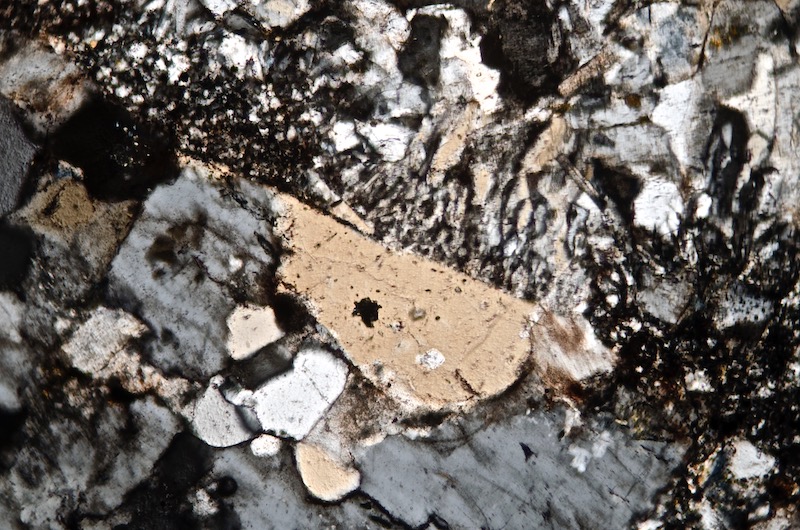
Section viewed with crossed polarising filters
We cut across rough ground to the head of Shiel Cleugh and follow the burn down to the River Breamish below. As we go, we inspect some of the many small outcrops and see something of a transition in the colour and texture of the rock. At the highest point, the rock is relatively grey and coarse-grained with many plagioclase phenocrysts and some iron-titanium oxides. As we move down the cleugh and out towards the periphery of the pluton, the rock transitions through a redder, medium-grained apperance with fewer plagioclase phenocrysts and more opaque oxides, to the dark, medium-grained ”Marginal’ type at the bottom of the cleugh that has fewer prominent plagioclase phenocrysts and a much higher iron-titanium oxide content. The ‘Marginal’ rock at the exit of the burn is quite altered and weak.


No sooner we are down, we are up again. The Shiel Cleugh burn joins the Breamish close to the marked path that will take us over High Cantle, to Rig Cairn and back through Linhope to the car at Hartside.
The hillside above High Bleakhope is strewn with boulders, most of them are the typical ‘Marginal’ type of rock but we find one boulder that has an extremely fine-grained and intensely dark rock included in or intruded into the dark red ‘Marginal’ rock The inclusion looks similar to the extremely fine-grained hornfelsed andesite we saw intruded into the andesite and the granite in the Breamish by Low Bleakhope. Thin section reveals it is quite different. This rock has both biotite and plagioclase phenocrysts.
Specimen 1

Prepared specimen in ordinary reflected light


Specimen 2

Prepared specimen in ordinary reflected light.


Thin section viewed with crossed polarising filters
Specimen 3

Prepared specimen in ordinary reflected light


Thin section viewed with crossed polarising filters

Section viewed with crossed polarising filters
We return to the path and go in search of more evidence that would support Al Hafdh’s multiple intrusion thesis.
Al Hafdh wrote, ‘The Dunmoor Granodiorite is seen chilled against the Marginal Granodiorite …….at High Cantle (NT926164)’ – but despite our searching, we can find no outcropping rock here.
We finally give up the search and with it, credence in Al Hafdh’s thesis.
Sadly, the same is true at the second of his key locations in this locality. He writes, ‘Standrop Granodiorite ….is chilled against Porphyritic Dunmoor Granodiorite at (938167) where the Standrop Granodiorite cuts through the Dunmoor Granodiorite.’
The outcrops at this location are very sparse and small and they are uniformly the coarse-grained, porphyritic ‘Central Belt’ type with quite a high mafic content. At Rig Cairn, we do find a point of contact but it is only a minor felsic intrusion into the plutonic rock.
Specimen 1

Prepared specimen in ordinary reflected light


Specimen 2

Prepared specimen in ordinary reflected light


Section viewed in plane polarised light (FoV 2.5 x 1.7 mm)

Al Hafdh’s thesis has provided us with structure and foci in our initial investigations but this excursion confirms our view that his multiple intrusion, ring dyke thesis does not accurately describe or adequately explain the Cheviot volcanic complex.
Return to car
From Rig Cairn, we take the footpath east towards the north side of Ritto Hill, through Linhope and along the metalled road back to the car.

References
H. Kynaston, Notes on Contact Metamorphism round the Cheviot Granite, Edinburgh Geological Society, 1899.
Carruthers, R G, Burnett, G A, Anderson, W, and Thomas, HH,1932. The Geology of the Cheviot Hills (Based on the work of C.T. Clough and W. Gunn) HMSO
Al-Hafdh N.M. 1985. The Alteration Petrology of the Cheviot Granite. Thesis submitted for PhD. at Newcastle University.
British Geological Survey Online geology map http://mapapps.bgs.ac.uk/geologyofbritain/home.html