
Location of the Kielderhead dyke
Clough described the Kielderhead dyke as keeping a very uniform west-north-west direction over a distance of four and a half miles indicating its presence in a number of locations. ‘Following the dyke from north-west to south-east we notice the following indications. In the cleugh running north-east from the top of Peel Fell the crossing place can be localized to within a few yards by the tracing up to it of various loose pieces of the rock and their cessation above it. It should be said here that the drift along the whole course of the dyke is of local origin, and there is no danger of being put on a false scent by far travelled basalts of similar aspect. About 380 yds. beyond this cleugh, and again a little’ over half a mile beyond, is much angular basalt of the characteristic kind and evidently near place. The next exposures are the two on the east side of Scalp Burn…’
A map of the Kielder area showing locations, roads, tracks, bedrock and the tholeiite basalt dykes


‘After this it is readily traceable for some distance, either by suspicious gaps in the freestone scars it has to pass through, or by finding the rock in situ. This last is the case a yard or two east of the track leading north from Kielder Head. 200 yds. beyond the track it forms first a feature facing south-west and then a green ridge. On the east of White Kielder it forms a green ridge or feature facing the south : the sandstone features are traceable close up to either side of the ridge and do not appear thrown. In the sike on the north side of Rigend Burn next to the east margin of the Map the dyke is again seen quite clearly.’
We focus on what Clough thought the best exposure, on the Farney Slack sike east of what is now known as the Scaup Burn.

Petrography and Petrology
C.T. Clough wrote of the Kielderhead dyke, ‘Hand specimens of this dyke show prominent porphyritic crystals of felspar, a character in which it stands alone among the dykes in this sheet (7, Plashets & Kielder). Perhaps it is also slightly less amygdaloidal than them as a rule.’
Holmes and Harwood observed that ‘such specimens (with porphyritic feldspar) would correspond the Corrie type, but, as those which we have collected are almost devoid of phenocrysts, they must be referred to the Salen type.’
Following Teall, they noted the ‘conspicuous’ olivine crystals in the rock, describing them as, ‘much broken and fissured, and serpentinization is general around borders and along cracks and has in places become complete.’ Also, ‘small inclusions of olivine rimmed with serpentine are to be found in some of the larger plates of augite.’ They added that some of the larger olivine crystals appear to include feldspar laths but, ‘careful examination shows that this is due to later penetration between the disrupted and altered cores.’ They described the augite as, ‘colourless to pale yellowish-brown, the tint darkening outwards, and here and there becoming faintly purple-brown and pleochroic, especially in contact with titanomagnetite.Its relations with plagioclase are characteristically ophitic.’
‘A few small aggregates of externally zoned bytownite are present (about An75 with borders ranging from An50 to An30 ). The common felspar laths are zoned throughout, the change accelerating towards the boundaries, which are about An30, from an internal composition near An55. Many of the laths are in pairs crossing at acute angles, but stellate clustering is not otherwise suggested.
The ores are in sharply crystallised individuals or skeletal rows scattered between the other minerals of the rock with a special tendency to cling to the plates and grains of augite.
The mesostasis is a nearly colourless to turbid brown glass charged with black globulites and skeletal growths and colourless aeieular ill-defined microlites. Its distribution is patchy, some parts of a section showing very little, while others contain it conspicuously.
Green-stained chalcedony also occurs irregularly as interstitial material, but this constituent is more abundant in small spherical amygdales sometimes enclosing a core of calcite.’

Specimen measures 45mm across.
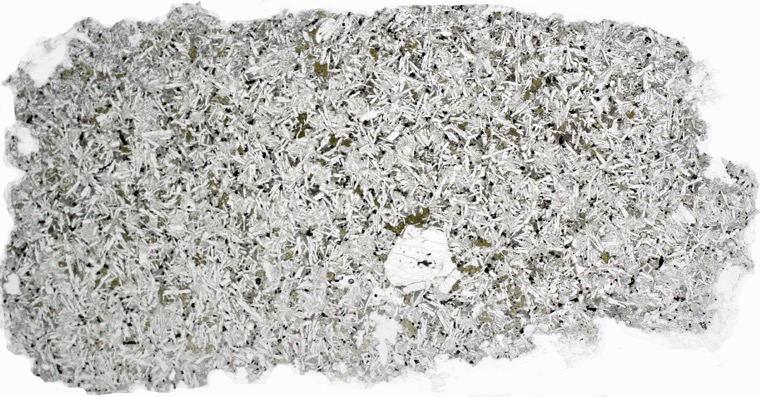
Section measures 25mm across.
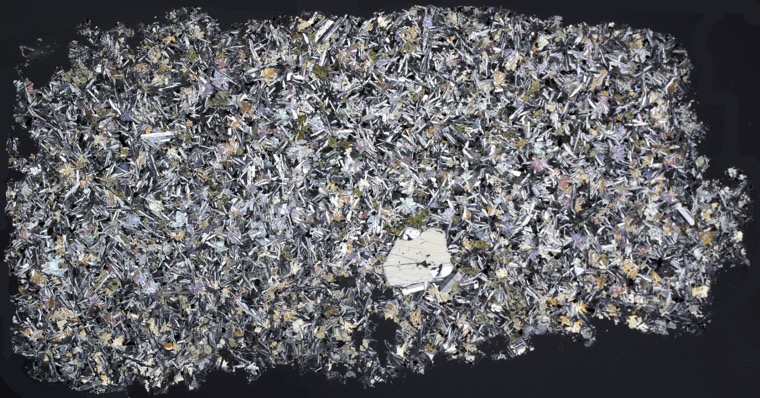
One or two glomerocrysts of calcium-rich plagioclase appear in each of the thin-sections we made from our samples of the Kielderhead dyke. Their more yellow cores indicate the zoning from higher calcium (anorthite) crystal interiors to lower levels at the edges.

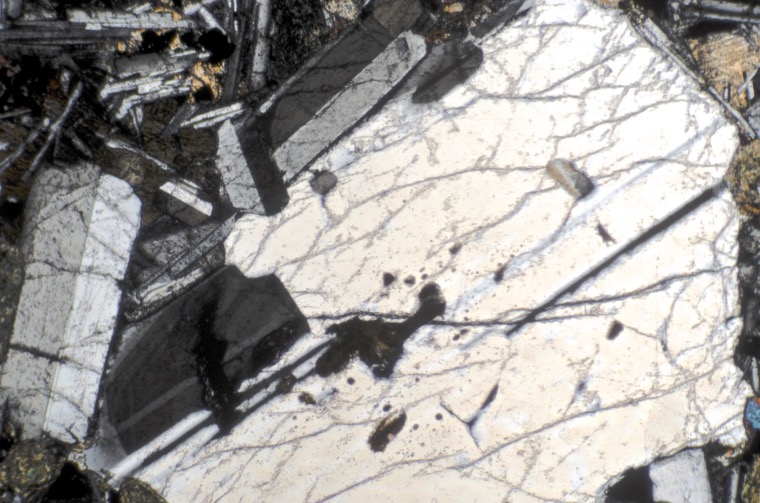

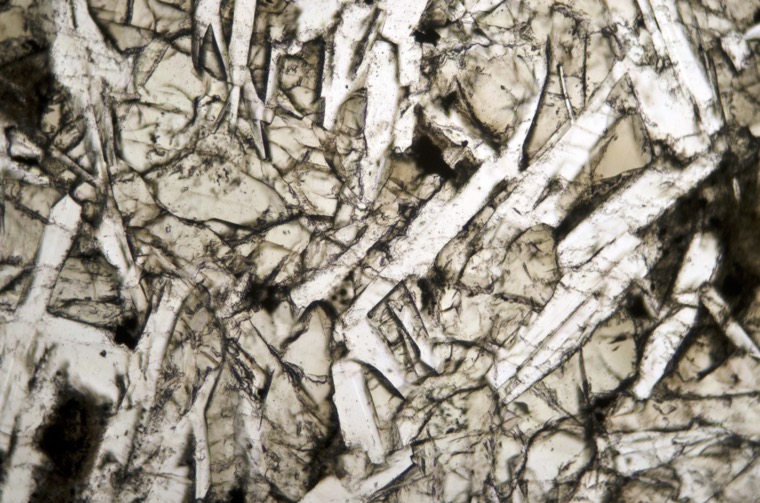
The pyroxene is present in our samples in highly birefringent plates, distinguishable because of its occasional twinning, cleavage and inclined extinction. The presence of the twinned crystal shown below suggests that much of the similar material that is in ophitic relation with the plagioclase is pyroxene rather than olivine.

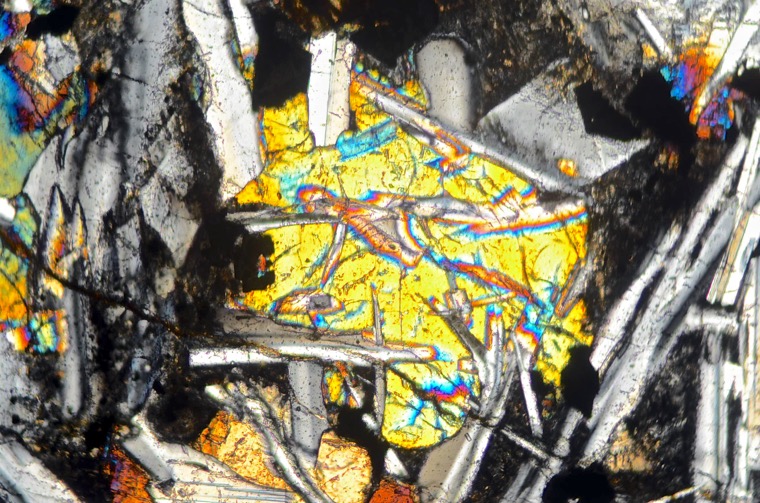


Some crystals, without well defined cleavage, show parallel extinction when aligned lengthways relative to the crossed polarising filters as shown below in the small pink-brown crystal.
The lemon tinted crystal towards the top left of the following photomicrograph presents a high-order green when viewed with a full wave plate in place and does not show inclined extinction relative to the few straight cracks running through it. This too might be an unaltered olivine crystal. However,the plagioclase crystals that it includes show no sign of their forceful penetration of the pre-formed crystal (as suggested by Homes and Harwood) so it could be a pyroxene.

Crystal is in the centre of the field viewed in plane polarised light (FoV 1.2 x 0.8 mm)



The dark-green areas of the section seen in plane polarised light that become highly verigated with crossed polarising filters could well be pseudomorphs after olivine with some of the altered crystals retaining their olivine cores. The green alteration material shows some pleochroism although it is not so marked as in similar patches in samples from the Morpeth dyke basalt. The alteration mineral has been described as serpentinite, chlorophaeite, iddingsite but given the difficulty in identifying these minerals we will simply identify it as a ‘green cryptocrystalline substance’.

The crystals appear to have retained their olivine cores.

Amygdales appear in all of our sections. Some o them consist wholly of a grey-green granular while some consist of clear glassy interiors with the grey-green granular material becoming more prevalent towards their perimeters.
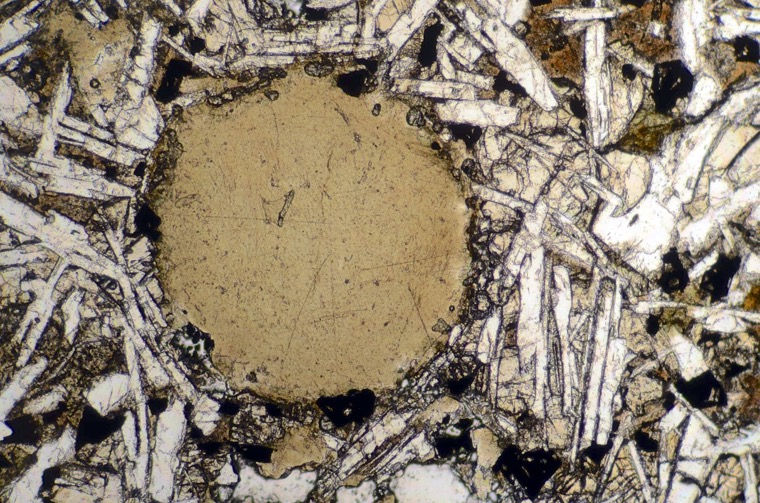


Sample viewed in plane polarised light (FoV 2.3 x 1.5 mm)

A relatively small amount of grey-brown mesostasis peppered with small opaques and micro-crystals is present in all our samples. Larger, well defined plates and skeletal masses of iron-titanium oxides occur throughout each sample.


References
Teall, J J H. 1884. Peteological Notes On Some North-Of-England Dykes. The Quarterly Journal Of The Geological Society Of London, Vol. 40. Pp. 209-247.
Clough, C.T.1889. The Geology of Plashetts and Kielder. (explanation of quarter sheet 108 S.W., new series, sheet 7). Memoirs of the Geological Survey, England and Wales. HMSO.
Holmes, A and Harwood, H F. 1929. The Tholeiite Dikes Of The North Of England. The Mineralogical Magazine and Journal Of The Mineralogical Society, No. 124. Vol 22.
British Geological Society, 1971. Sheet 7, Kielder Castle. http://www.largeimages.bgs.ac.uk/iip/mapsportal.html?id=1001472
Delving, J. et al. 1979. Olivine, their pseudomorphs and secondary products. Pedologie 29, 3. Ghent.