Location 1. Hornfelsed andesite around NT983178 and NT984179
Location 2. ‘Marginal’ quartz monzonite around NT981179
Location 3. ‘Marginal’ quartz monzonite at Cunyan Crags NT977180

This excursion provides opportunities to investigate the rock at the granite/lava border. An exposure where the junction is visible would be a great find but, given the degree to which the Cheviot bedrock is cloaked in peat, this is unlikely.
Another point of interest is an inlier of andesite that has been mapped between Long Crag and Cat Crag on Dunmoor Hill but that we haven’t, as yet, succeeded in finding. it would be interesting to mark the degree to which the lava and the granite were affected by their direct contact.
Map showing the excursion route, locations and igneous rock types

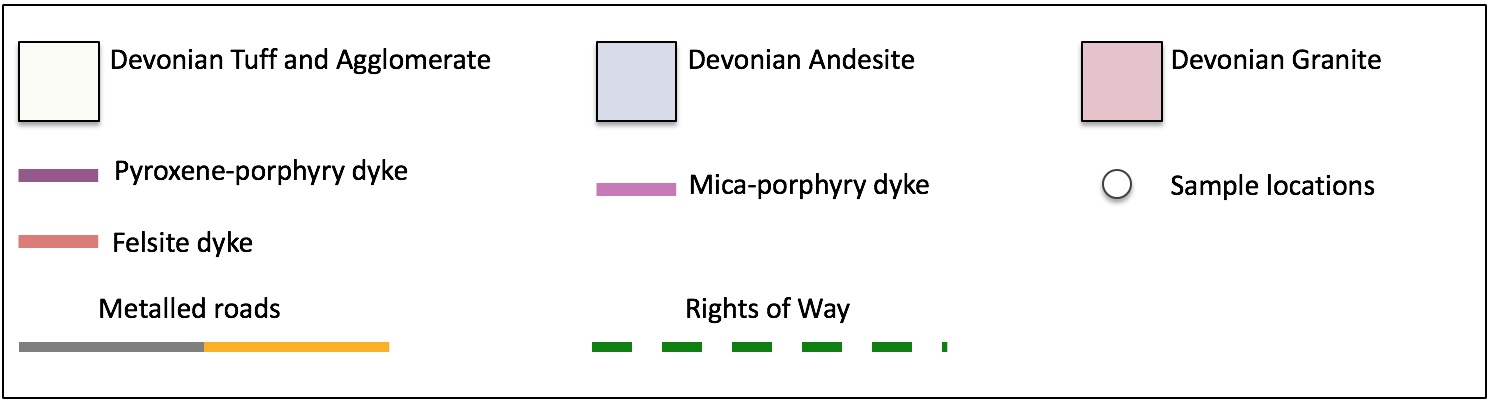
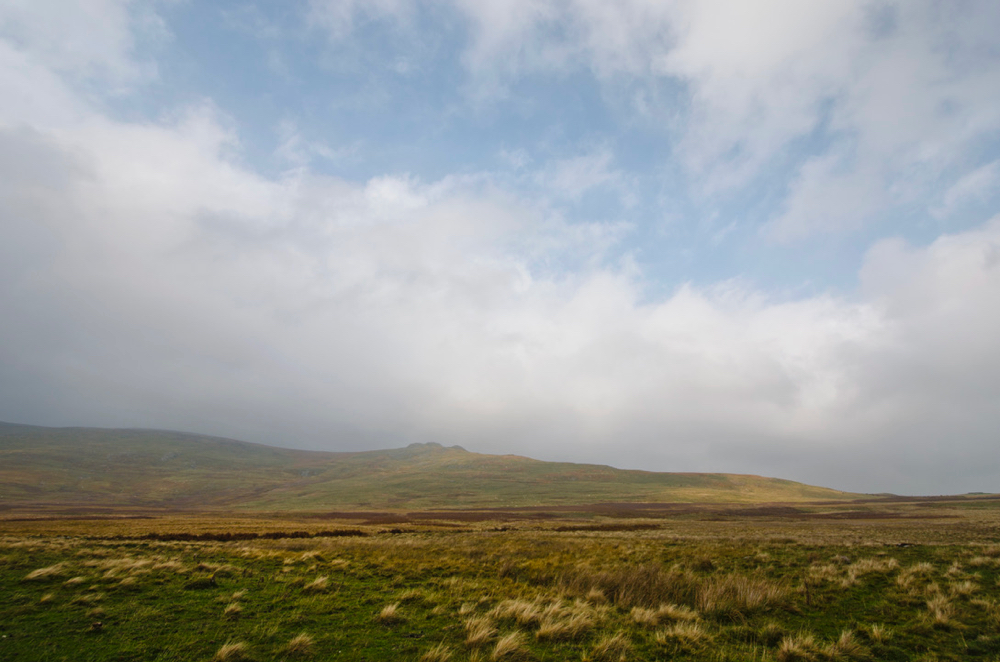
We park out of the way of vehicles and gates on the grass at the roadside a short distance up the hill past Greenside Farm and walk back down to the start of the footpath that leads north-west then north-east towards the site of the medieval village at the foot of Dunmoor Hill. It is easy walking and as we approach the south-east side of the hill, we see a number of rock exposures ranging up the slope that is topped by Cunyan Crags, a sizeable outcrop of the Cheviot pluton. Somewhere between them, the lava/pluton junction runs south-west towards Linhope.

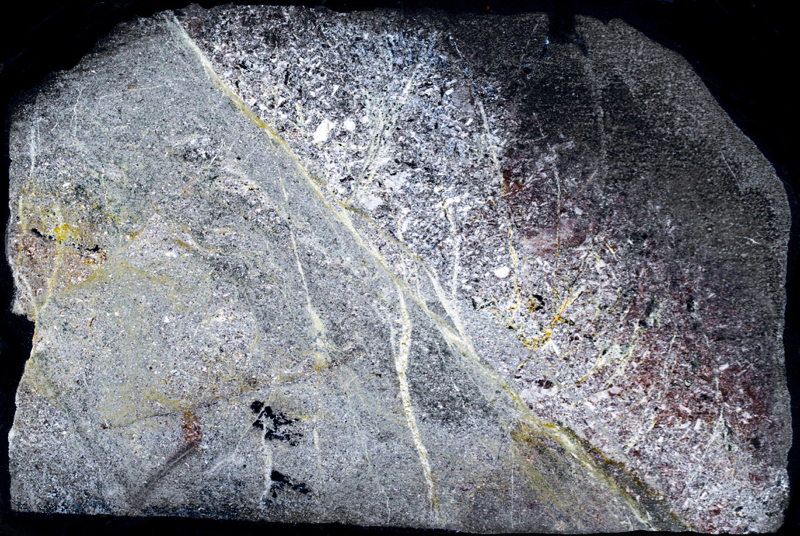
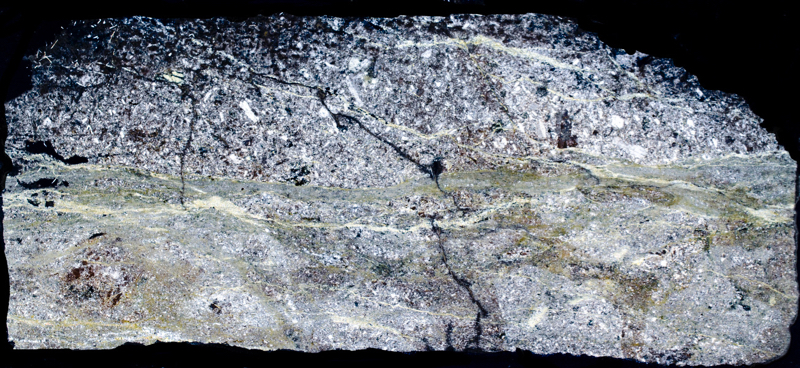
Altered andesite with pyroxene-rich veins
We begin by investigating some of the exposures that we saw from the track. The Geological Survey mark these as andesite.
The first one we examine at NT9843178 immediately takes our interest because it is a very hard and variegated rock that looks distinctly granitic in parts. We wonder if this is a mixture of ‘Marginal’ plutonic rock and hornfelsed andesitic lava.
Thin sections will reveal that the main body of the rock is a reddish (haematite-rich), hornfelsed andesite with largely albatised plagioclase phenocrysts and altered pyroxenes together with occasional quartz crystals all set in a fine-grained, opaque-rich ground. The andesite has been intruded by a dark-grey, very fine-grained rock as well as by pyroxene-rich veins.
In these veins, the pyroxene appears alongside feldspars together with a little quartz.
Both the intrusive rock and the veins may be varieties of the dark, pyroxene-rich ‘Marginal’ rock that we have seen near Low Bleakhope in the Breamish Valley.
Specimen 1

Prepared specimen viewed in reflected light measuring 30mm across.
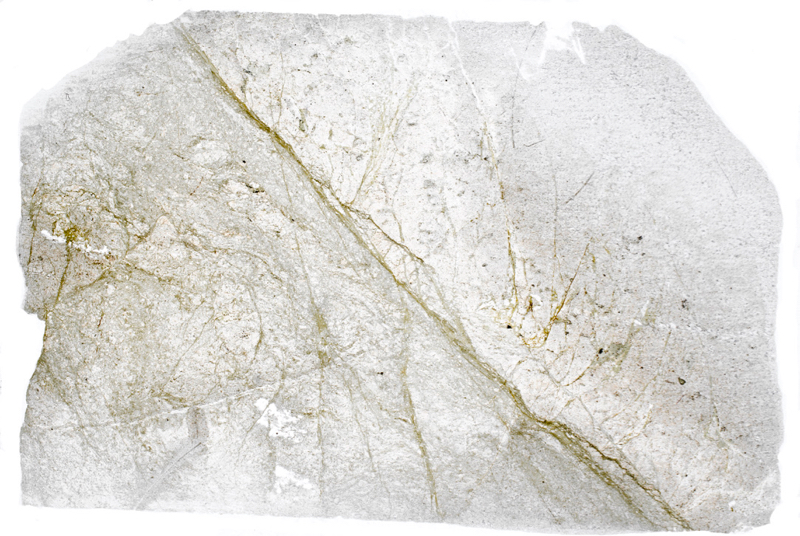
This section measures 30 mm across.
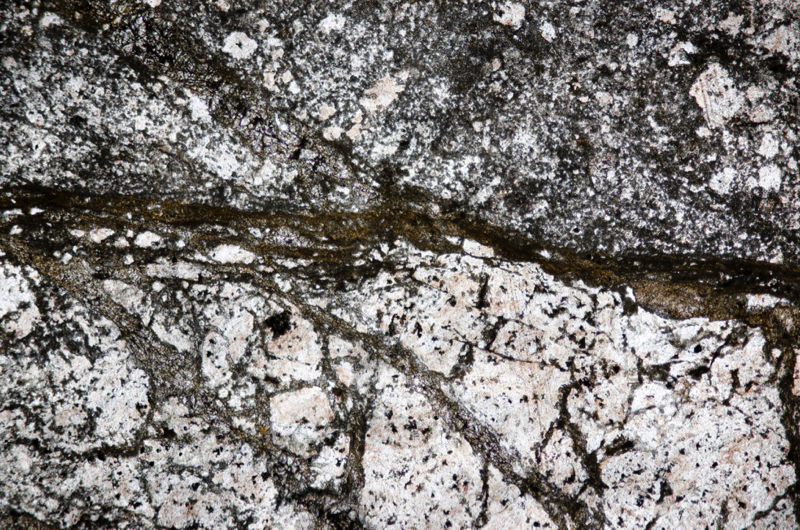
Section viewed in plane polarised light (FoV 2.3 x 1.5 mm)

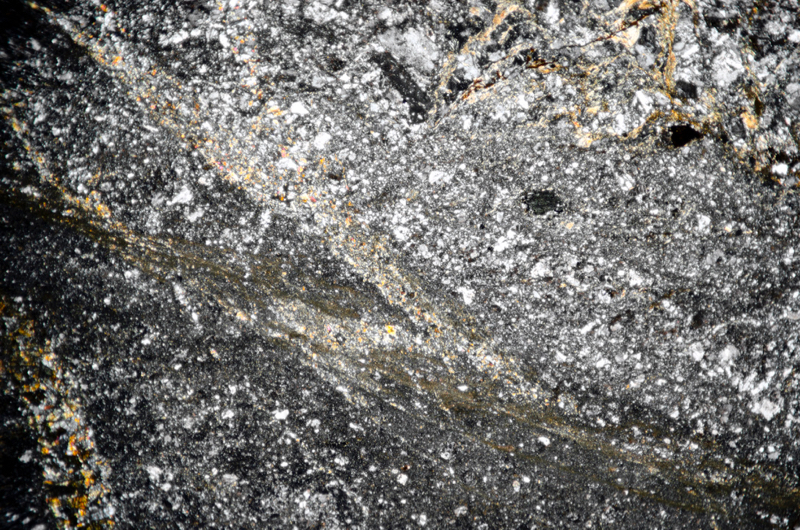
The andesite is in the very top part of the image with the fine-grained intrusive material below it.
Section viewed with crossed polarising filters (FoV 4.6 x 3.0 mm)
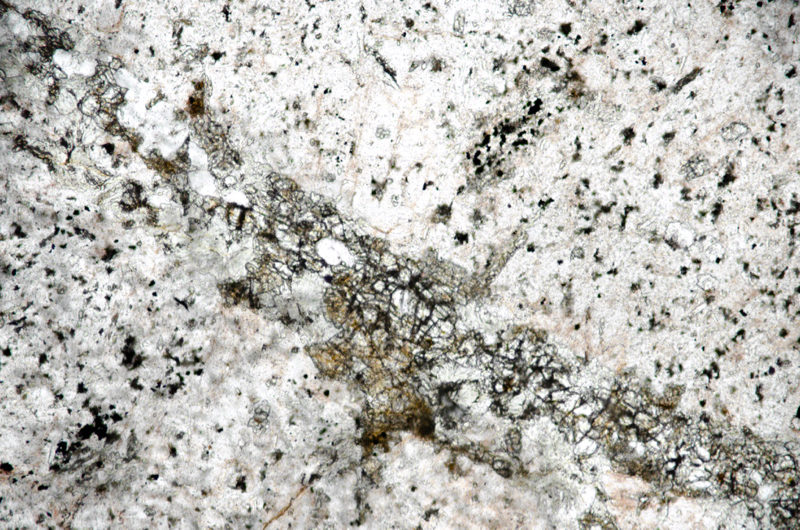
Section viewed in plane polarised light (FoV 1.2 x 0.8 mm)
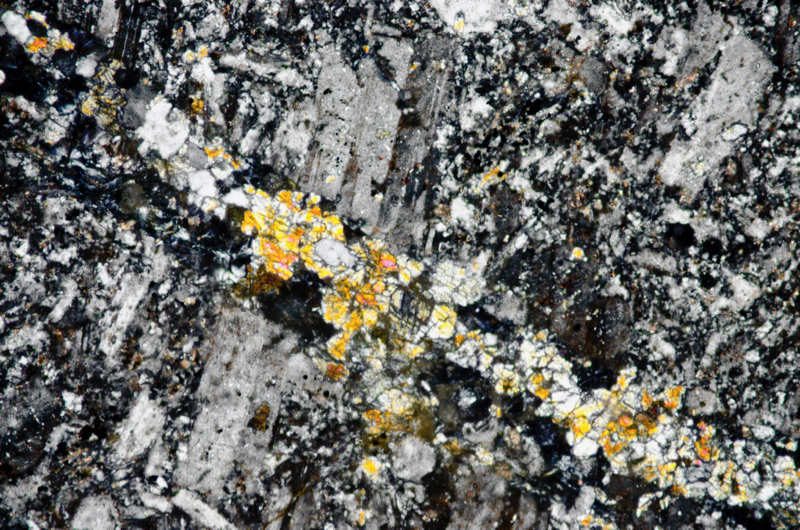
Note the fractured and partially albitised plagioclase phenocryst on each side of the vein.
Specimen 2

Prepared specimen viewed in reflected light measuring 43mm across.
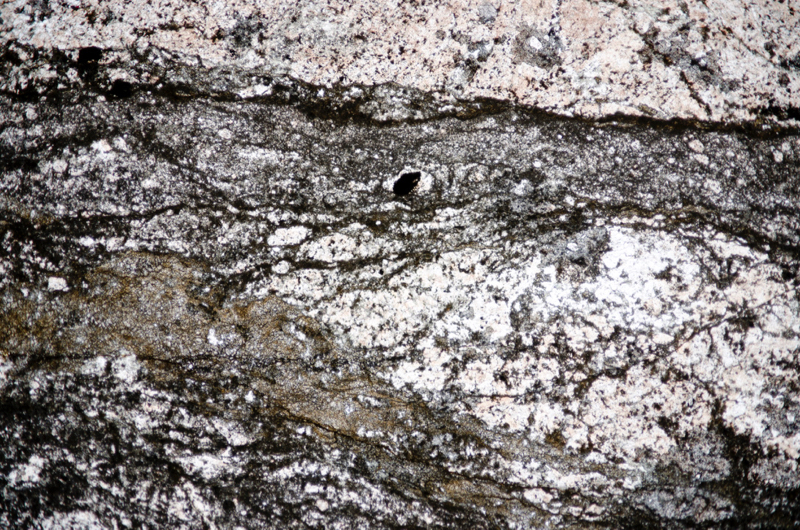


The rock at the second exposure looks more obviously andesitic – it is darker and we see phenocrysts. However, thin sections present us with a surprise. Most of the ‘phenocrysts’ are quartz with few of the large plagioclase phenocrysts that we would have expected to see.
The rock is obviously altered; amphibole minerals have replaced primary mafic minerals, much of the groundmass has been altered to tiny flakes that appear orange in thin section and have parallel extinction, and the presence of so much quartz suggests that it is granitic.
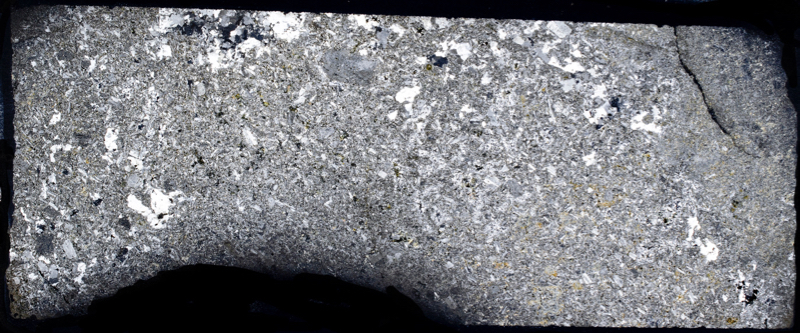
Specimen 3
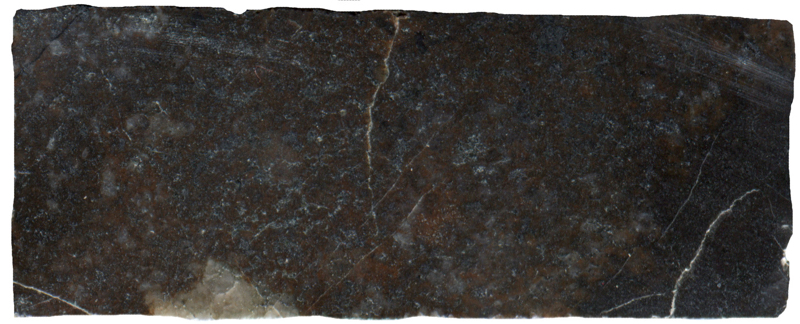
Prepared specimen viewed in reflected light measuring 45mm across.
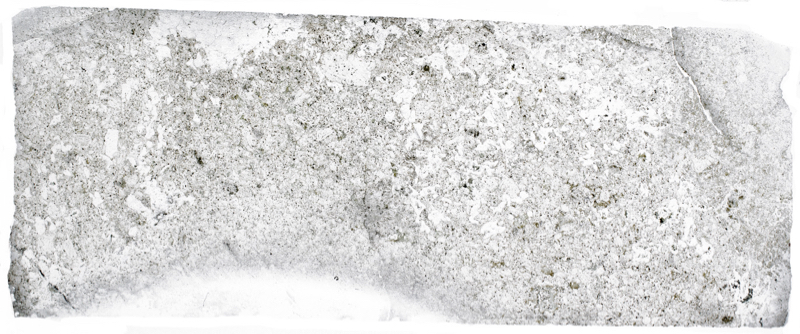
This section measures 45mm across.
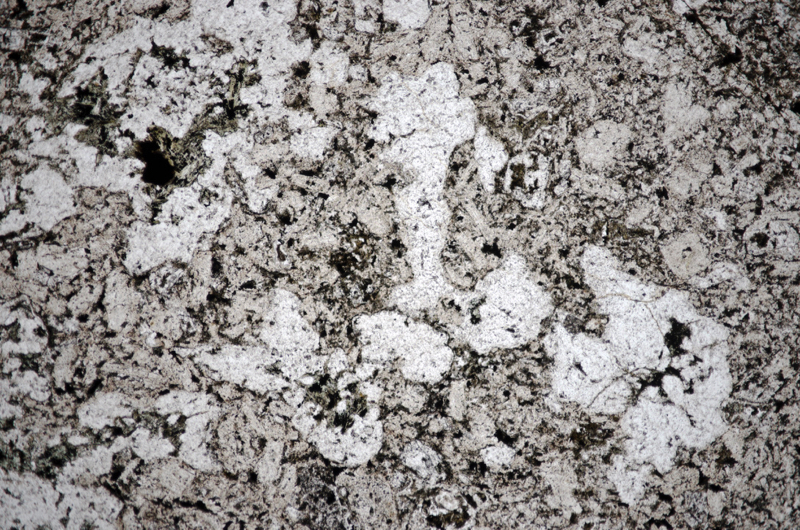
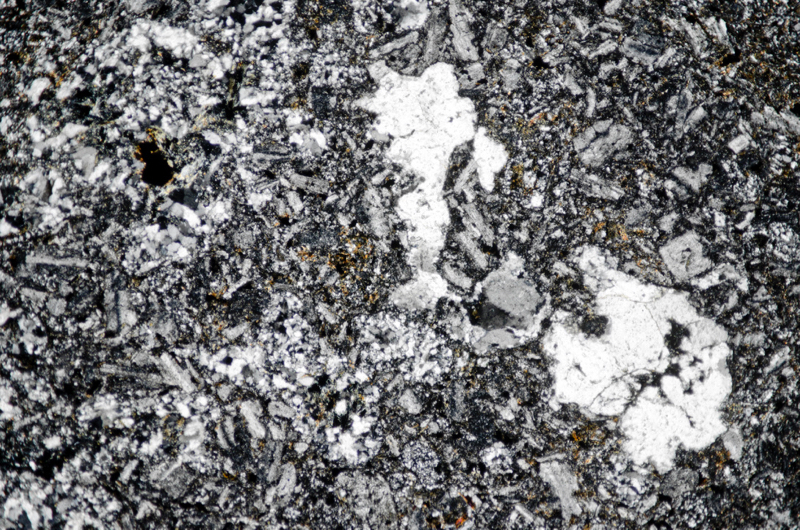
Section viewed in plane polarised light (FoV 4.6 x 3.0 mm)
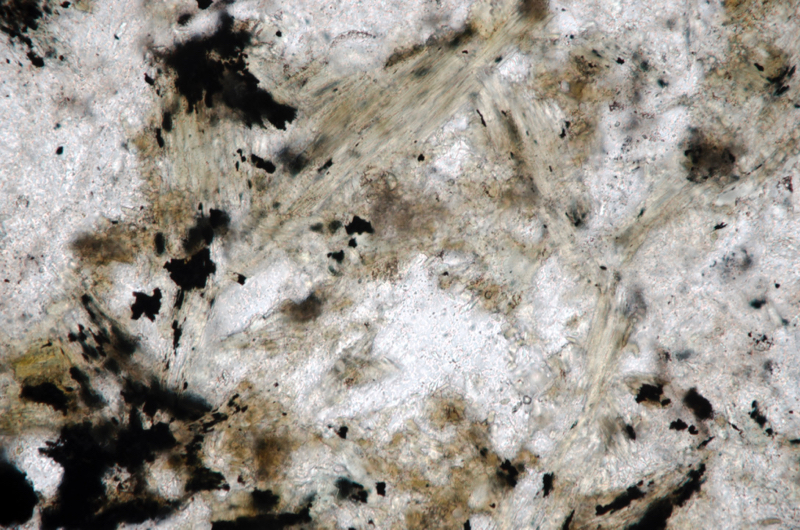
Section viewed in plane polarised light (FoV 0.5 x 0.3 mm)
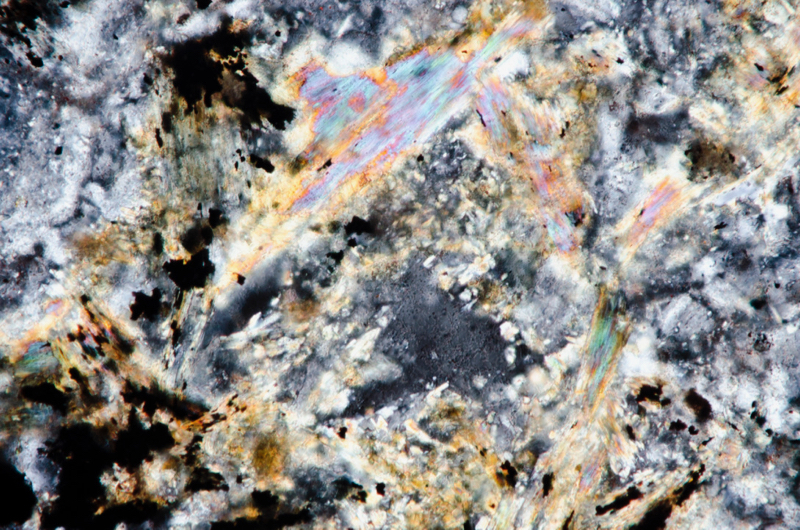

The rock at the third exposure we sample is hornfelsed andesite. Here, we do see comparatively large plagioclase phenocrysts in a groundmass that is even more altered. Here are the same, although no quite so extensive, patches of quartz that we saw in the rock at the previous location. The surprise comes in the presence of tourmaline. It is unlike the tourmaline that we have seen elsewhere in the Cheviots in that it is grey-brown rather than the usual dark blue-green and it is less strongly pleochroic. The presence of tourmaline with quartz points to hydrothermal alteration in addition to the metamorphic effects associated with heat from the nearby pluton.
Specimen 4
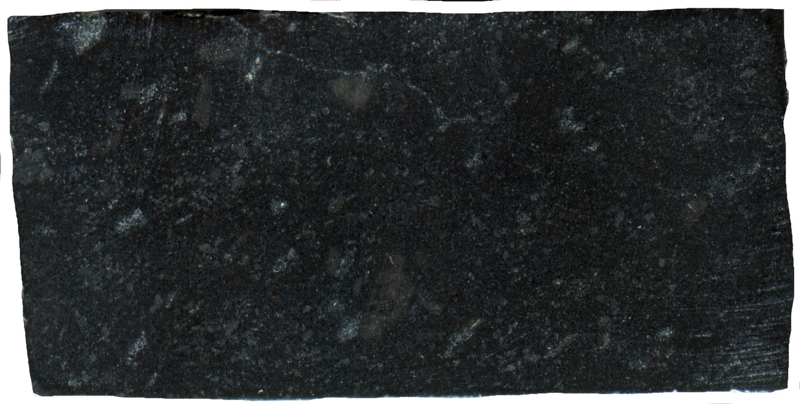
Prepared specimen viewed in reflected light measuring 42mm across.
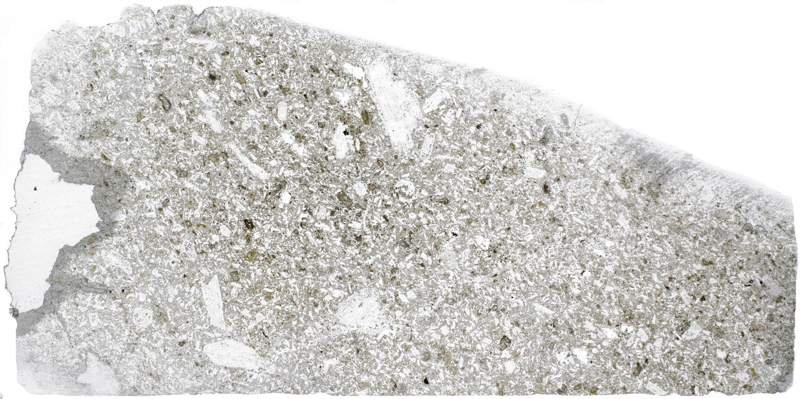
This section measures 45mm across.

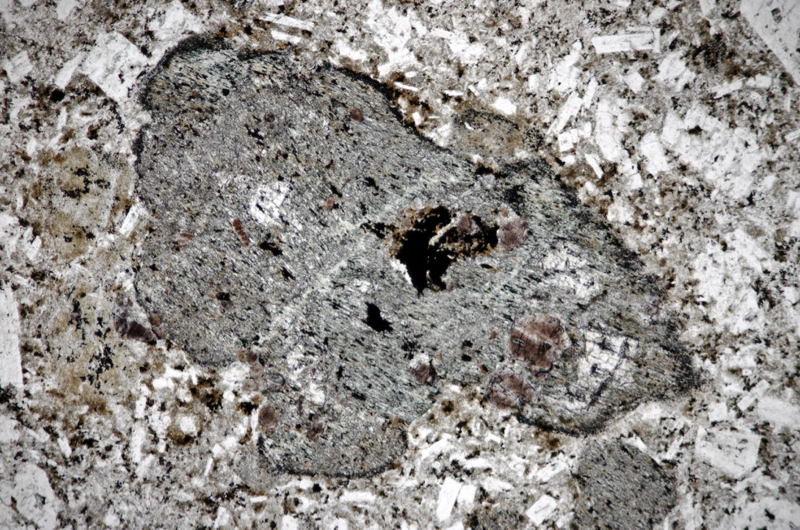
Section viewed in plane polarised light (FoV 2.3 x 1.5 mm)
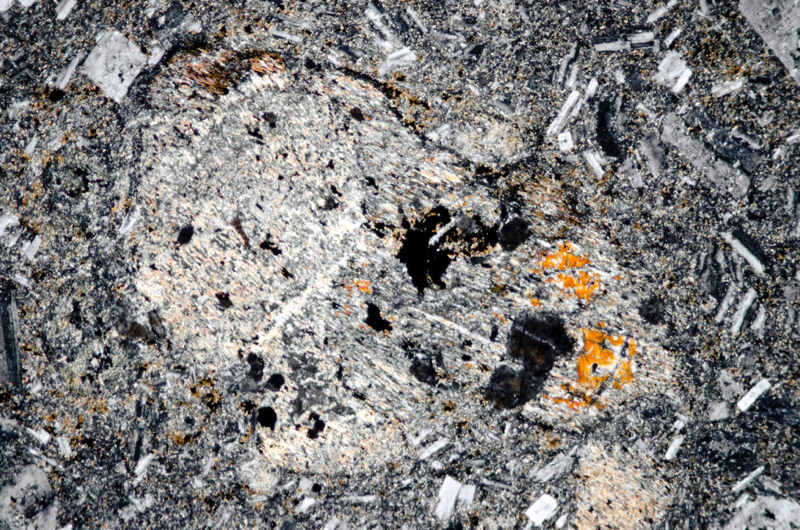

Section viewed in plane polarised light (FoV 4.6 x 3.0 mm)
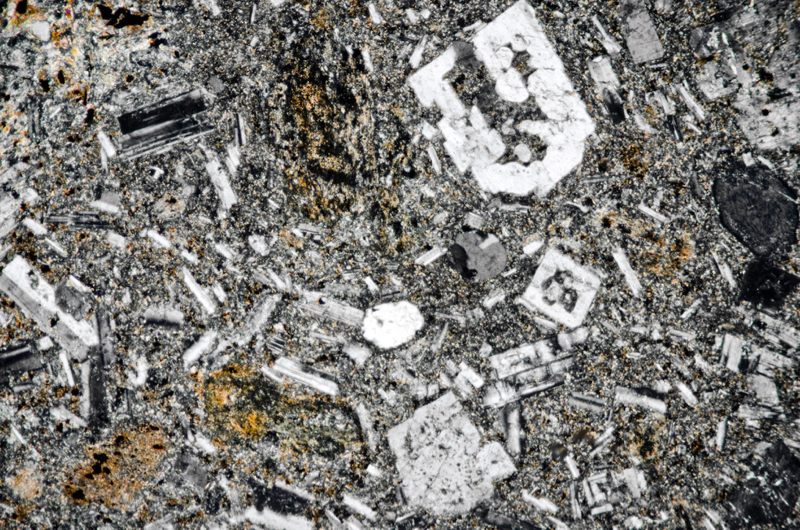

The orange mineral flakes in the groundmass exhibit parallel extinction. Section viewed with crossed polarising filters (FoV 4.6 x 3.0 mm)
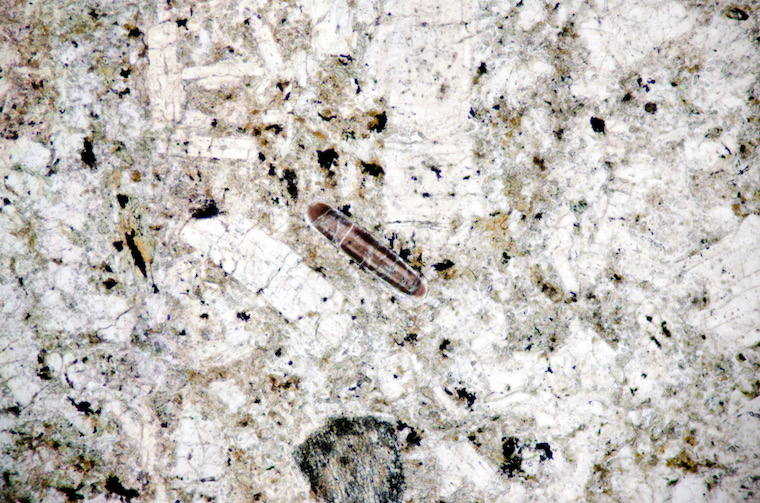
Section viewed in plane polarised light ((FoV 1.3 x 0.8mm)

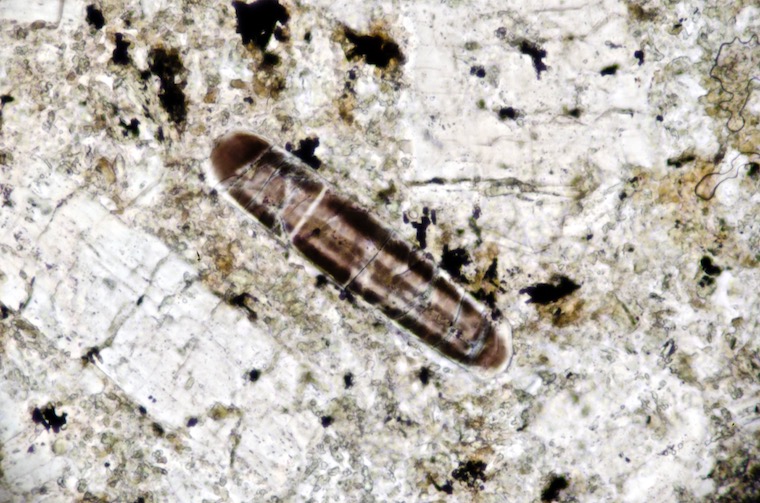
The tourmaline crystals that appear in our samples of the hornfels in this area are all grey-brown in colour. This crystal’s zoning is clearly seen.
Section viewed in plane polarised light (FoV 0.6 x 0.4mm)

At this location, andesitic rock gives way abruptly to granitic rock offering some samples that are intensely dark and fine-grained while others appear to be porphyritic (although the phenocrysts may be xenocrysts ripped off coarser-grained host rocks) and still others approach the look of the sub-equigranular rocks up on Cunyan Crags.
As we move up the hillside, we see a transition from the fine-grained ‘porphyritic’ variety outcropping close to the pluton-andesite boundary to the medium-grained sub-equigranular variety that then continues up the crags.
Specimen 1. Chilled porphyritic ‘Marginal’ plutonic rock
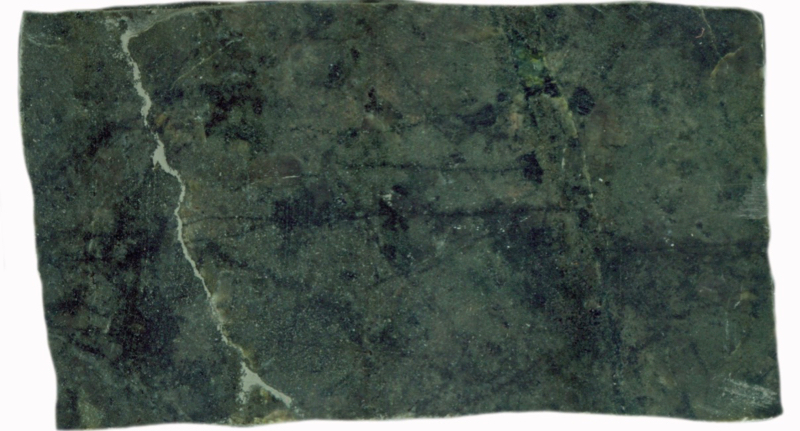
Prepared specimen viewed in reflected light (37mm across)

Thin section from this specimen viewed in plane polarised light. (35mm across)
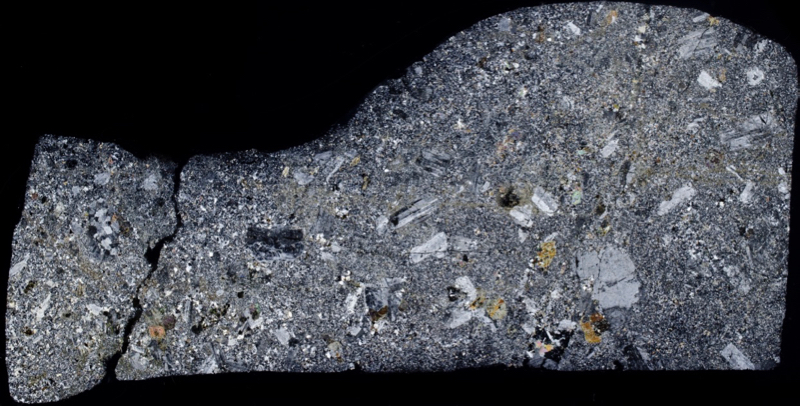
The fine grain of the groundmass may be explained by the rock’s close proximity to the pre-crystallised mass of andesite.

Section viewed with crossed polarising filters (FoV 4.6 x 3.0 mm)
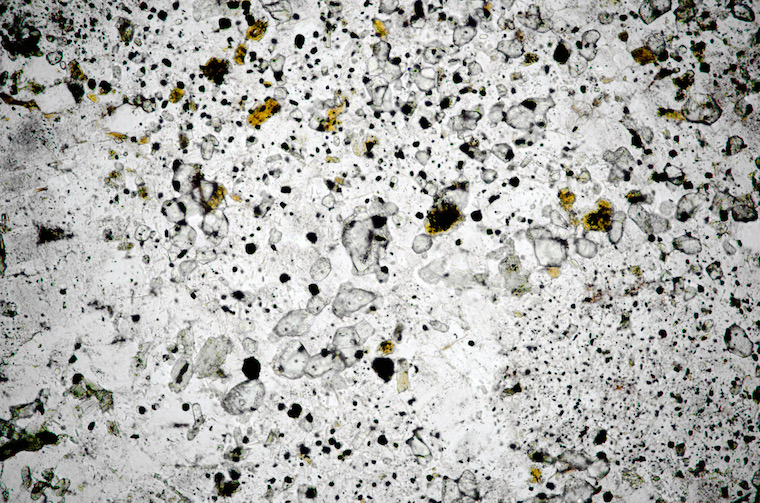
The high relief, clear to pale-green crystals scattered throughout the groundmass are most probably pyroxene. There is also an abundance of fine-grained magnetite. Section viewed in plane polarised light. (FoV 1.3 x 0.8 mm)
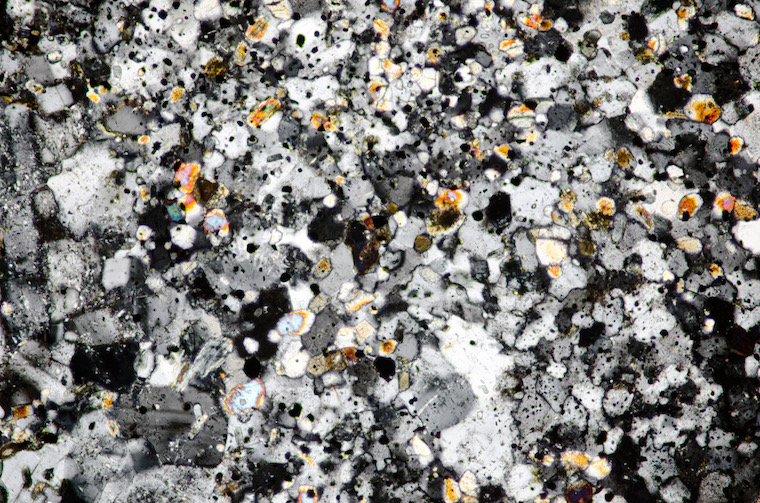
The mid-first to second order interference colours suggest clinopyroxene rather than orthopyroxene. Section viewed in with crossed polarising filters (FoV 1.3 x 0.8 mm)
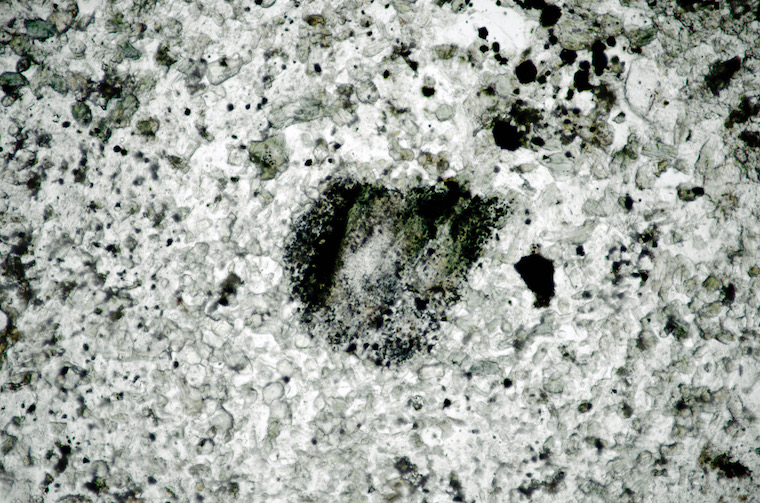
The non-pleochroic crystal, much altered and darkened by opaques, is viewed in plane polarised light. (FoV 2.5 x 1.7 mm)


Section viewed with crossed polarising filters(FoV 2.5 x 1.7 mm)
Specimen 2
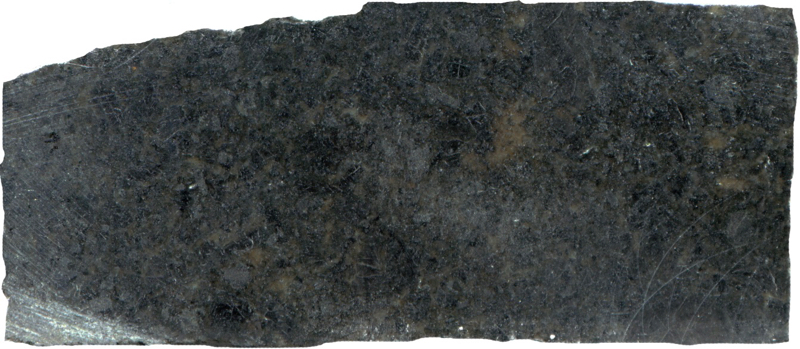
Prepared specimen viewed in reflected light (48mm across)

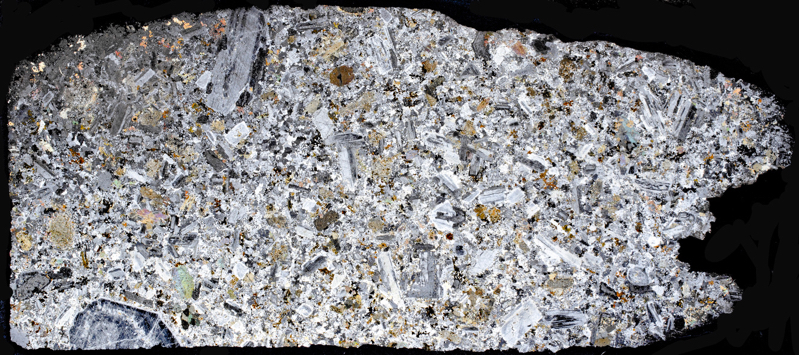

We note that the larger crystals have been disrupted by the many small quartz grains that puncture them and wonder if this is a magmatic effect of mixing and/or cooling, or due to a later alteration in the solid phase. Section viewed with crossed polarising filters and Benford plate (FoV 4.6 x 3.0 mm)

Viewed in plane polarised light (FoV 2.3 x 1.5 mm)

Specimen 3. Medium-grained, subequigranular ‘Marginal’ rock with very occasional clusters of fine-grained material

Prepared specimen viewed in plain reflected light (48mm across)

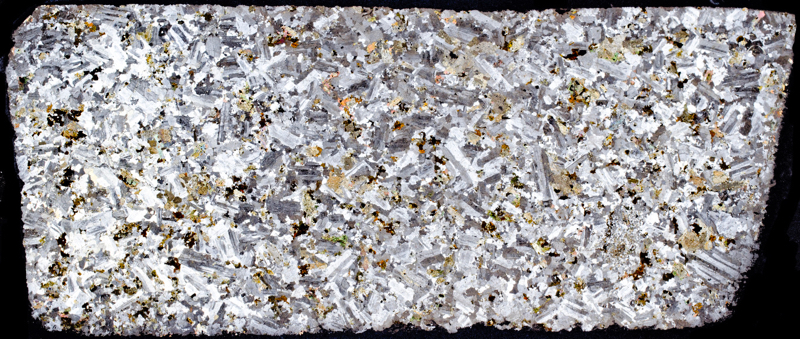
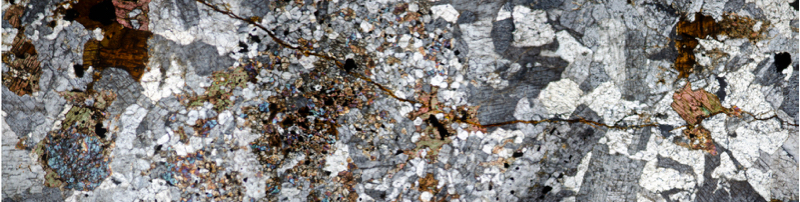
Section viewed with crossed polarisers and Benford plate (FoV 13.8 x 3.0 mm)
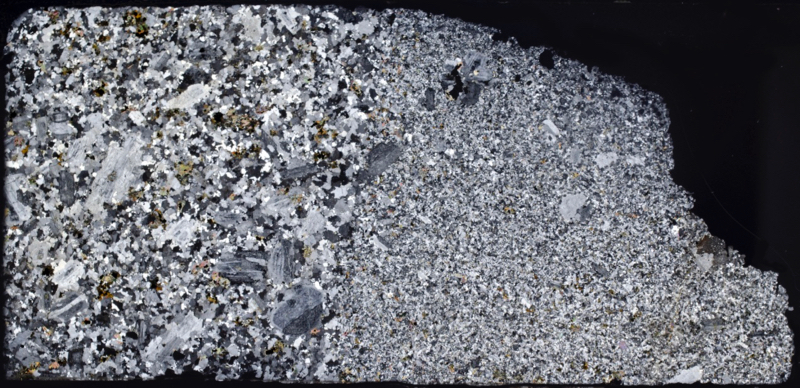
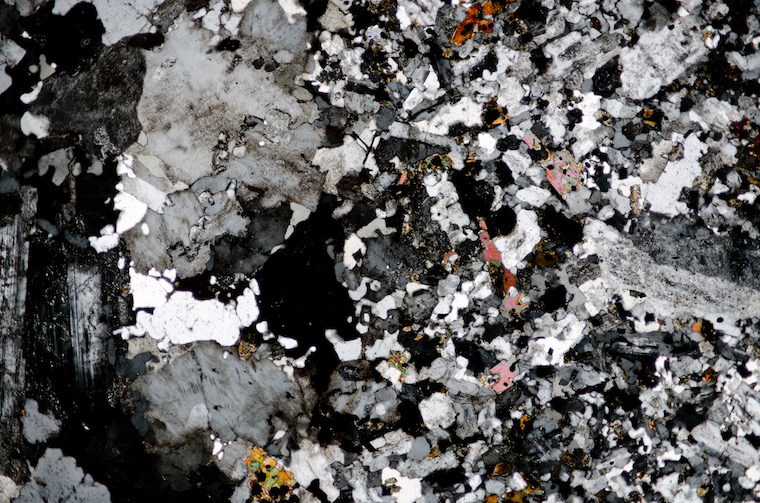
Specimen 4. Junction of sub-equigranular ‘Marginal’ host rock and a fine-grained mafic intrusion

Prepared sample viewed in reflected light. The intrusion is the dark material to the right.

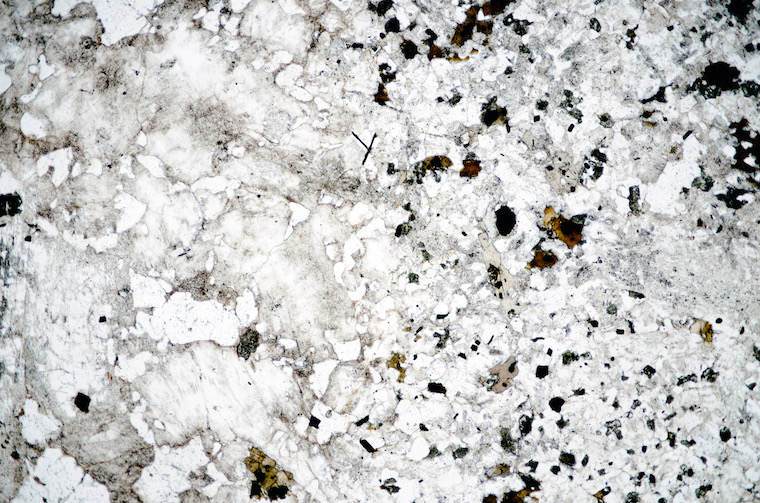
Section viewed in plane polarised light. (FoV 5 x 3.3 mm)
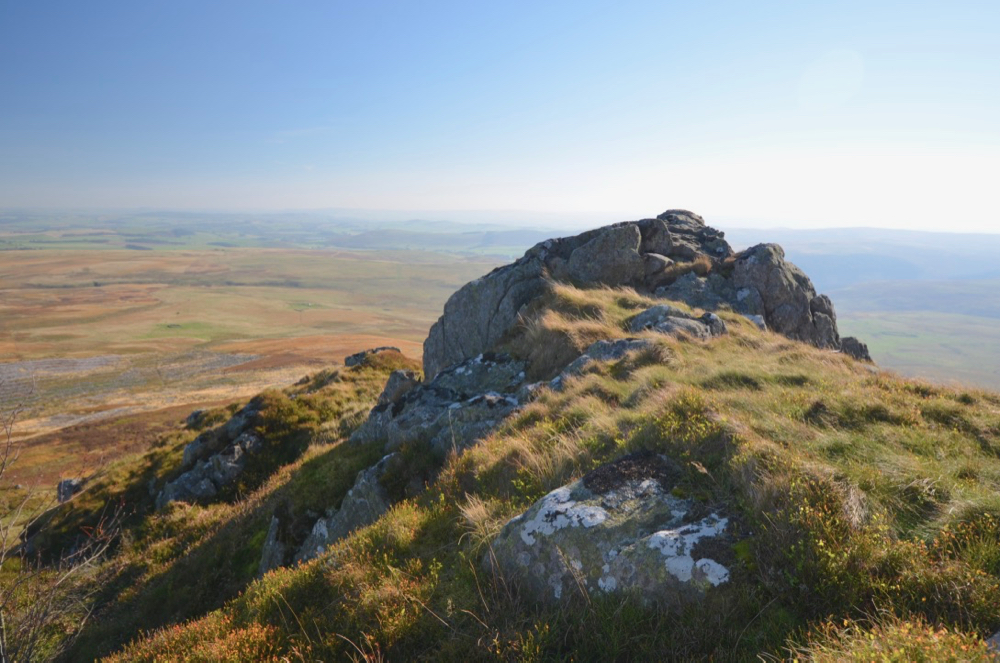
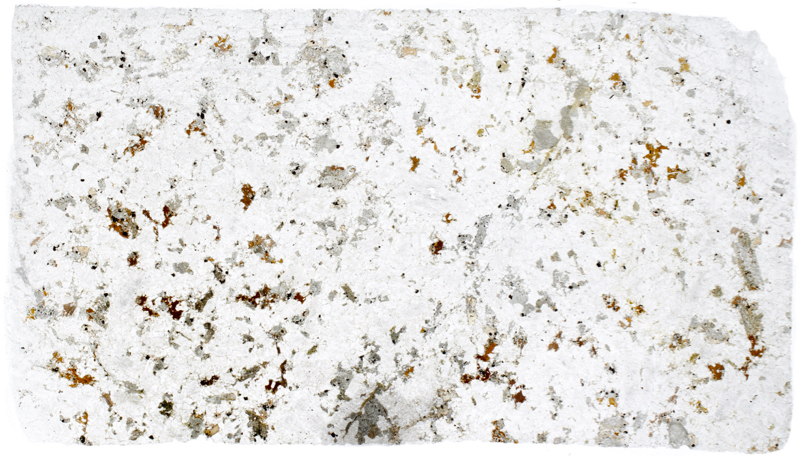
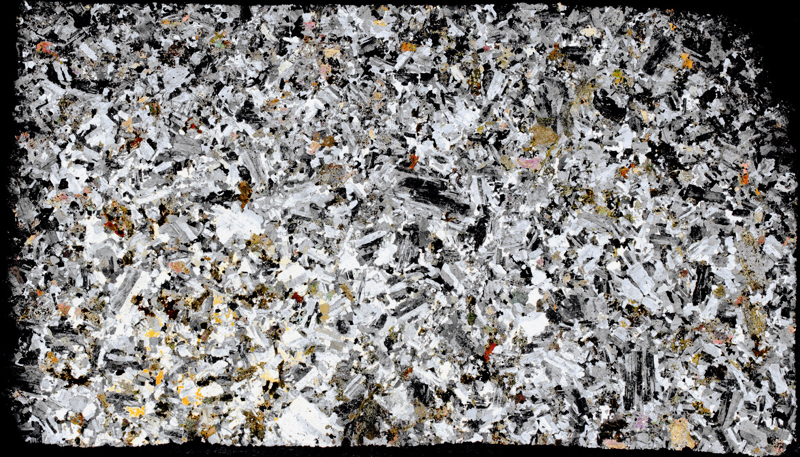
Cunyan Crags in the area of NT977181 presents substantial exposures of the Cheviot’s typical ‘Marginal’ rock that is dark grey/brown. sub-equigranular and allotriomorphic.
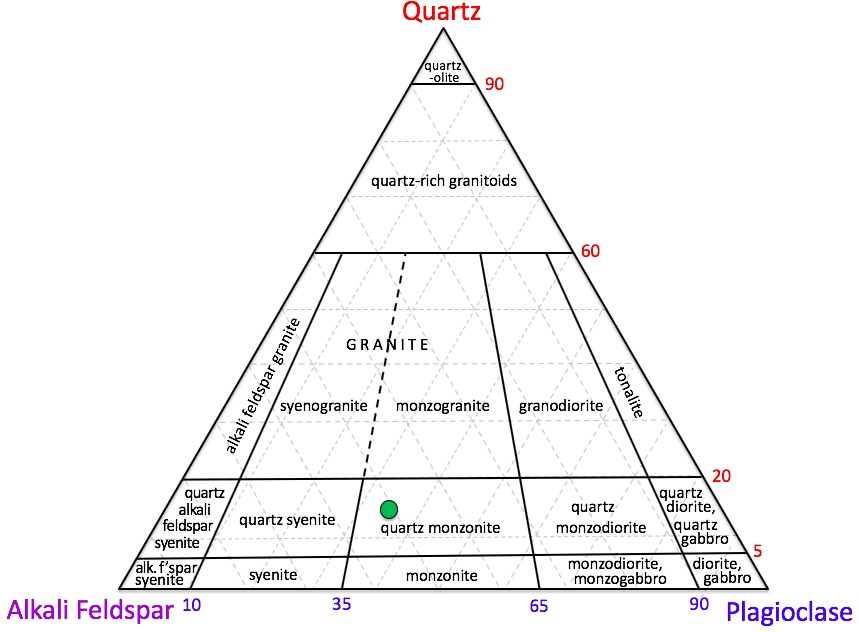
A pixel count on images of the first specimen provides us with approximate mineral content percentages: mafic-mineral content 21%.
The QAP relationships of quartz 14%, plagioclase 35%, K-spar 51% which supports its classification as a quartz-monzonite.
A small vein that runs through our sample contains both actinolite and epidote.
Specimen 1
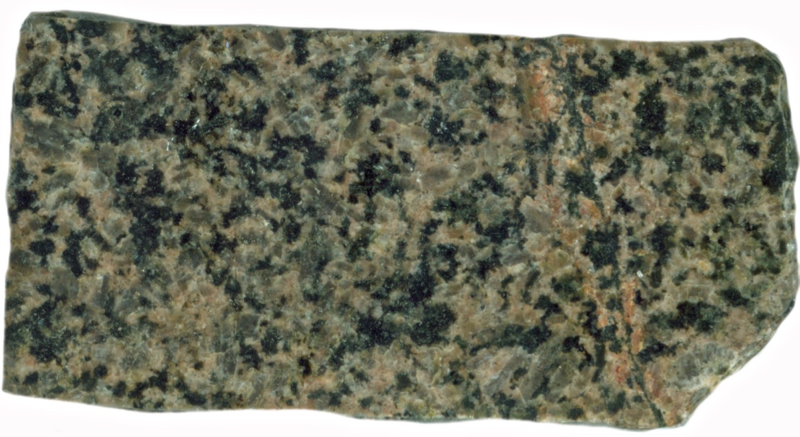
Prepared specimen viewed in reflected light (41mm across)
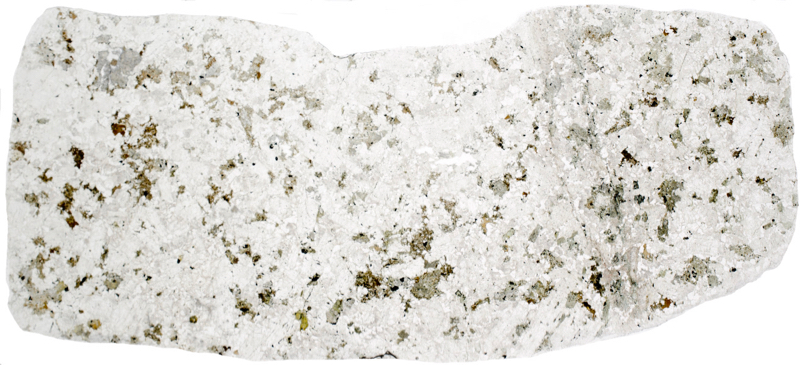
(41mm across)
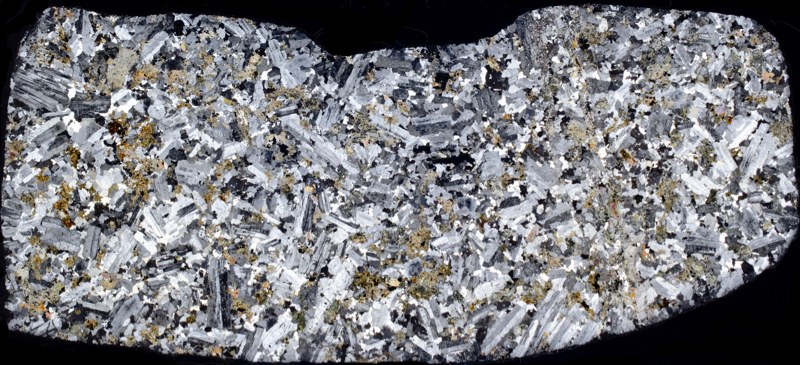
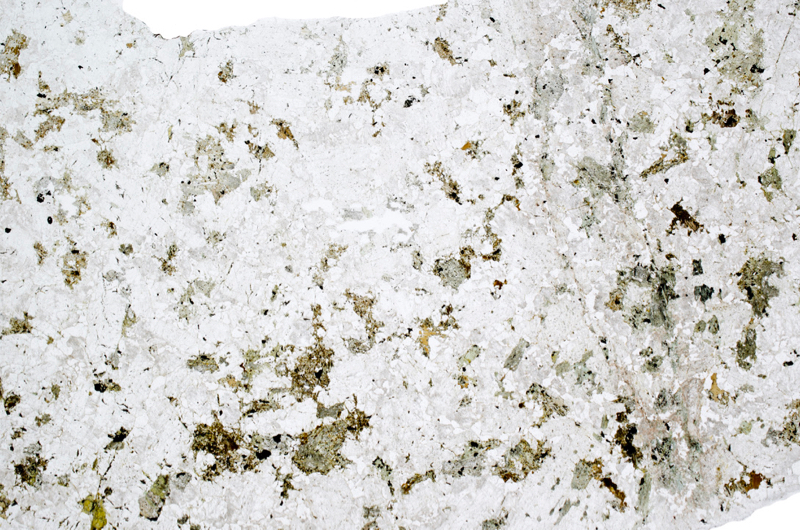
Section viewed in plane polarised light (20mm across)

Section viewed in plane polarised light (FoV 1.2 x 0.8 mm)
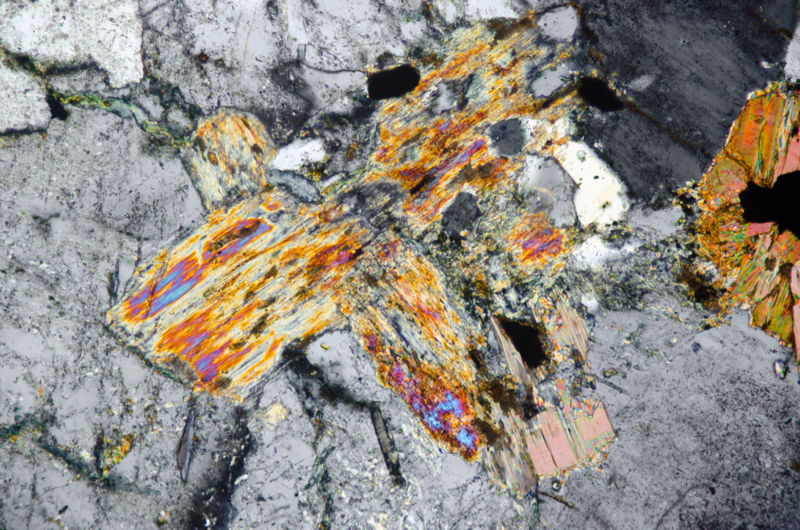
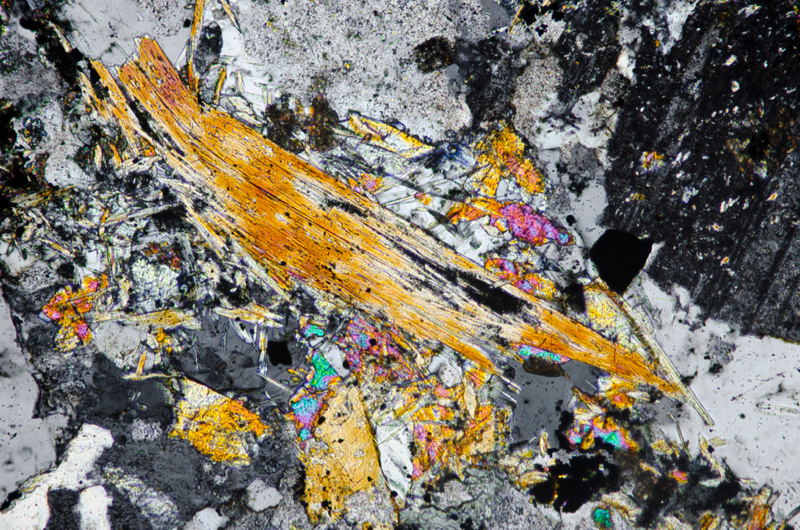
Section viewed with crossed polarising filters and Benford plate (FoV 1.2 x 0.8 mm)
Specimen 2. A sample of the same variety of the ‘Marginal’ type from a different part of the crag

Prepared specimen viewed in reflected light (48mm across)
Next, there’s a long boggy stretch that crosses, according to Robson’s map, the boundary between the outer ‘Marginal’ quartz monzonite and the ‘Central Belt’ medium-grained, porphyritic granites that lie closer to the centre of the area occupied by the pluton.
We are heading for an outcrop at NT970178 where Al-Hafdh records his porphyritic ‘Hedgehope’ granodiorite chilled against the ‘Marginal’ quartz monzonite that evidences his sequence of multiple intrusions. We search but we do not find a chilled porphyritic rock against a more mafic granular one, but we do find a great variety of rocks in this vicinity. Over a few square metres below NT970178, we find;
granular, medium-grained ‘Central Belt’ rock that is less mafic than the ‘Marginal’ type, sub-equigranular ‘Marginal’ rock, mixed fine-grained and coarser-grained ‘Marginal rock, and ‘Marginal’ rock that has been invaded by a fine-grained, felsic material.
Some of these rocks are strongly granophyric and some are not.
It’s tempting to see the redness of some of these rocks together with the presence of large crystals and crystal masses and take them to be of the ‘Central Belt’ type – since these are always reddish and often porphyritic. However, under the microscope, the ‘phenocrysts’ in most of the rocks look more like inclusions in the fine-grained component rather than phenocrysts and glomerocrysts that have crystallised out of the same magma.
Specimen 1. ‘Central Belt’ rock
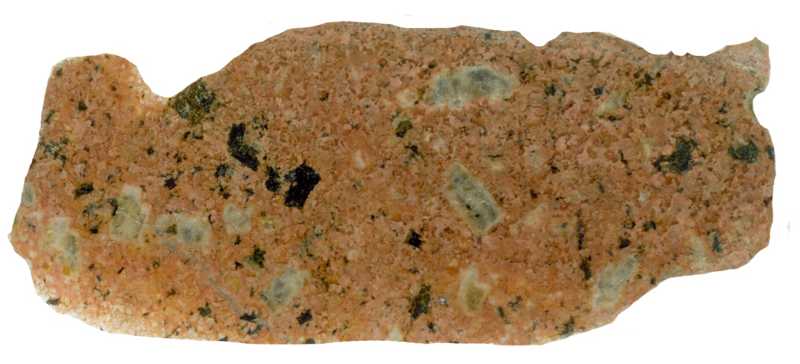
Prepared specimen viewed in reflected light

There is much less mafic material in this sample than in the others from this location
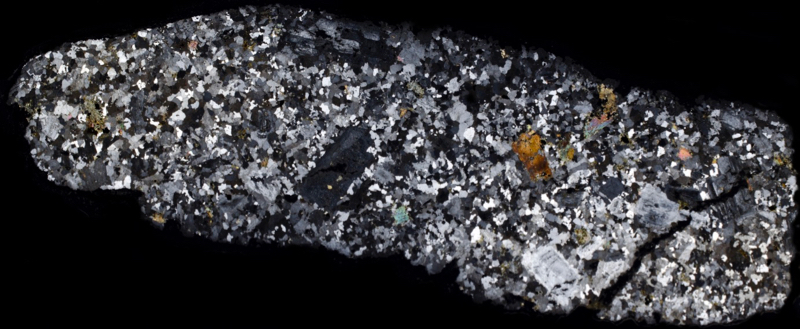

Section viewed with crossed polarising filters (17mm across)
Specimen 2
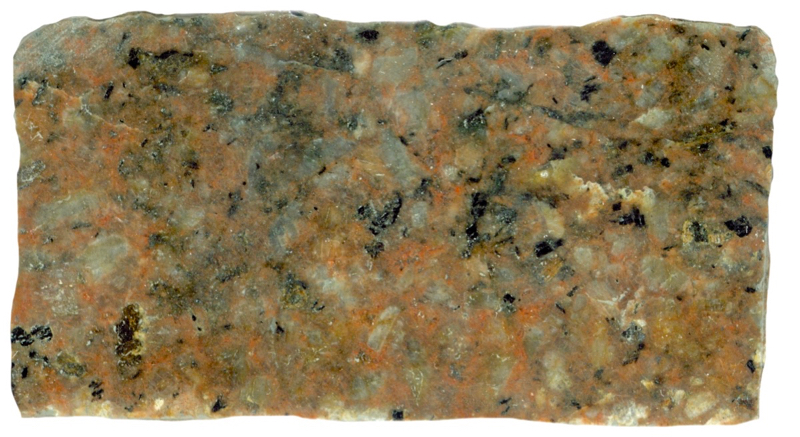
Prepared specimen viewed in reflected light
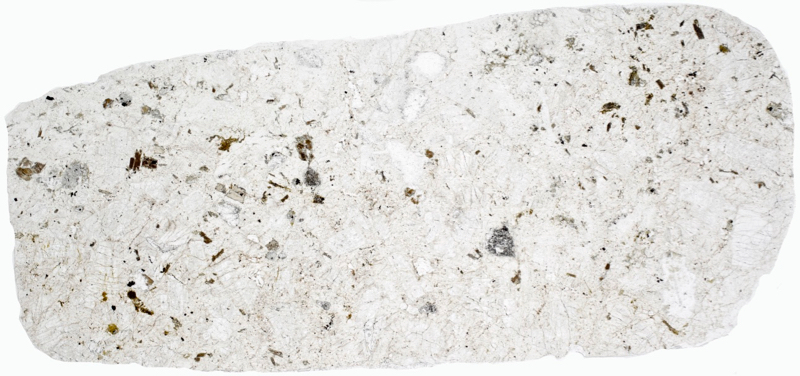
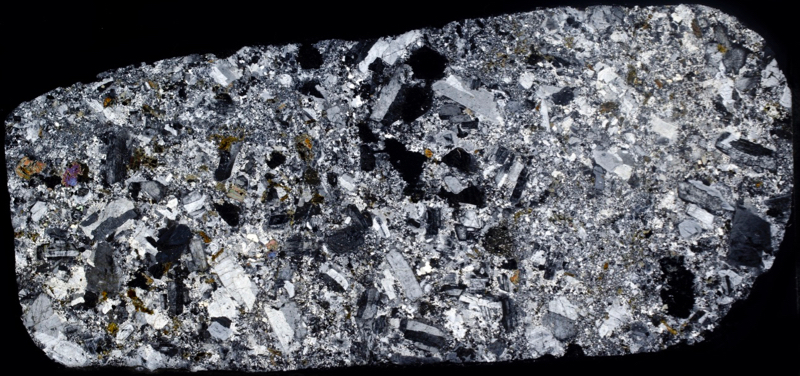

Section viewed with crossed polarising filters (FoV 1.2 x 0.8 mm)

Section viewed in plane polarised light (FoV 1.2 x 0.8 mm)


Along with the many broken crystals, the kinked biotite is another sign of stress due to disruption of consolidating or pre-consolidated magma by another intrusion of magma. Section viewed with crossed polarising filters (FoV 1.2 x 0.8 mm)
Specimen 3. Mixed fine-grained and coarser-grained granophyric ‘Central Belt’ or ‘Marginal’ rock

Prepared specimen viewed in reflected light
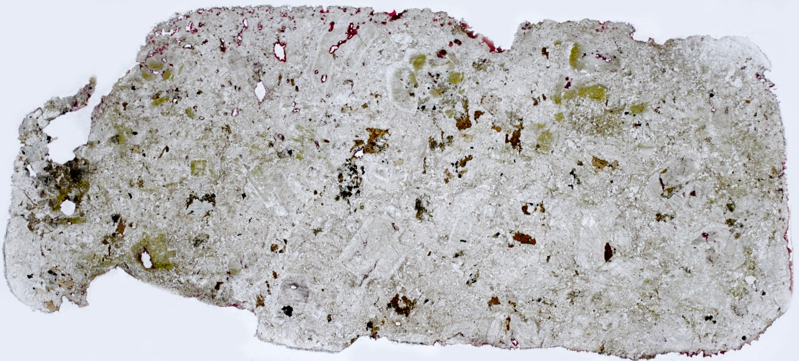

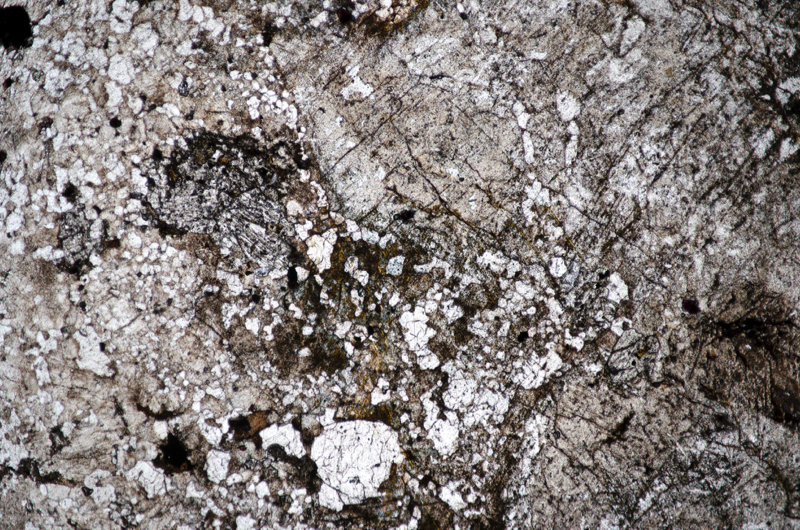
Section viewed in plane polarised light (FoV 1.2 x 0.8 mm)

Specimen 4
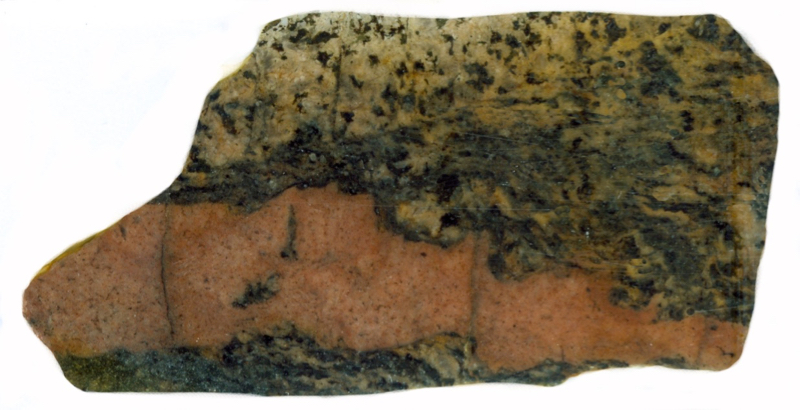
Prepared specimen viewed in reflected light


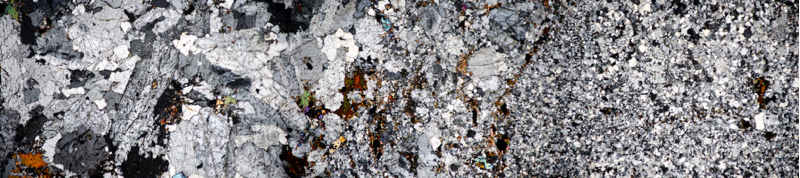
Section viewed with crossed polarising filters and Benford plate (13mm across)
Specimen 5. Sub-equigranular ‘Marginal’ rock

Prepared specimen viewed in reflected light
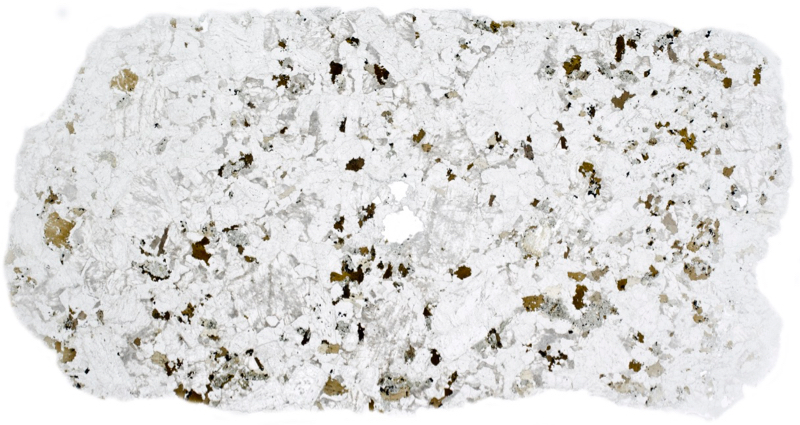
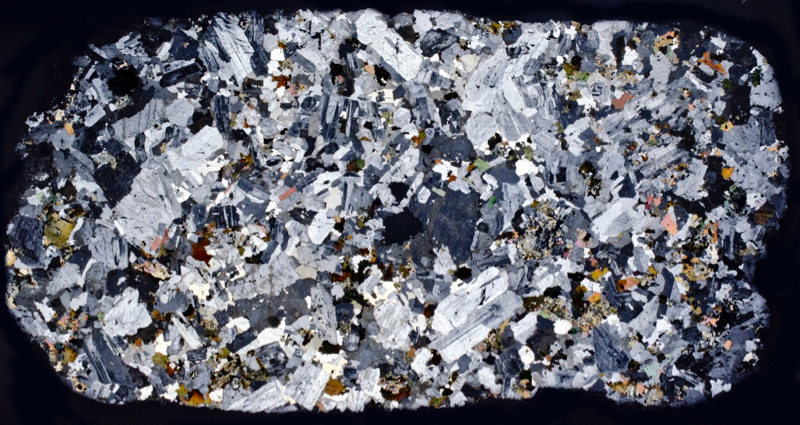
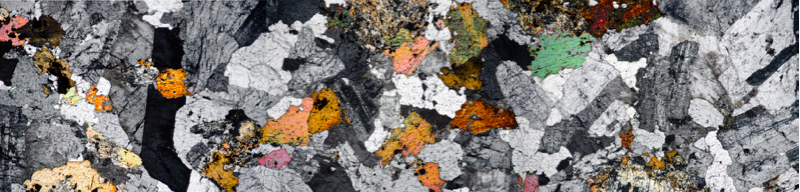
Section viewed with crossed polarising filters (13mm across)
Specimen 6

Prepared specimen viewed in reflected light
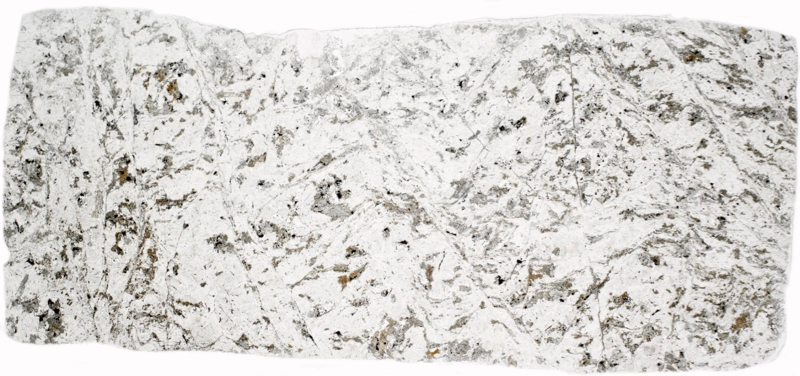
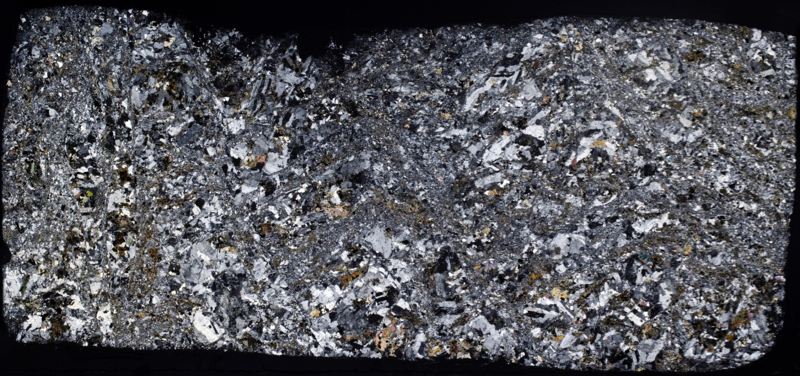
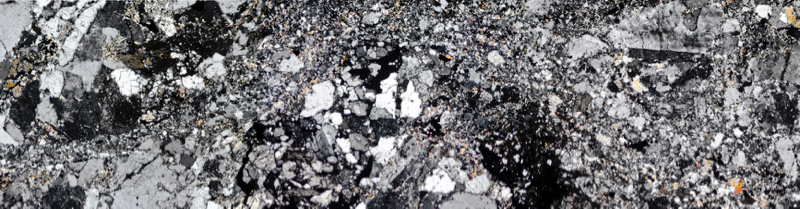
Section viewed in crossed polarising filters (12.5mm across)

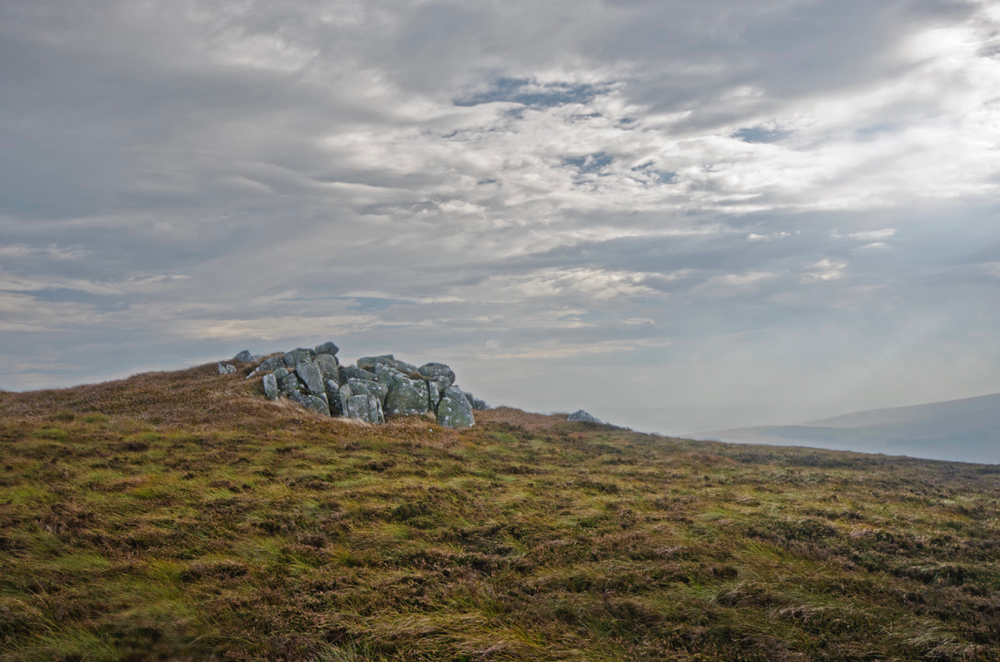
The summit tors can be seen on the skyline.
From location 4, we head over rough ground towards the tors that mark the north end of Long Crag and the slightly higher ones to our right that lie close to the fence and footpath that runs down to Cunyon Crags. We pass by both exposures, for now, and take the rough track leading from Long Crag to the summit tors of Dunmoor Hill.
The sample we take from the summit tors is a very interesting one. It reveals a junction between a coarser-grained, fairly mafic, ‘Central Belt’ rock and a finer-grained variety that, had it been closer to the plutons periphery, we might easily have classified as ‘Marginal’ on account of its even lower quartz and high mafic mineral content.
In seeking to explain the presence of such a mafic rock here, perhaps we need to remember that the higher ground in the Cheviots represents plutonic rock that was close to the andesitic roof of the pluton, Housey Crag andesite exposures evidence this. So, this rock may be ‘Marginal’ in respect of it’s proximity to the upper margins of the pluton.
In the hand sample, the finer-grained material is the darker of the two with patches of lighter coloured, larger crystals within it.
In thin section it is clear that the two varieties contain the same minerals; much plagioclase, some K-spar and quartz, with biotite, pyroxene and opaques. In both materials, the opaque oxides accumulate within and at the edges of altered pyroxene and biotite and as the finer-grained one has the higher percentage of these, it also has the higher percentage of opaques.
Al-Hafdt’s ‘Distribution Map of Cheviot Granites’ draws boundary lines between two different rock types fairly close to this location – that between his fine-grained, porphyritic ‘Hedgehope’ type and his coarse-grained, granular ‘Standrop’ type (although he doesn’t record having sampled this exposure). The coarser-grained rock in our sample does resemble his ‘Standrop’ type, but the finer-grained material is more granular than porphyritic and therefore doesn’t align with the porphyritic character of his ‘Hedgehope’ type.
Robson’s distribution map, drawn earlier than Al-Hafdh’s, shows a junction very close to this location between the non-granophyric ‘Standrop’ type and the ‘Granophyric’ type.
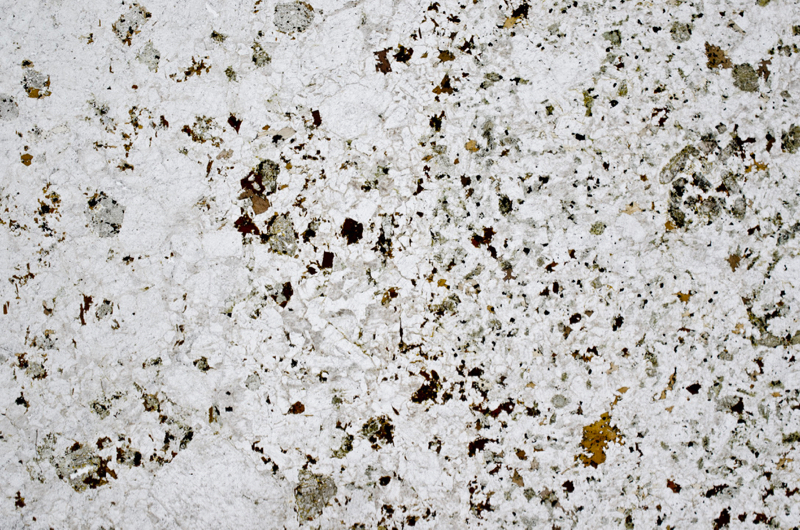
The quartz in both varieties in our sample is coarsely granophyric.
Comparing Al-Hafdh’s and Robson’s maps that show the distribution of Cheviot granites in this area
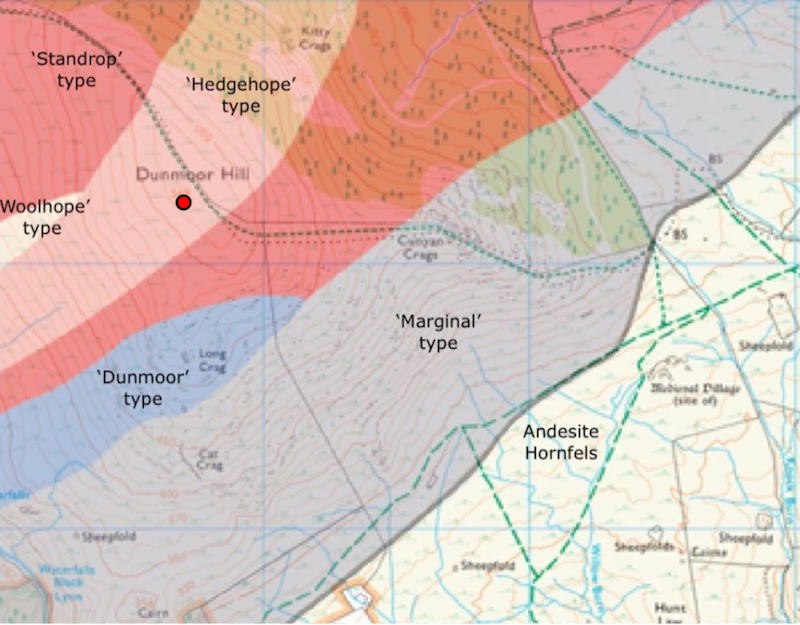
The red dot indicates the location of the sample discussed here.

Possibly, this junction is only a small scale feature, but on the other hand it may be one of those rare occurrences in the Cheviots – a visible junction of two different masses of magma. We aim to return to determine the extent and orientation of the junction.
Junction of coarse-grained and medium-grained rocks
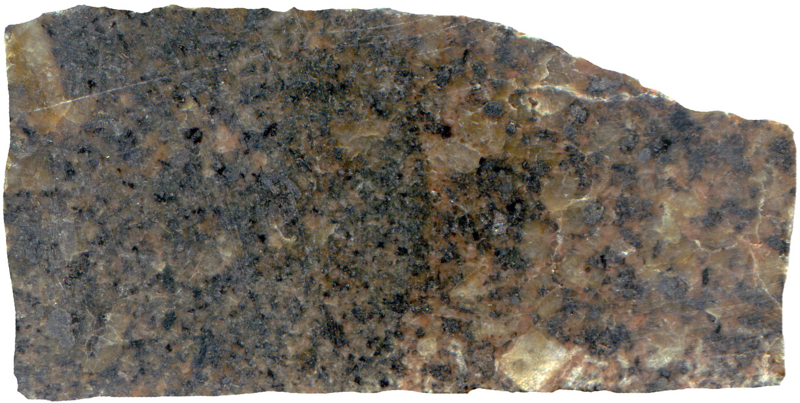
Prepared specimen viewed in reflected light measuring 42mm across.
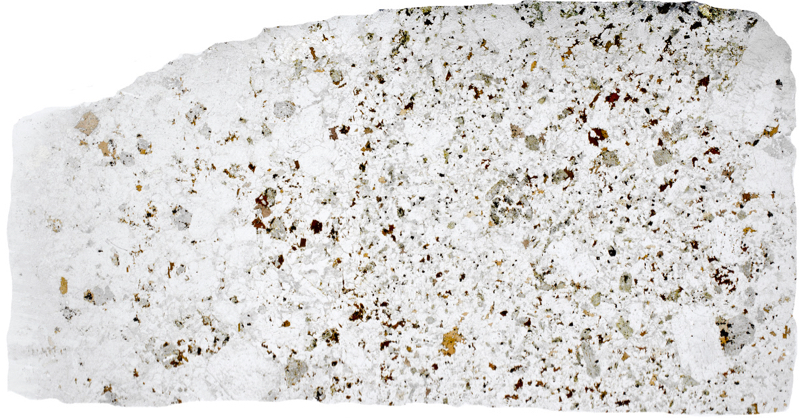
This section measures 40mm across.
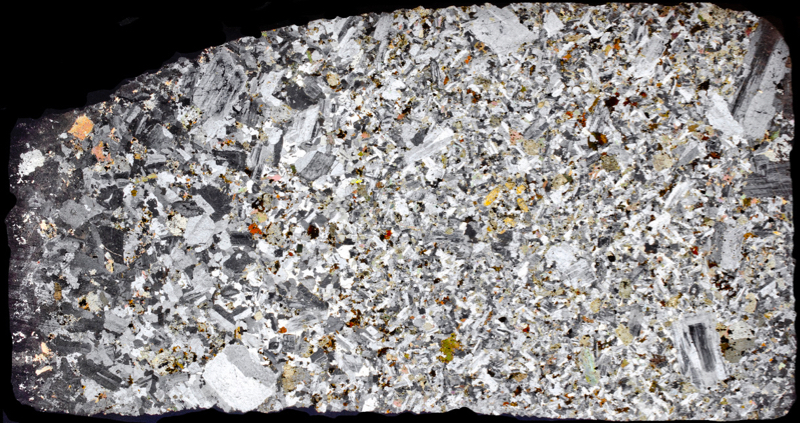
Section viewed in plane polarised light (20mm across)
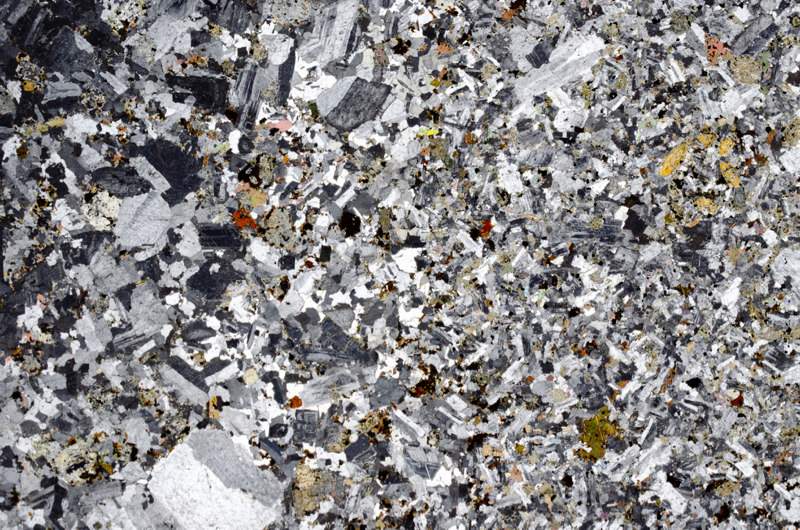
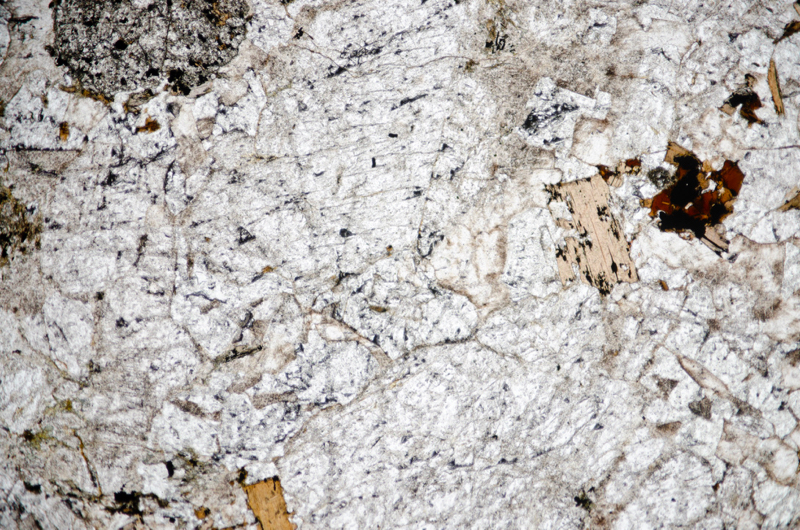
Section viewed in plane polarised light (FoV 4.6 x 3.0 mm)
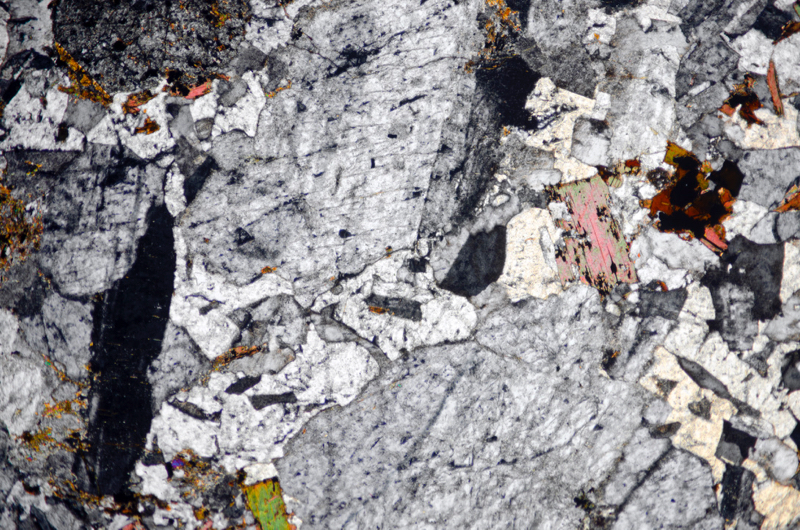
The quartz in our sample has a coarse granophyric texture.
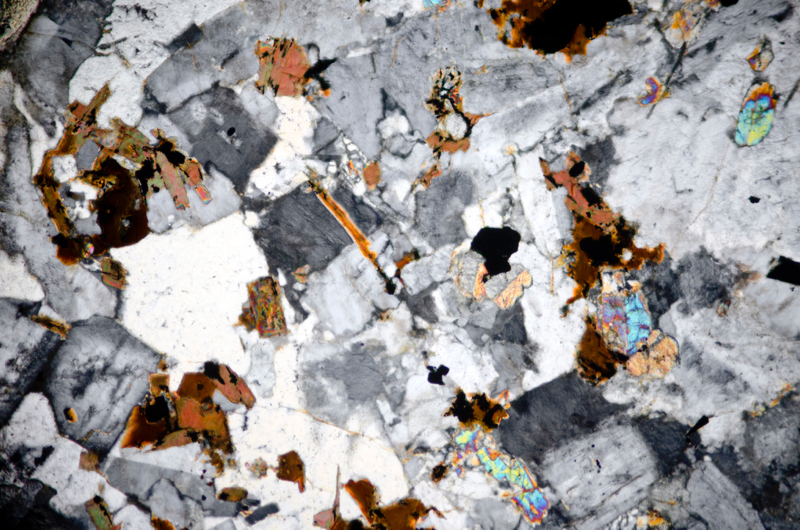
Section viewed with crossed polarising filters and Benford plate (FoV 2.3 x 1.5mm)
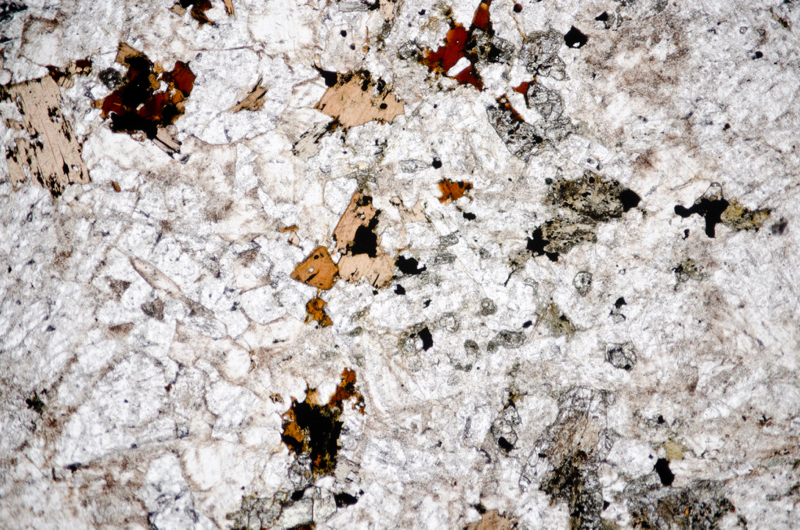
Section viewed in plane polarised light (FoV 4.6 x 3.0 mm)

The quartz is coarsely granophyric
Click here to read an account of the second part of this excursion
References
Al-Hafdh N.M. 1985. The Alteration Petrology of the Cheviot Granite. Thesis submitted for PhD. at Newcastle University.
Robson D.A. 1976 A Guide to the Geology of the Cheviot Hills Transactions of the Natural History Society of Northumbria, Newcastle Upon Tyne Vo. 43, No. 1.
British Geological Survey Online geology map http://mapapps.bgs.ac.uk/geologyofbritain/home.html