Location of the Acklington dyke in east Northumberland
The great length, continuous exposure and consistent petrology of the Acklington dyke have given it a special place in the Northern England/Southern Scotland suite of palaeogene dykes.
The dyke is first recorded east of the village of Acklington from where it strikes north-west and crosses the River Coquet in the fields of Acklington Park where it was once quarried. No outcrops of the dyke are visible at this location now although pieces of the dyke rock can be found in the vicinity of the linear cutting that marks the location, width and trend of the dyke.
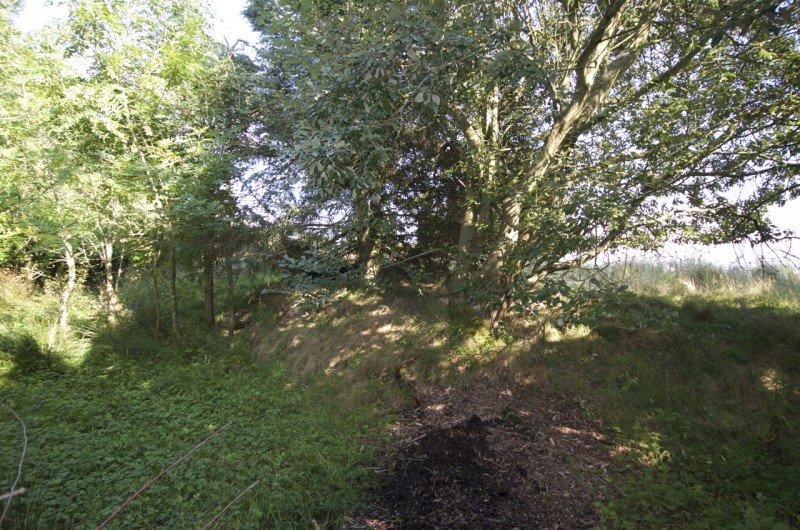
There are signs that it was also quarried at Swarland two and a half miles further west where boulders and cobbles of dyke rock can be found in the rough ground amongst the trees.
Map showing the course of the Acklington dyke through east Northumberland
The red line represents the dyke
Coloured circles mark sample locations

Petrography and Petrology
The rock’s dominant mineral is feldspar which appears in crystal form as haphazardly oriented laths that are usually of labradorite composition but can sometimes be as sodium rich as andesine. Rare samples of the dyke have been reported to contain corroded or fretted phenocrysts, sometimes occurring in glomerocrysts, of very high calcium plagioclase. Harwood and Holmes identified samples of this sort as instances of the ‘Anorthite-bearing Acklington’ type.
The augite in the rock tends to be granular or twinned and columnar while the rare hypersthene appears in stumpy crystals that have a turbid appearance due to patches of fibrous alteration products.
The generally abundant mesostasis can be a clear, colourless to sepia glass, or more commonly, a turbid devitrification product. We read that all of the rock’s alkali felspar and quartz is contained in the mesostasis along with varying amounts of plagioclase and pyroxene materials that occur in nearly the same proportions as they occur in the crystalline phases. Both glassy and devitrified types of mesostasis contain a good deal of globular and skeletal ore material. Heslop noted that where the dyke was in proximity to the Cheviot andesites, the mesostasis was more glassy.
Vesicles and chlorite lined calcite amygdaloids are few and small.
Acklington Park quarry

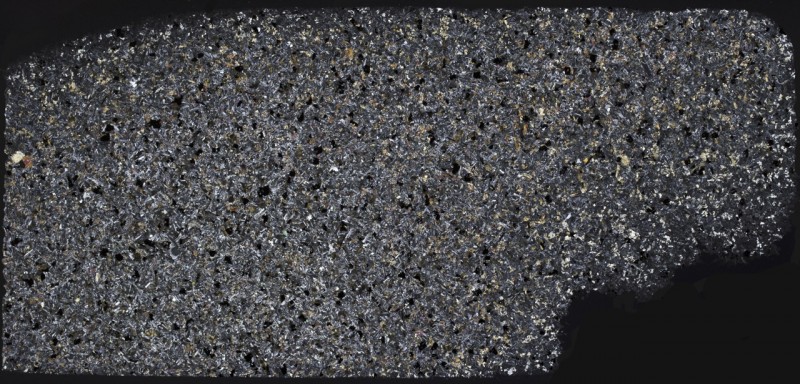
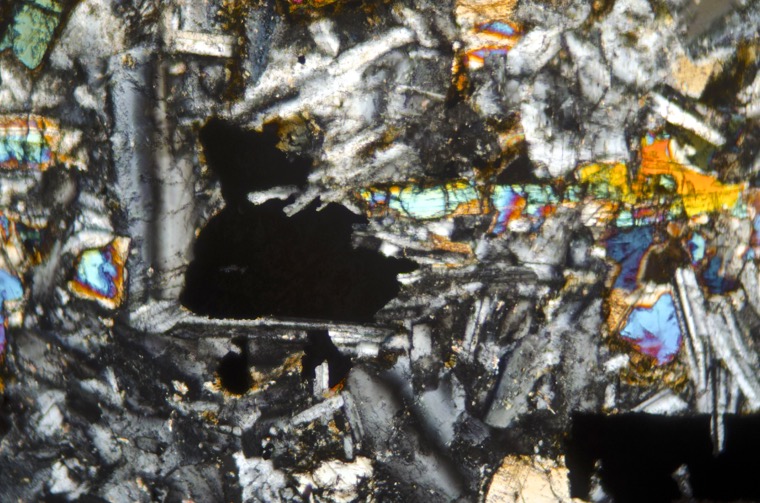
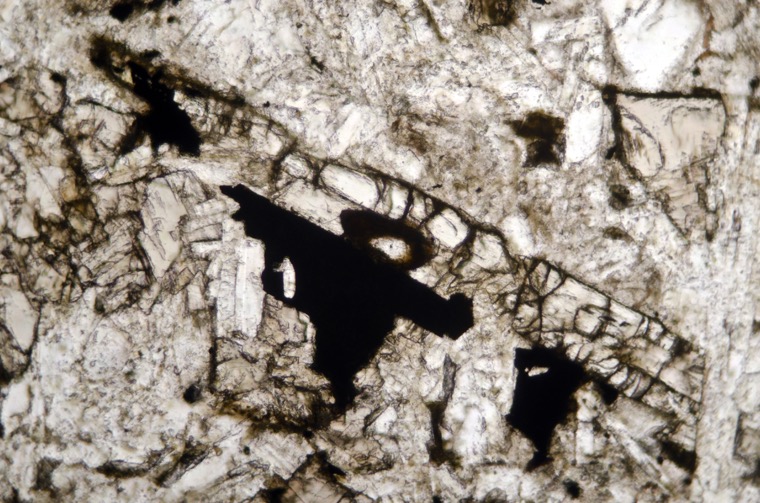
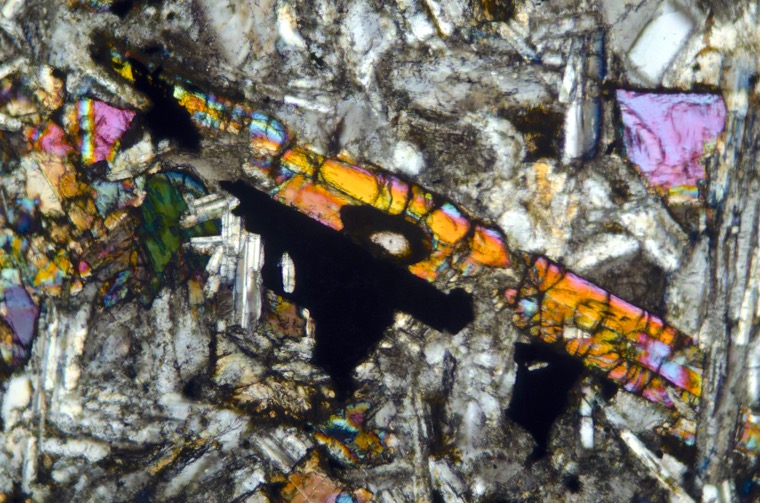
The basalt in our samples from Acklington Park quarry show many of the characteristics of the typical Acklington dyke basalt described by Holmes and Harwood.
The plagioclase appears in forms that range between small, clearly defied lathes through larger stumpy, columnar crystals,to plate-like crystals with poorly defined edges.
Most of the pyroxene is clinopyroxene in mostly granular form but also sometimes twinned, and columnar. Orthopyroxene occurs in isolated stumpy crystals in a relatively unaltered state.
The mesostasis occupies very little of the rock and the opaques are quite distinct from it, occurring as large, clearly defined skeletal shapes and plates.
We don’t find any amygdaloids in our samples.
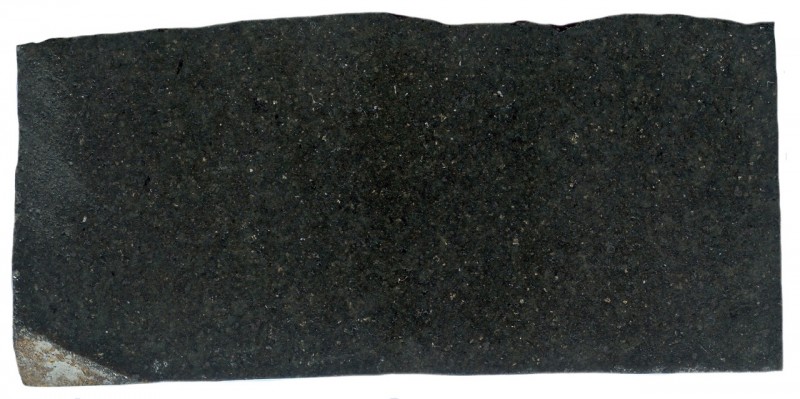
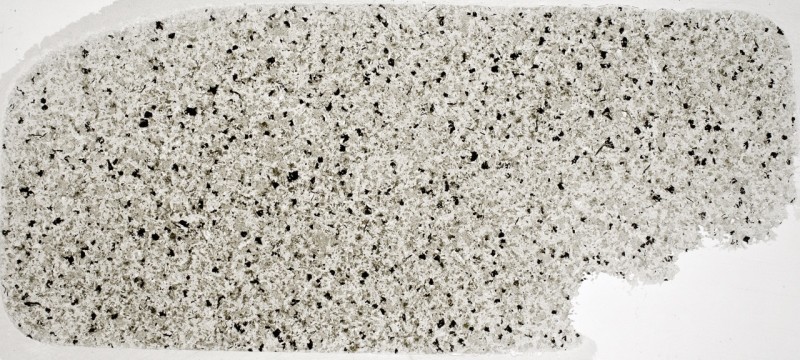
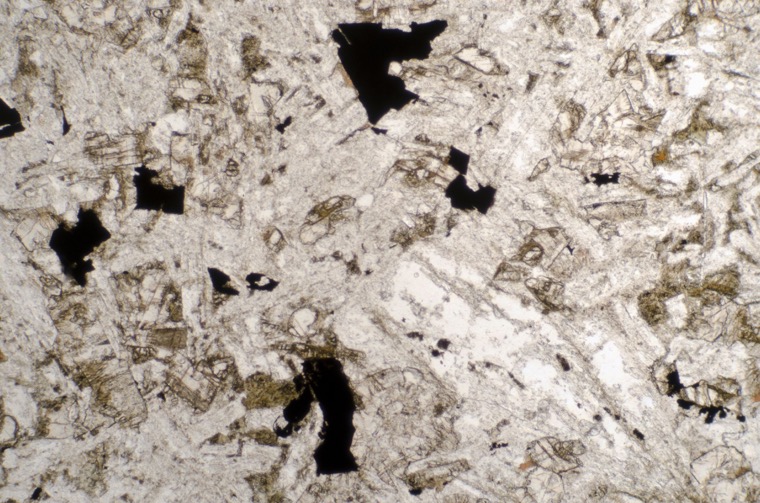
Sample viewed in plane polarised light (FoV 2.3 x 1.5 mm)
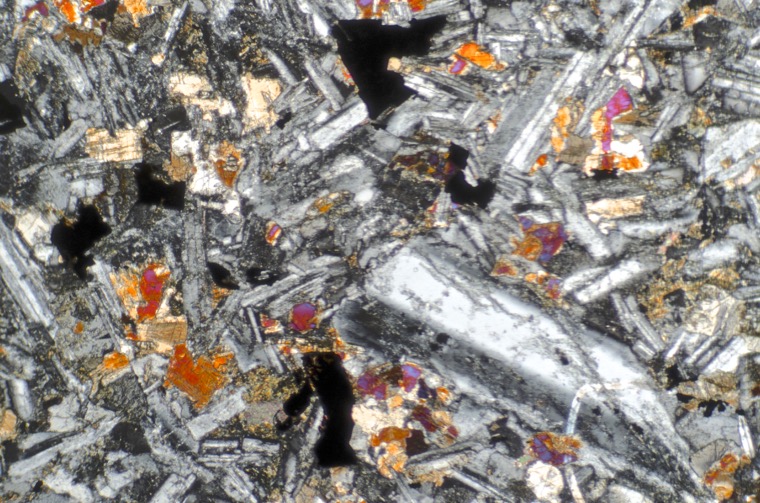
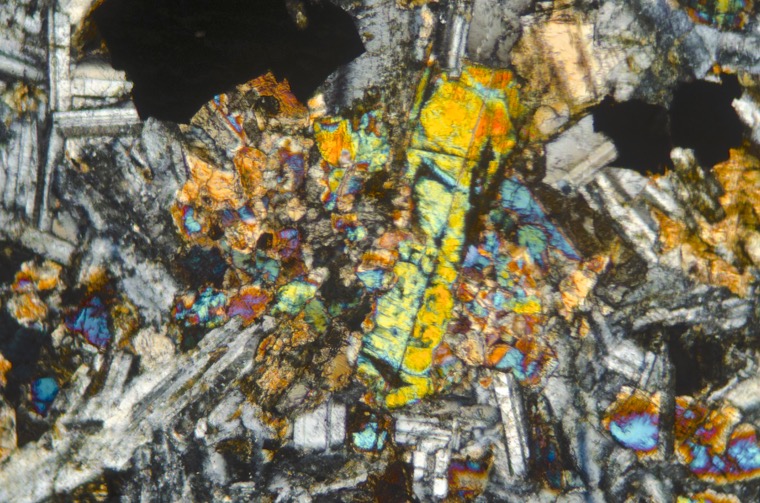
Sample viewed with crossed polarising filters (FoV 1.2 x 0.8 mm)
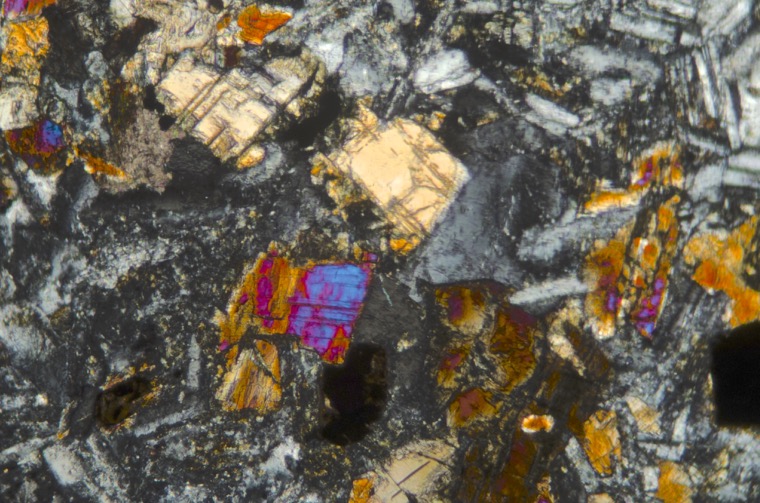
Sample viewed with crossed polarising filters (FoV 1.2 x 0.8 mm)
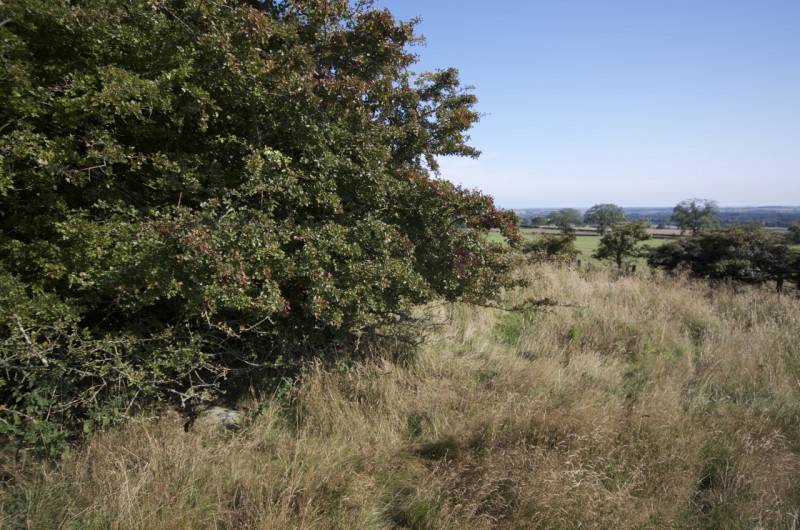
The basalt in the samples from Swarland is very similar to that in the Acklington Park rock. The appearance of the plagioclase and relatively sparse mesostasis are the same.
However, the clinopyroxene appears in granular ‘strings’ as well as in columnar and granular masses and the iron-titanium oxides appear in slightly larger skeletal forms.
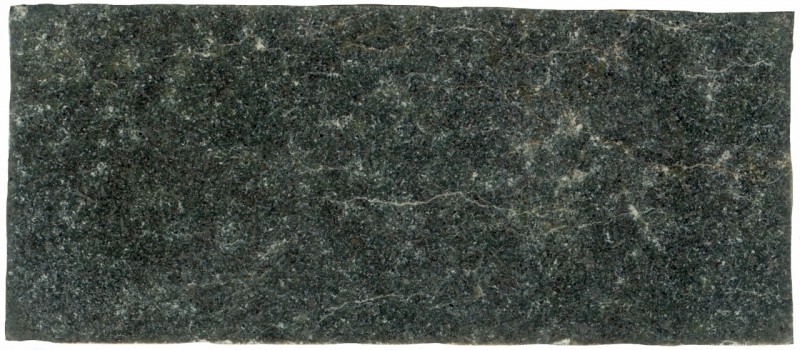
The sample is viewed in reflected light.
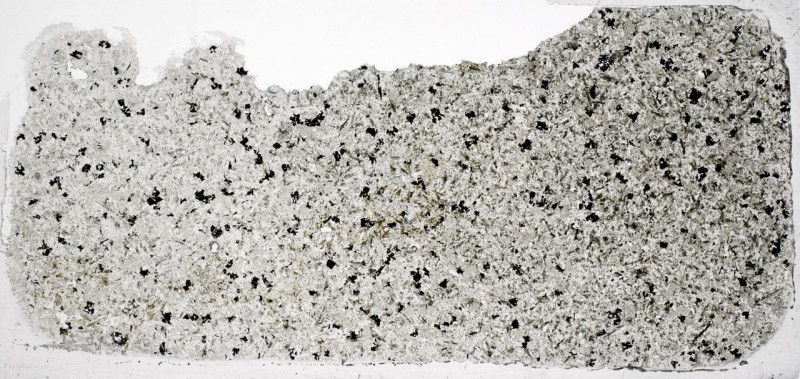
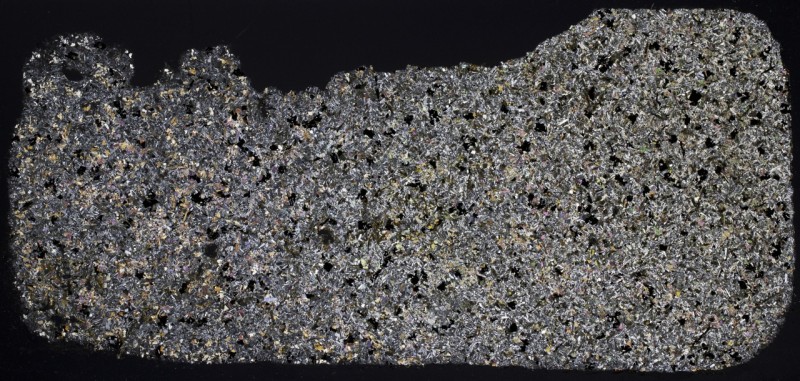
Sample viewed with crossed polarising filters (FoV 2.3 x 1.5 mm)
Sample viewed in plane polarised light (FoV 1.2 x 0.8 mm)
Map showing the course of the Acklington dyke in north-west Northumberland
The red line represents the dyke
Coloured circles mark sample locations


16 miles west of Swarland, another pair of tell-tale parallel ridges in the field at the summit of the hill north-west of Newton evidence yet another quarry and the continuing course of the dyke.
At Clennell, there is quite a lot of basaltic rock in and alongside the bed of the River Alwin. There has been some disagreement as to whether this is the Acklington dyke in situ, or displaced material from the dyke, or displaced material from some other rock. The sample we take has a very different appearance to other samples of the dyke which suggests that at least some of the River Alwin basalt is from elsewhere.
We find one broken boulder of Acklington dyke rock lying in the grass by the enclosures on the hill half a mile north of Alwinton that might well have had its origin in the dyke that is shown to cross this land nearby.
Further west, beyond Clennell Street on the steep, eastern side of the Hosedon Burn, we find the Acklington dyke outcropping from the surrounding Cheviot andesite in a number of places.
The final exposure of the dyke in the west of Northumberland is in Upper Coquetdale near Bygate where it is exposed crossing the River Coquet. Here, the dyke’s tholeiite basalt can be seen in its least altered state.
Location 3. Clennell
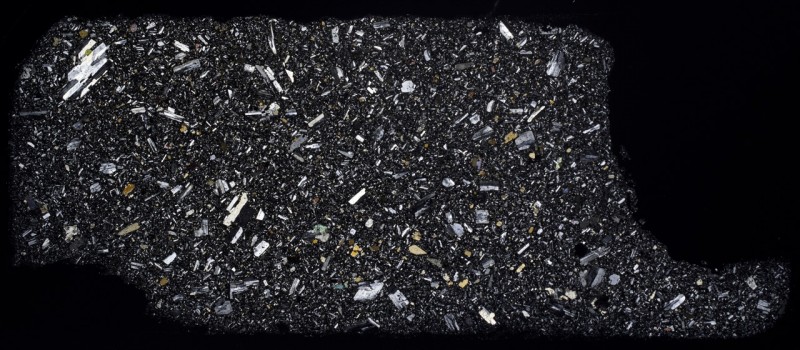
Lebour writes, “The Acklington dyke…. as it approaches the Cheviot porphyritic mass, through which it cuts, spreads irregularly over the beds of Tuedian age in which it is encased. This is very beautifully seen along its course from a little to the South-West of Biddlestone to the banks of the Alwin, at Clennell.” Perhaps the location NT926071, shown below, marks the western end of this overflow, but as we observed, certainly not all of the basalt here is tholeiitic.

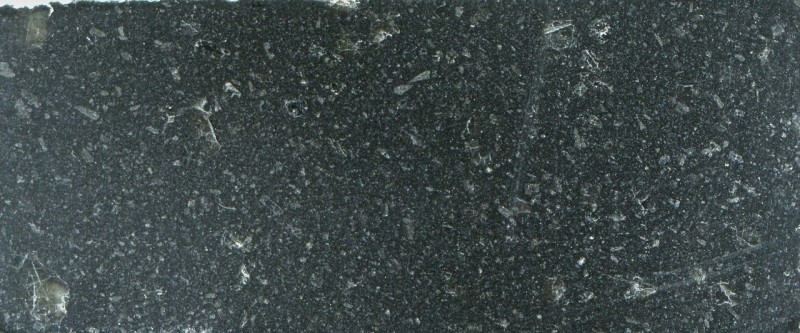
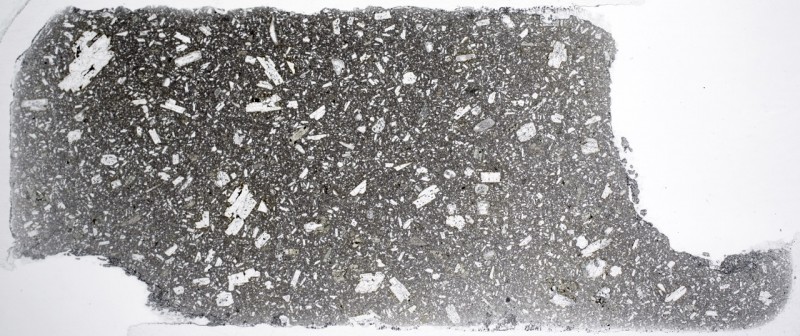
The lack of mesostasis and the profusion of plagioclase phenocrysts signals the rock is not from the Acklington dyke.
Location 4. Hosedon Burn Valley

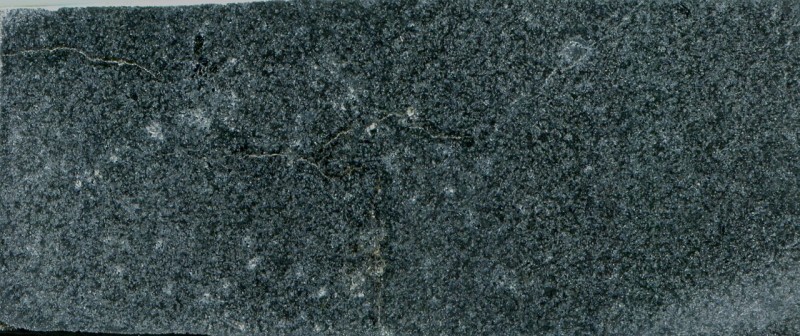
Viewed in reflected light.
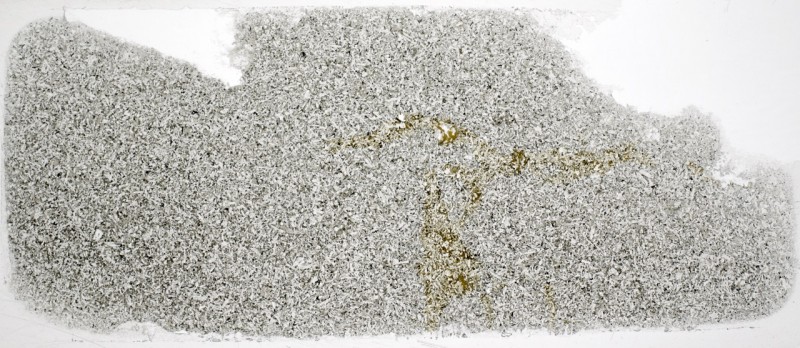
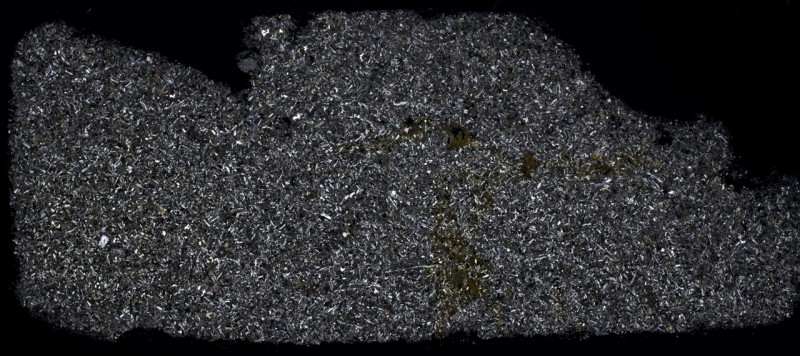
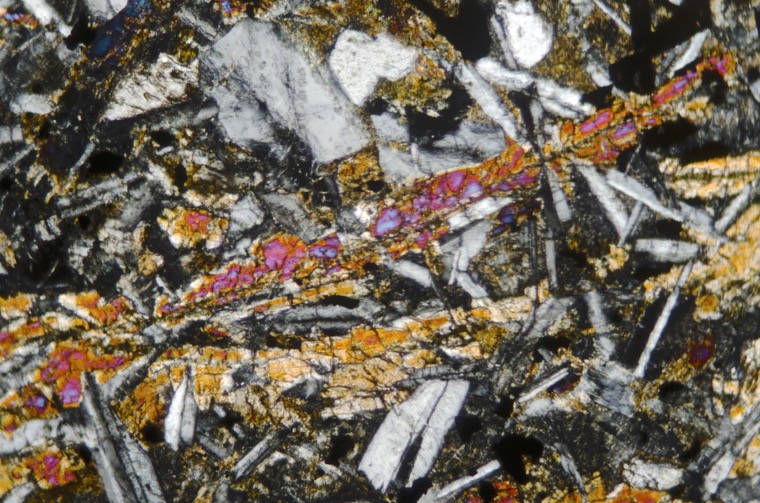
The Acklington dyke basalt in the valley of the Hosedon Burn shows evidence of alteration, calcium compounds replacing some of the pyroxenes and mesostasis.
Plagioclase appears in a range of crystal forms from slender laths to small, zoned plates.
Pyroxene appears in granular patches, twinned columns that are becoming granulised, and also granular ‘strings’.
Patches of clear glass remain in the iron-stained and calcified mesostasis and iron-titanium opaque oxides are plentiful but relatively small.
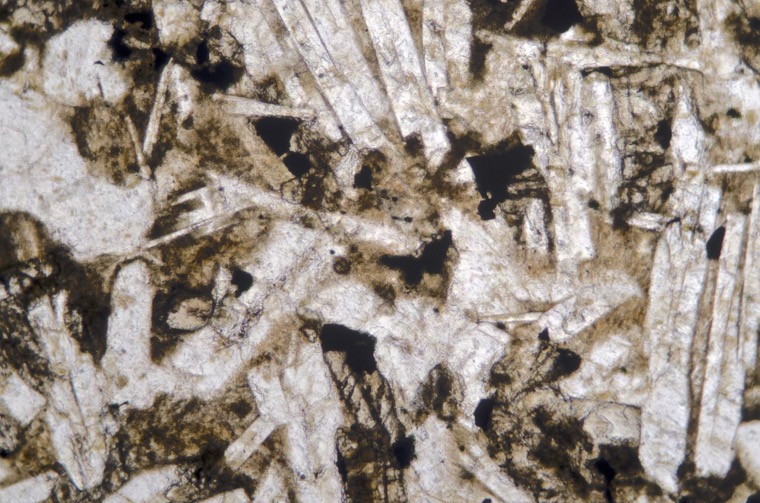
Sample viewed in plane polarised light (FoV 1.2 x 0.8 mm)
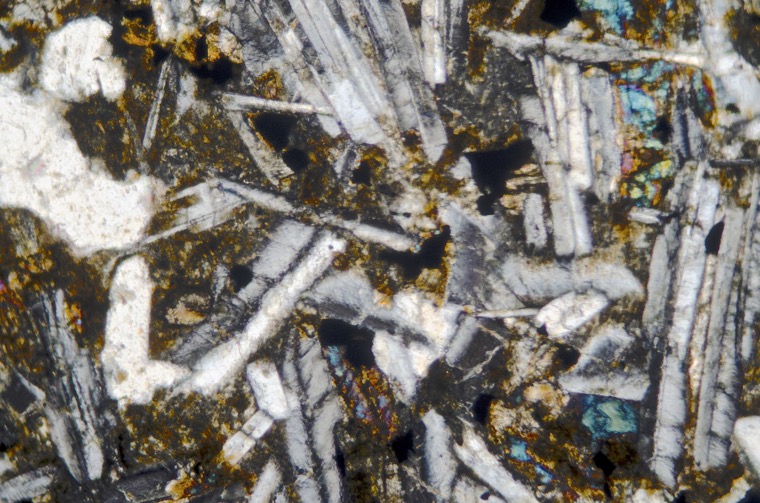
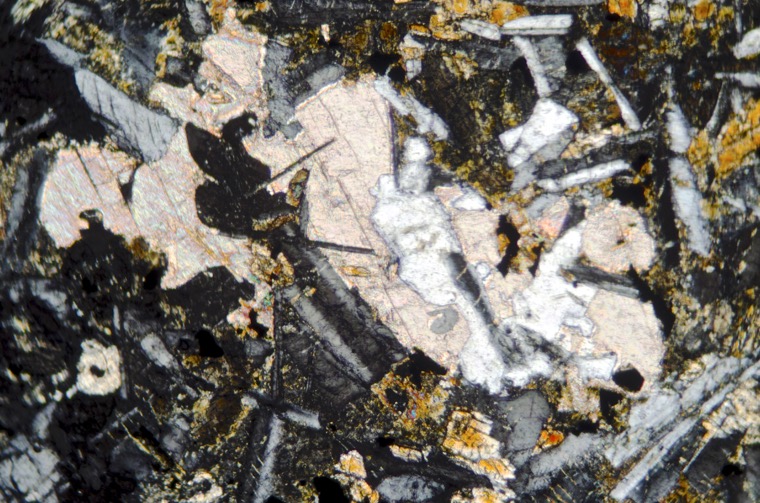
Sample viewed with crossed polarising filters (FoV 1.2 x 0.8 mm)
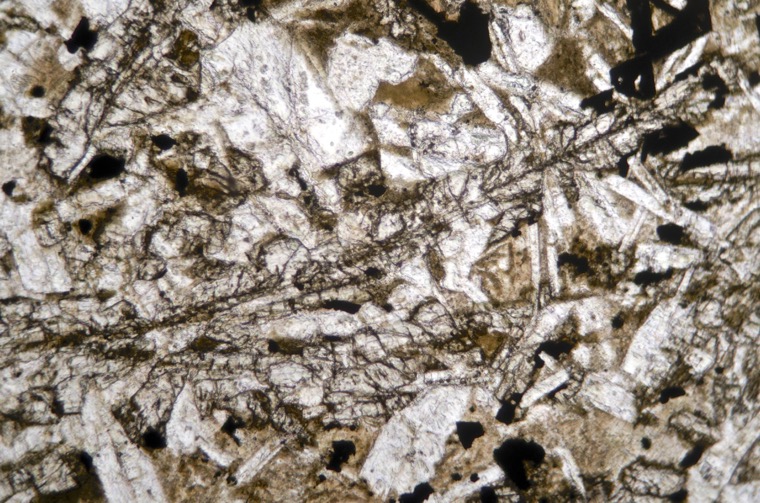
Sample viewed in plane polarised light (FoV 1.2 x 0.8 mm)
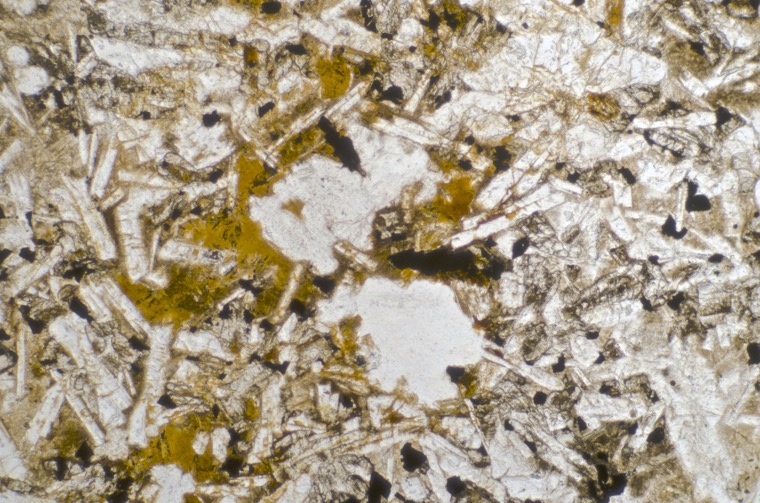
Sample viewed in plane polarised light at (FoV 1.2 x 0.8 mm)
Location 5. River Coquet at Bygate

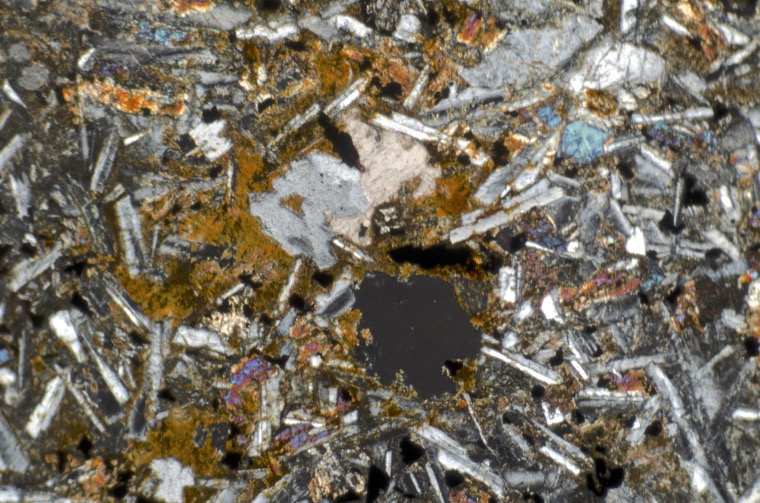
The tholeiite basalt is less altered here than in any of the other exposures or remains of the dyke in Northumberland.
The pyroxenes are, as always, fewer in numbers than the felspars. They appear both in granular and columnar forms.
The randomly orientated plagioclase laths and the very occasional plagioclase phenocrysts are particularly well defined against abrown mesostasis that is remarkably free of carbonatisation.
The iron-titanium oxides are also very distinct, appearing in larger plate and skeletal forms as well as in fine, linear forms that are crossed all along their length by shortlinear crystals.
At an even finer scale, the mesostasis is ‘etched’ by a profusion of lighter coloured linear forms. We haven’t seen this texture in any of our other samples from the dyke.
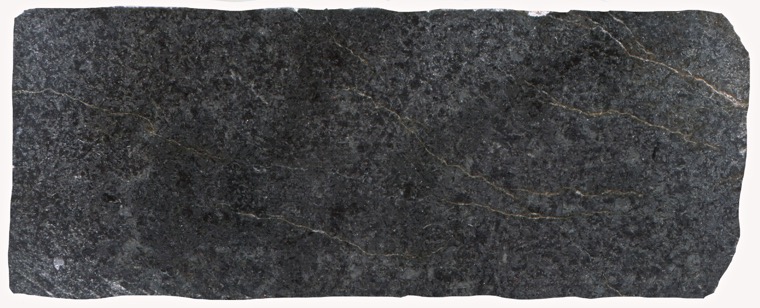
Specimen viewed in reflected light
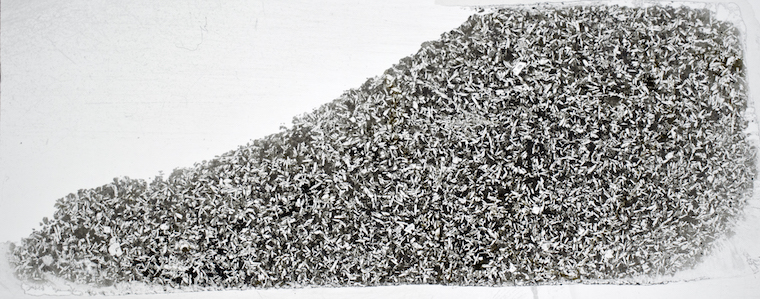
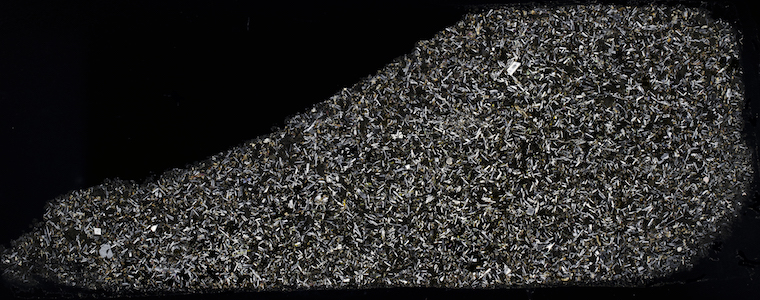
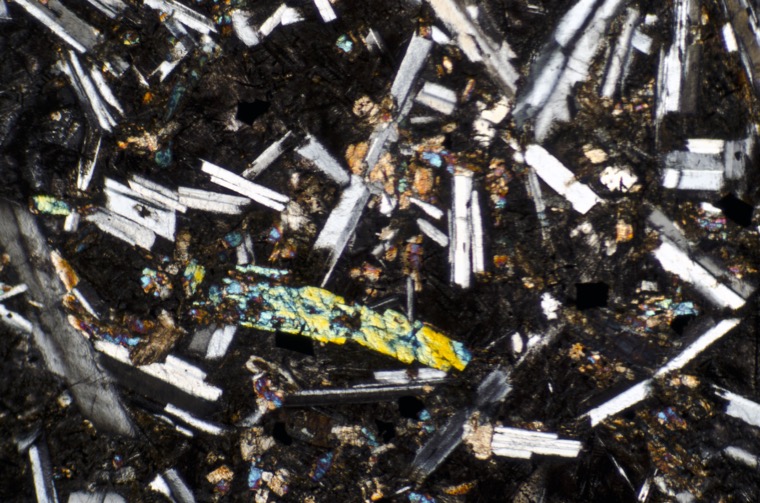
Thin section viewed with crossed polarising filters (FoV 2.3 x 1.5 mm)
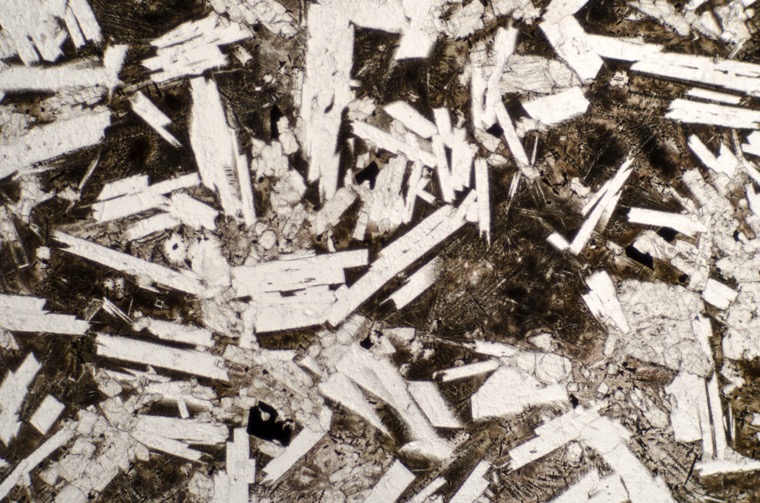
Sample viewed in plane polarised light at (FoV 2.3 x 1.5 mm)
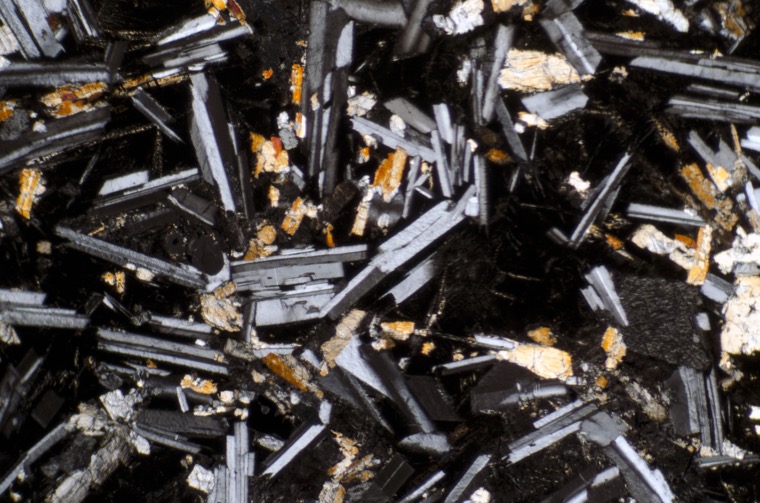
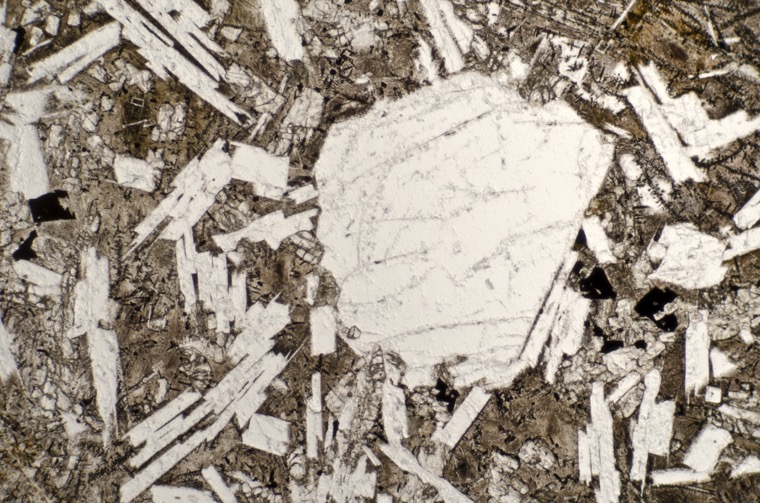
Sample viewed in plane polarised light at (FoV 2.3 x 1.5 mm)
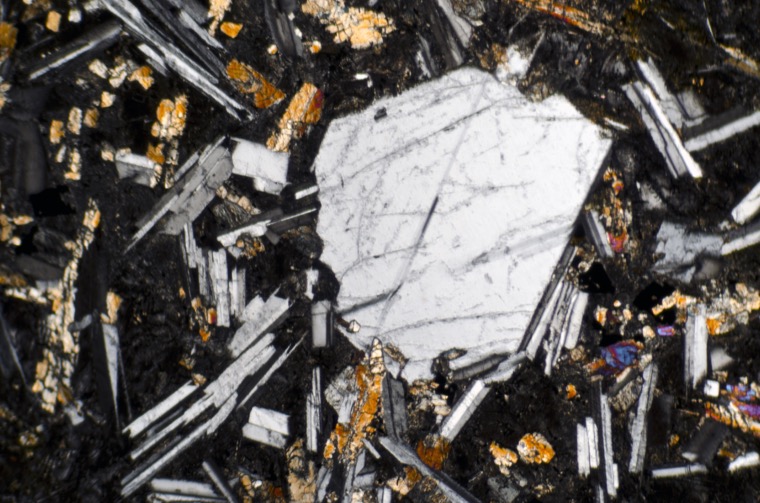
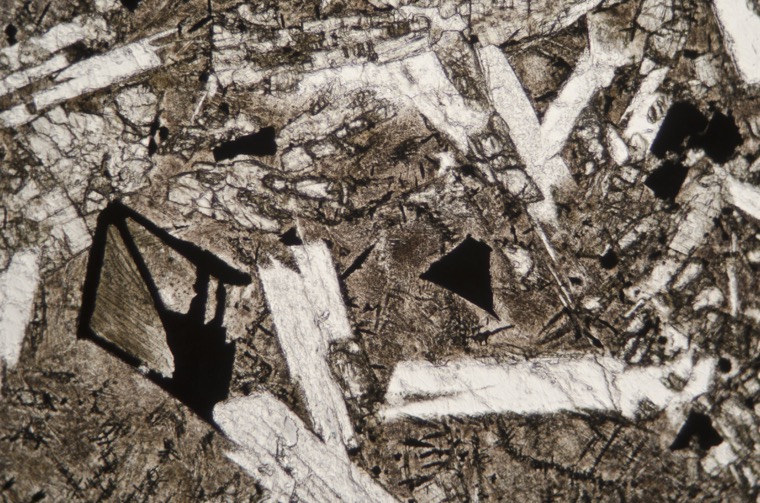
Sample viewed in plane polarised light (FoV 2.3 x 1.5 mm)
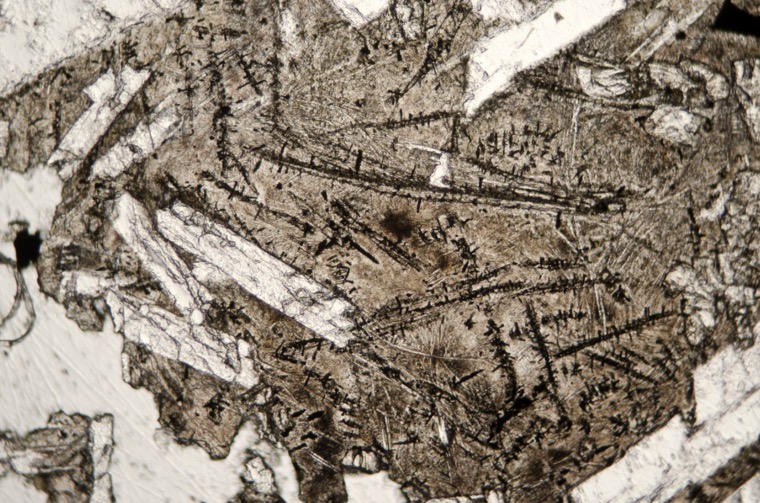
Sample viewed in plane polarised light (FoV 2.3 x 1.5 mm)
References
Lebour, G A, 1878. Outlines Of The Geology Of Northumberland. M & M N W Lambert, Newcastle upon Tyne.
Teall, J J H. 1884. Peteological Notes On Some North-Of-England Dykes. The Quarterly Journal Of The Geological Society Of London, Vol. 40. Pp. 209-247.
Holmes, A and Harwood, H F. 1929. The Tholeiite Dikes Of The North Of England. The Mineralogical Magazine and Journal Of The Mineralogical Society, No. 124. Vol 22.
British Geological Society