
Map showing the excursion route, locations and igneous rock types


This excursion down the Breamish Valley can be extended to include visits to Coldlaw Cairn, Shielcleugh Edge and High Cantle. On this stage we are interested in locating some of the many dykes in the valley as well as investigating the pluton-lava boundary.
The dykes have been associated with the intrusions of the Cheviot pluton and the Biddlestone laccolith and are currently classified into four types:
– felsite,
– porphyry (recorded on some survey maps as mica-porphyry on account of the biotite that appears in the rock),
– quartz-porphyry (on account of its quartz phenocrysts),
– andesite (recorded on some survey maps as pyroxene-porphyry on account of the pyroxene in the rock).
With the kind permission of Mr. and Mrs Nelson who farm much of the land that we will be walking over, we aim to locate examples of each of the four types today. The BGS maps show porphyry and quartz-porphyry dykes down-river of their farm at Low Bleakhope, andesite dykes upstream of High Bleakhope and also at the mouth of the Ainsey Burn and a felsite dyke a short distance up the same burn.
The excursion begins with the 5 kilometre walk from the car parking space at Hartside, along the private road past Alnhammoor and up the Breamish valley to Low Bleakhope farm. It’s quite a hike but there’s plenty to see out here on a fine day.
Location 1. The Breamish valley near Low Bleakhope

Granite and a quartz-porphyry dyke
We begin our investigation along the 1 kilometre stretch of river below Low Bleakhope between locations NT940160 and NT934154. We sample an outcrop by the river at NT940160 close to where the road swings down to run alongside it. It proves to be a surprise. We would have expected to find the mafic ‘Marginal’ type here but this is a sub-equigranular, quartz-rich rock, with a little biotite and it’s replacements – similar to that on top of Cheviot and at the pluton- lava boundary in the Hawsen Burn.
Following the burn upstream, we find more of the same rock mixed and mingled with a much more mafic, dark-grey rock. We would have thought these were two quite different rock types, but we find that both red and grey material are very similar structurally.
The most mafic of the three examples shown below bears some resemblance to the dioritic marginal quartz-monzonites we see at the western and northern perimeter of the pluton, but it has a more even grain-size and is less mafic.
Specimens 1, 2 and 3

Prepared specimen in ordinary reflected light (45mm across)
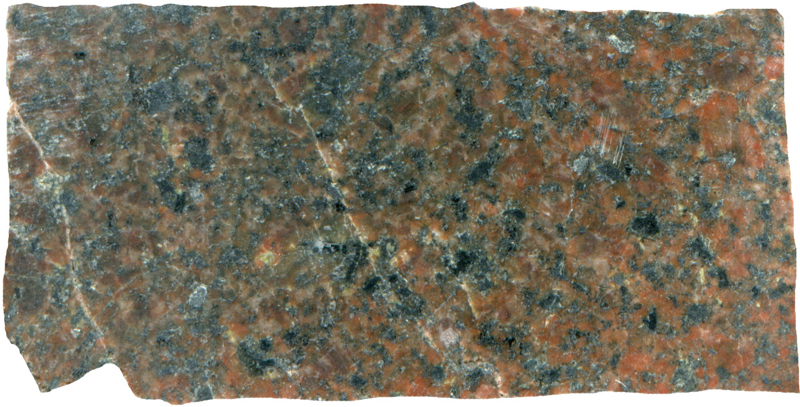
Prepared specimen in ordinary reflected light (39mm across)
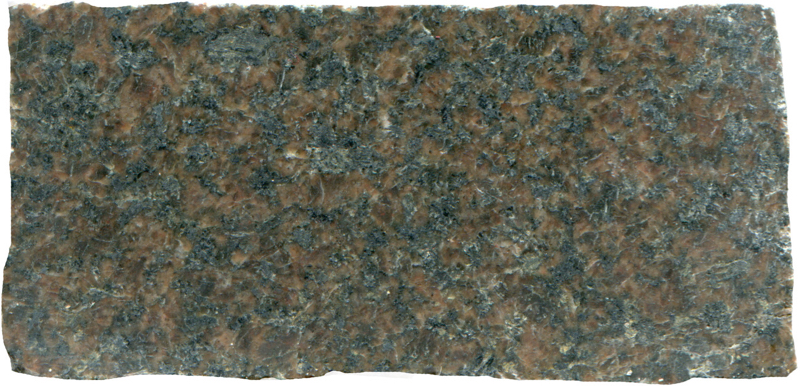
Prepared specimen in ordinary reflected light (38mm across)
In the same hundred metre stretch, we also find the dyke marked as a mica porphyry on BGS maps. However, the presence of quartz phenocrysts in the iron-stained, devitrified quartz-orthoclase groundmass, leads us to think it is a quartz-porphyry dyke
Specimen 4

Prepared specimen in ordinary reflected light (44mm across)

(37mm across)

More granite and another dyke

We walk upstream to a second occurrence of a version of the sub-equigranular rock that is as felsic as the first we saw and then there is another outcrop of porphyritic dyke material at the location where the Geological Survey shows a second mica-porphyry dyke crossing the river.
Mica-porphyry is described as being very similar to quartz-porphyry but lacking in quartz phenocrysts but with the possibility of quartz in the groundmass.
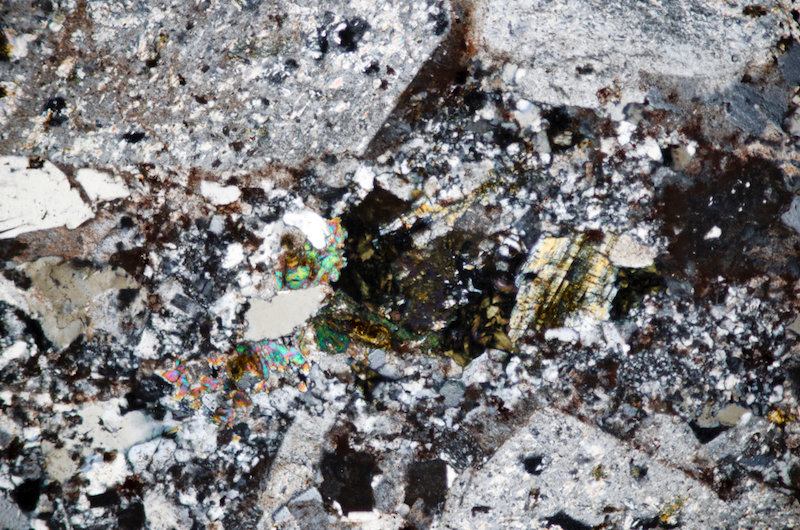
Our sample reveals a relatively coarse groundmass with areas of granophyric texture that commonly fringe the numerous phenocrysts of sericitised plagioclase. Unsurprisingly, in its unaltered state, this rock would have been abundant in biotite but most of the mica phenocrysts have been altered to chlorite and opaque iron-titanium oxides. Surprisingly, we also see a few anhedral quartz phenocrysts in this rock too, so should we classify this as another quartz-porphyry dyke?
We also see small amounts of what is most likely pyroxene.
Specimen 5
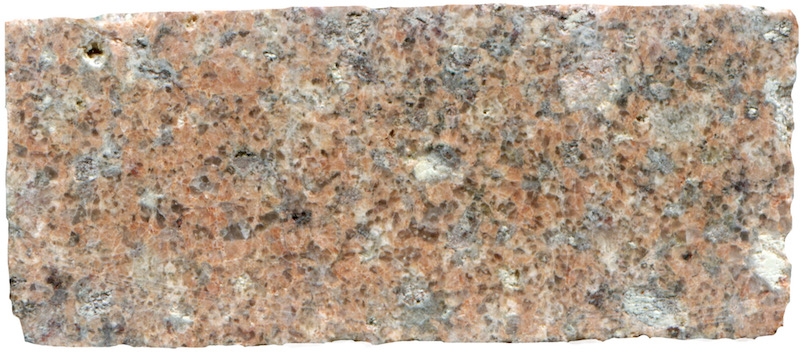
Prepared specimen in ordinary reflected light (45mm across)
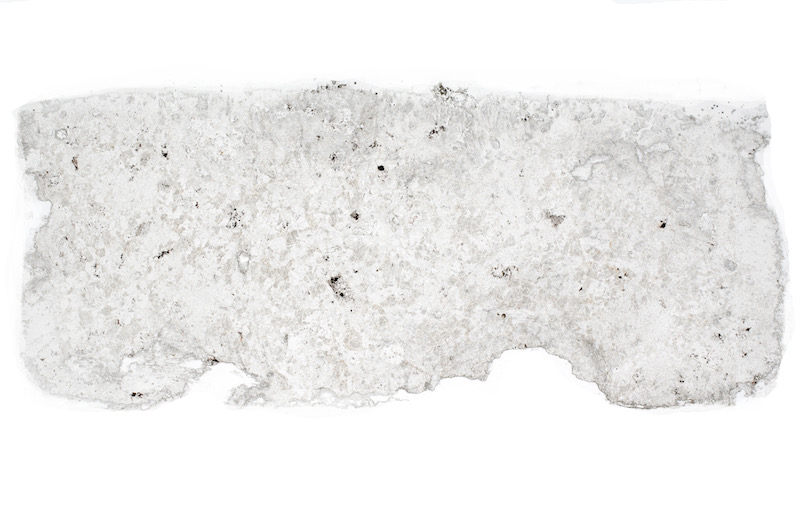


Section viewed in plane polarised light (FoV 4.6 x 3.0 mm)
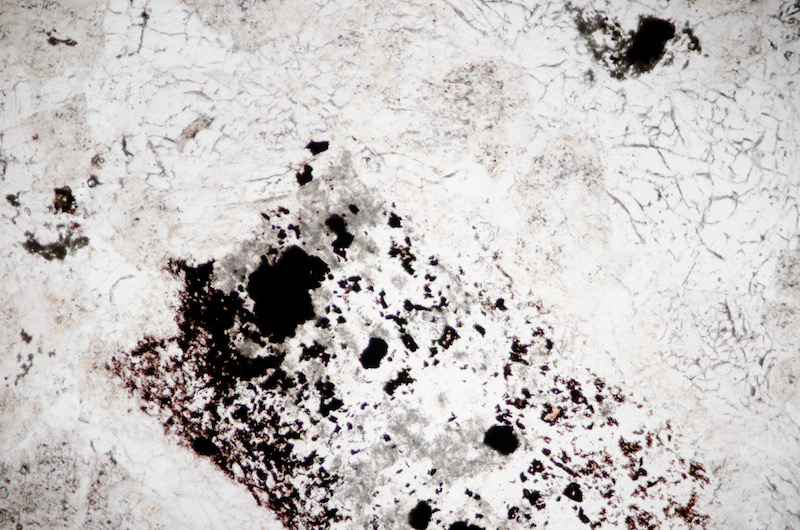
Section viewed in plane polarised light (FoV 2.3 x 1.5 mm)
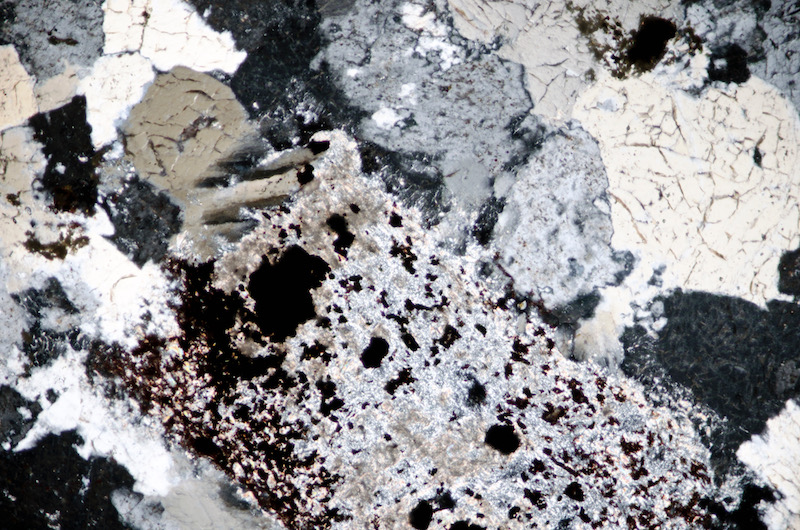
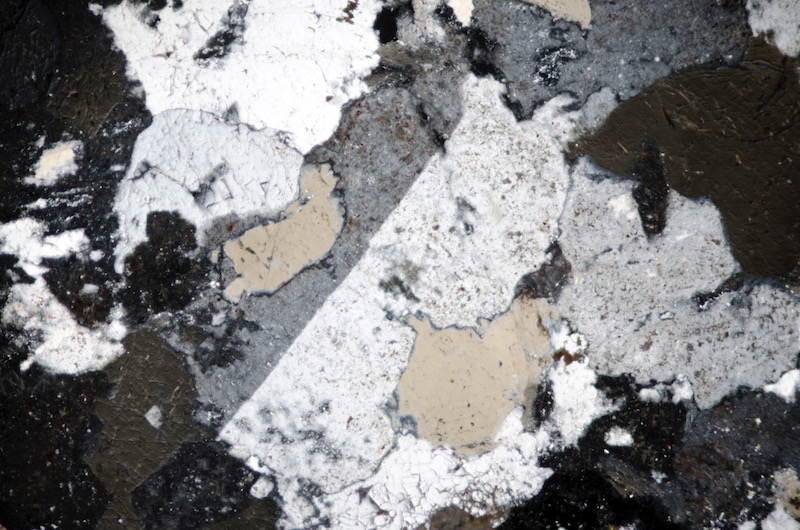
Section viewed with crossed polarising filters (FoV 2.3 x 1.5 mm)
Specimen 6
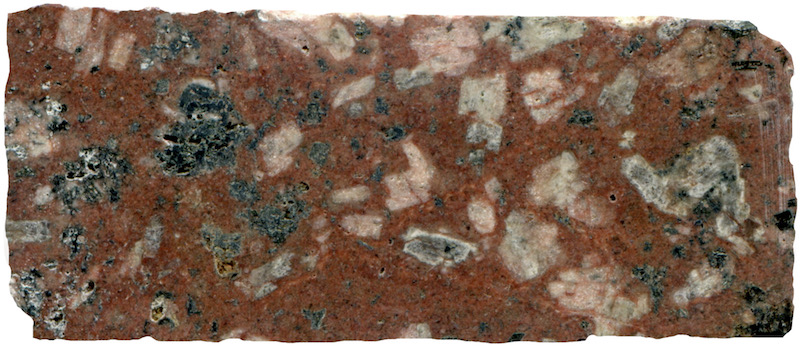
Prepared specimen in ordinary reflected light (45mm across)
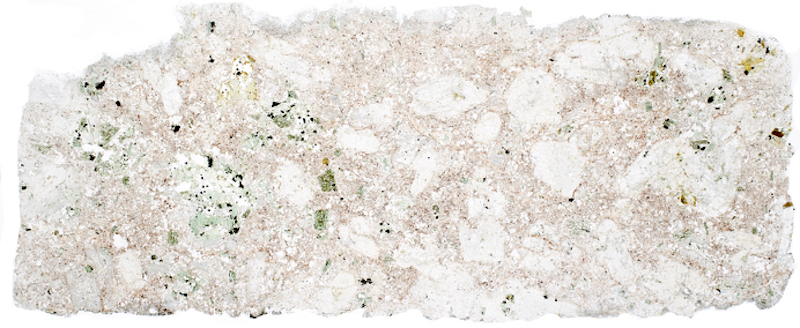
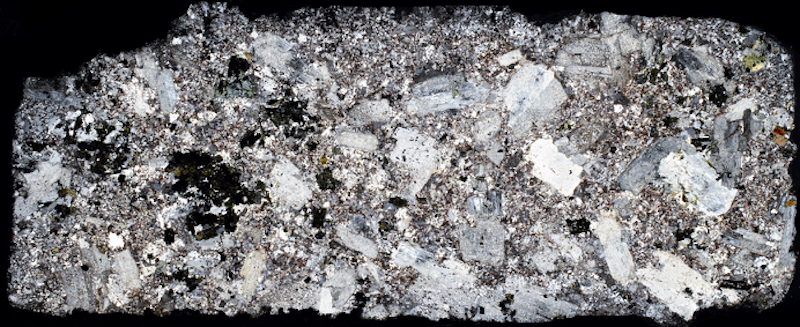
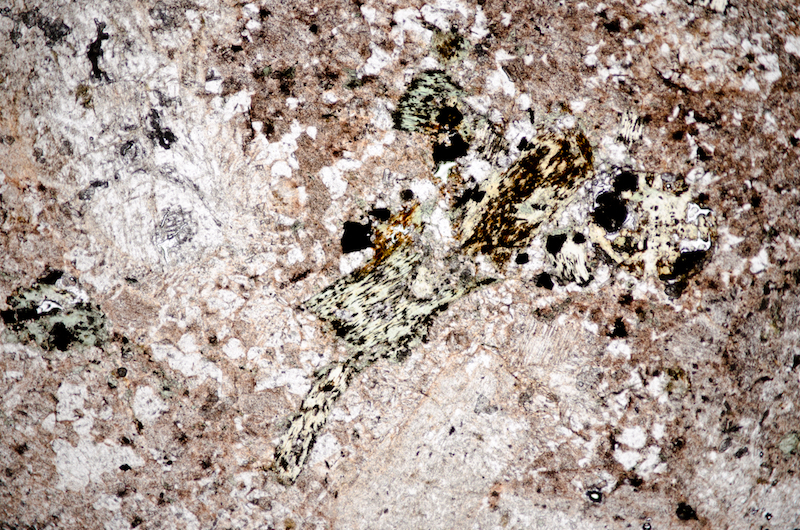
Section viewed in plane polarised light (FoV 4.6 x 3.0 mm)
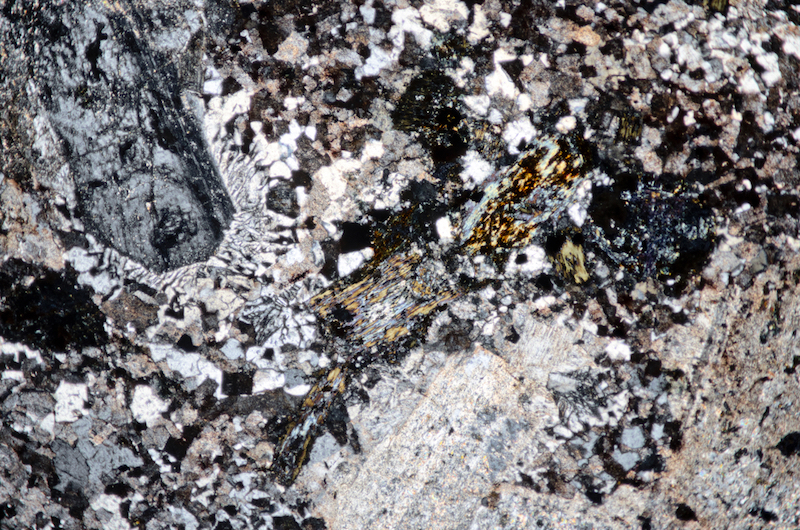

Section viewed in plane polarised light (FoV 2.3 x 1.5 mm)
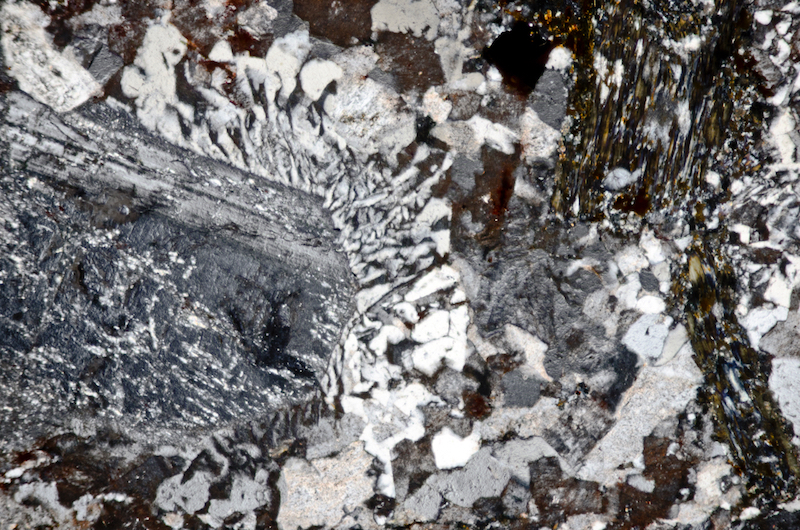

Section viewed with crossed polarising filters (FoV 2.3 x 1.5 mm)

Section viewed in plane polarised light (FoV 2.3 x 1.5 mm)

Red and dark grey mingled rock
All along the river here between the two dykes marked on BGS maps as mica-porphyry and quartz-porphyry, the pink-to-red rock mingles and merges with the dark grey rock.
Thin sections reveal that, in this section of the river bed, the dark grey rock is always the much finer-grained and mafic-mineral rich of the two. It always appears to be a later, quite fluid intrusion into the red rock so that crystals of the latter have become embedded in the former. A sample from the east end of the sampled stretch shows that the red rock here is granitic. Quartz crystals appear in the mass of the red rock and also as xenocrysts in the black rock, presumably torn from the host, red rock. This black rock is an extremely fine-grained mix of what looks like feldspar, opaque oxides and formerly mafic minerals now altered to chlorite.
Further west, closer to buildings at Low Bleakhope, quartz is absent in both the red rock and the black rock. The red rock here is haematite-rich andesite that has been extensively carbonatised and the black rock, for the most part andesitic, has been extensively chloritised or carbonatised, or both. Many tiny, clear granules of clinopyroxene are scattered through the dark rock as well as occasional yellow to brown granular clusters that are associated with opaque material.

The samples are arranged from east (left) to west (right).
Herbert Kynaston had quite a lot to say about these rocks. In ‘Notes on Contact Metamorphism round the Cheviot Granite’ he described them as,
‘… peculiar banded rocks, which are well exposed in the River Breamish, a few hundred yards below Low Bleakhope. The exact nature and relations of these rocks are very difficult to make out. They have a banded and streaky appearance, pink and dark greyish bands alternating with one another. Under the microscope the rocks show the effects of very decided contact alteration; but it is difficult to say what was the true nature of the original unaltered rock, the exposure having doubtless undergone considerable decomposition from surface agencies. The rocks must have varied a good deal in composition originally, and may possibly represent altered tuffs.
One slide ….has an extremely confused and streaky appearance under the microscope, being in some places fairly clear; sometimes greenish from the predominance of numerous small flakes of a chloritic mineral; probably altered biotite; and sometimes of a dense reddish brown colour from the predominance of turbid felspar.
Throughout the whole slide are scattered numerous grains of the characteristic secondary pyroxene, biotite and chlorite flakes, and magnetite granules. Small veins occur filled up with a granular aggregate of secondary augite, probably representing veins of calcite. The clear bands in the slide consist of a microcrystalline mosaic of quartz and felspar, scattered throughout which are numerous granules of secondary pyroxene and magnetite. Occasionally the felspar and quartz have the appearance of being inter-grown, after the manner of micro pegmatite, the turbid felspar being traversed in different directions by narrow bars and canals of quartz, and the quartz is also included in the felspar as simple grains.
Another slide, which was prepared from a strongly banded rock, shows the same structure on a far more extensive scale. The slide consists partly of a fairly coarse granular aggregate of felspar, intersected here and there by a curious network of quartz, and including grains and irregular patches of quartz, and partly also of a microcrystalline mosaic of quartz and felspar. A few corroded phenocrysts of plagioclase also occur.
The grains of secondary pyroxene are more numerous and larger than in any of the other rocks examined. They are unevenly distributed, being frequently dispersed in irregular bands or concentrated into compact groups. Flakes of biotite and grains of secondary sphene are also occasionally present.’
Kynaston’s detailed description and interesting speculations are clearly of their age and our current understanding of mineral formation would not allow for secondary pyroxene appearing here as a metamorphic product of calcite – perhaps he was observing the mineral that we are identifying as epidote. However, we would agree with him that, ‘these rocks are decidedly of interest; but it would be unsafe to pronounce any decided opinion upon their exact nature before a more thorough investigation of their relationships can be made.’
We find ourselves wishing for the resources to explore the these rocks in more depth.
Carbonatised andesite (or is it tuff?)
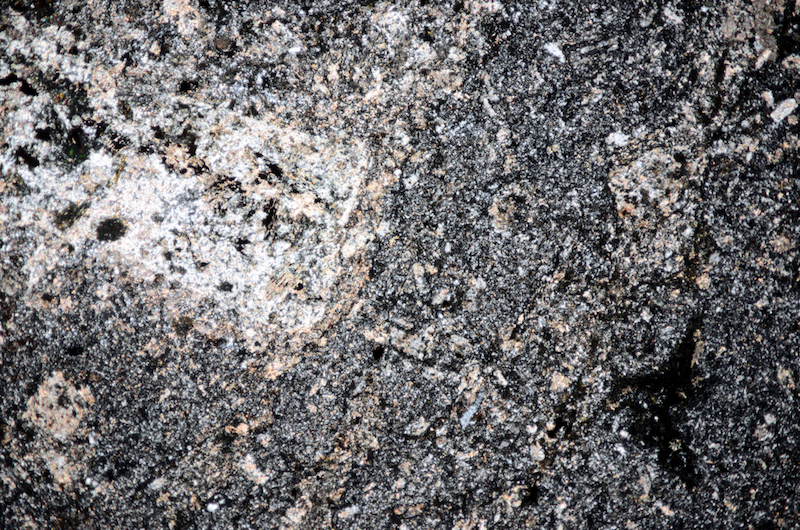
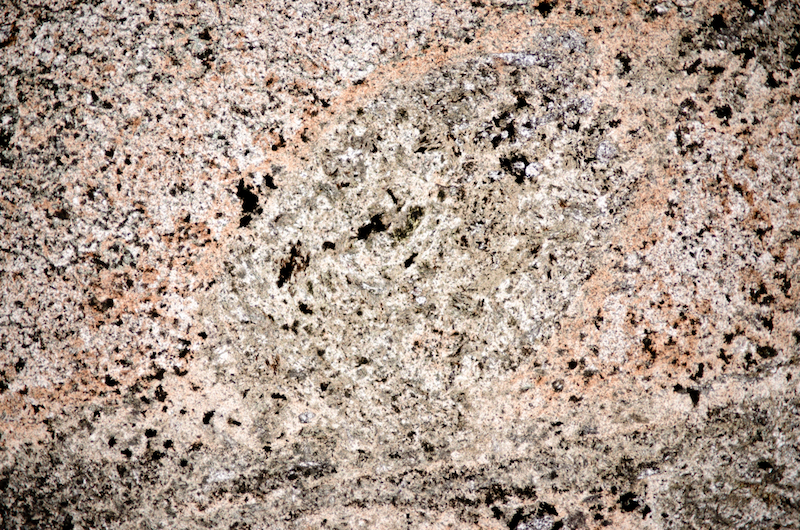
This is a highly carbonatised rock that looks like andesite but has some characteristics that sow seeds of doubt. In our specimen, the rock appears to be layered but, given our sample is so small, we can’t say if this is actually the case . There are patches in the sample that look differentially altered suggesting they are pseudomorphs of phenocrysts or altered microliths. The area of quartz in the sample doesn’t look like it was introduced by a silica vein, it looks more likely to have originated in a lithic fragment which, along with the patchiness and suggestion of layering, would support Kynaston’s idea that at least some of these rocks may have had their origins in tuffaceous material. A couple of veins run along fractures in the rock. These look like they could have been of the same mafic material that veins other rocks in the vicinity but the extreme alteration makes it impossible for us to be sure. A few crystals of clinopyroxene have survived.
Specimen 7

Prepared specimen in ordinary reflected light (45mm across)
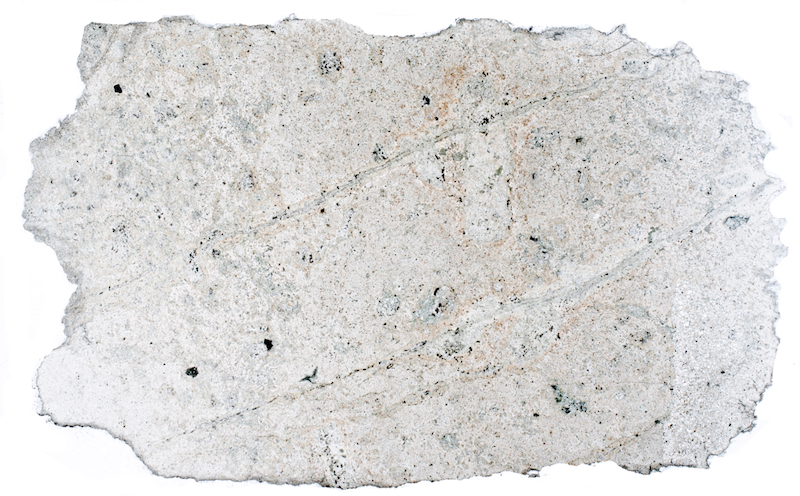

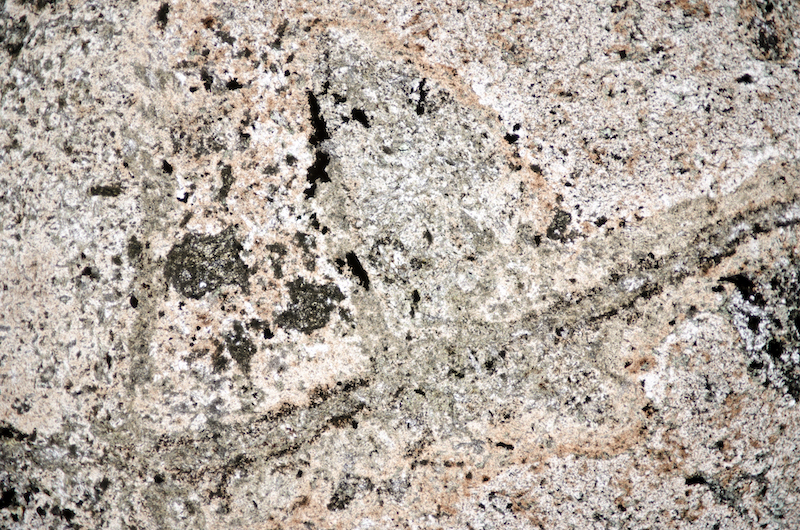
Section viewed in plane polarised light (FoV 4.6 x 3.0 mm)
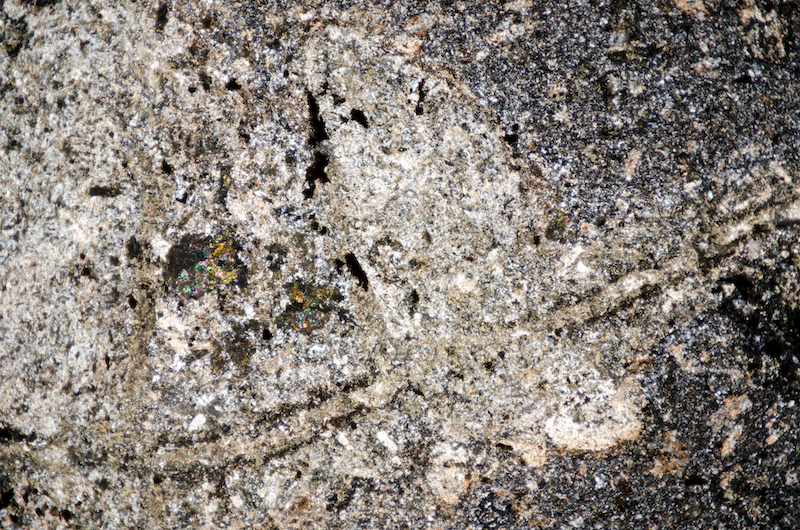
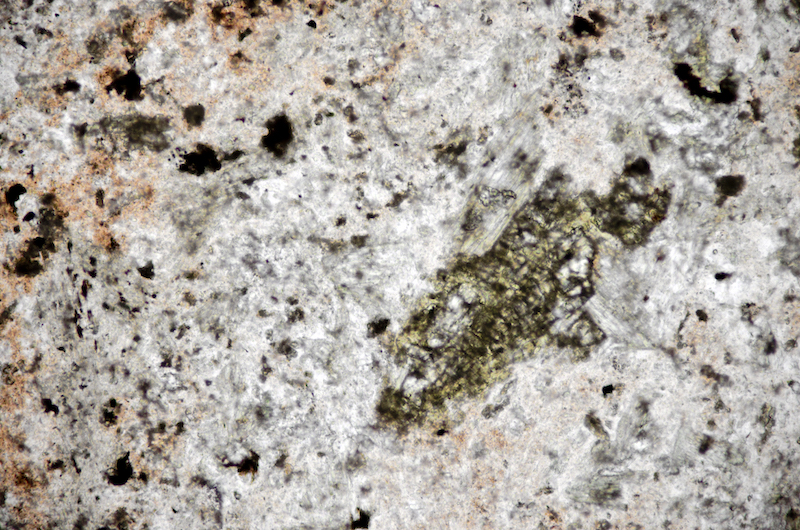
Section viewed in plane polarised light (FoV 1.2 x 0.8 mm)

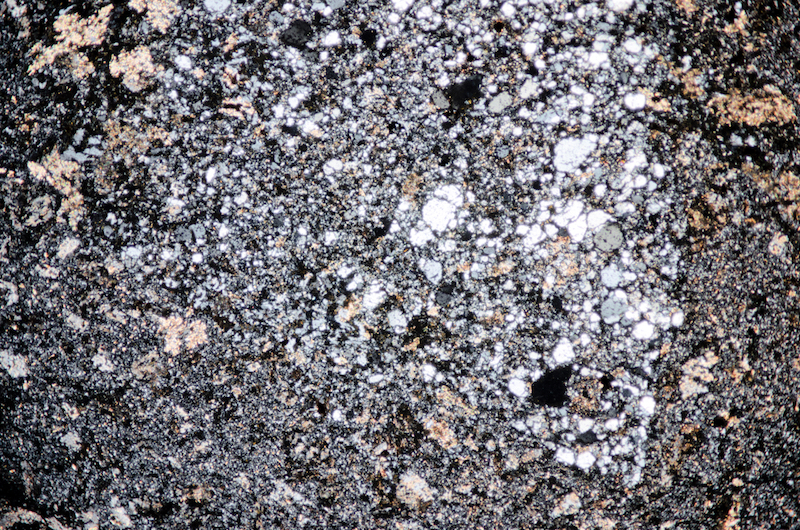
Section viewed with crossed polarising filters (FoV 4.6 x 3.0 mm)
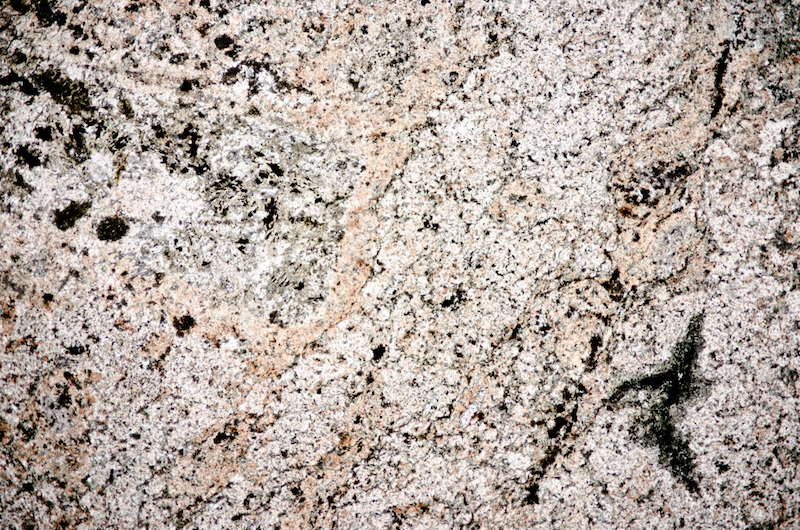
Section viewed in plane polarised light (FoV 1.2 x 0.8 mm)
Section viewed with crossed polarising filters (FoV 4.6 x 3.0 mm)
Vein of granitic rock in andesite
Veins of haematite-rich silica are common in Cheviot andesite but this sample is surprising because the thin red vein is a haematite-stained, evolved granitic rock containing almost as much potassium feldspar as quartz. This granitic rock contains rods of opaque oxide material that reminds us of similarly formed opaques found in the evolved granite at Woolhope Crag. The rock also contains epidote.
The epidote also appears in veinlets that run through the andesite which has been extensively carbonatised – revealing again an association between high-calcium levels in a rock and the presence of epidote.
Even though the vein is thin, its rock has a medium, even grain and shows no sign of chilling at the edges. This suggests that when the vein formed, the host rock was at a high temperature – presumably due the proximity of the hot pluton. Perhaps we have here a vein of ‘Marginal’ evolved granite, directly connected to the pluton, rather than a quartz and haematite vein of the type associated with the Variscan deformations as seen in the Harthope Valley, or a vein related to the Cheviot dyke swarm (because it is not porphyritic), or a vein of the ‘Marginal’ dioritic material that many geologist since Jhingran have mapped in contact with the andesite in this area.
The altered andesite contains many tiny granules of pyroxene, as Kynaston observed. Oddly, what looks like the the fine-grained andesitic material also appears in places within the granitic vein.
Specimen 8
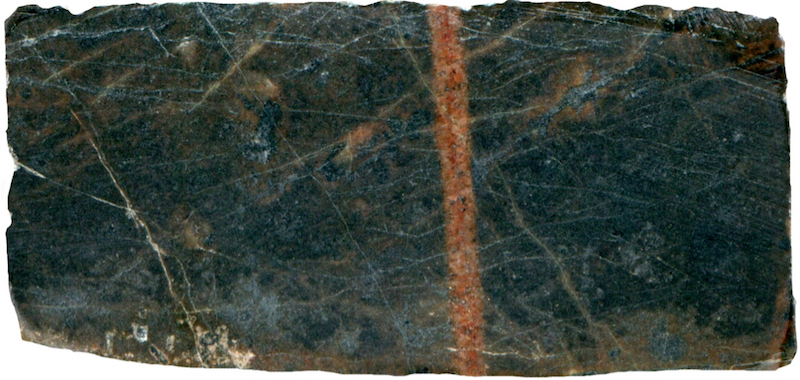
This contains veinlets and patches of epidote. Prepared hand specimen in reflected light (42mm across)

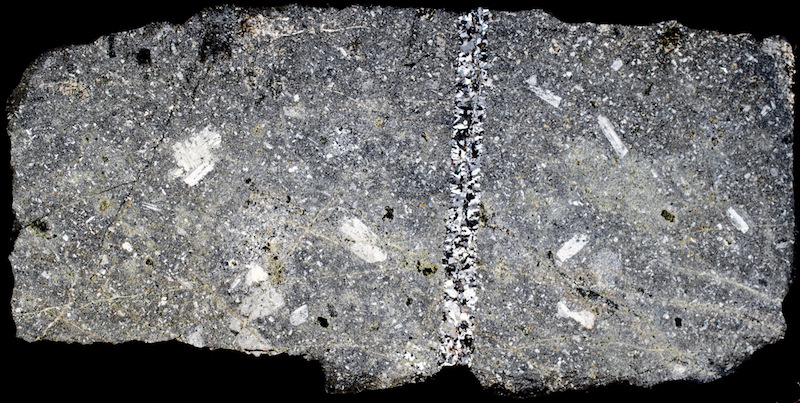
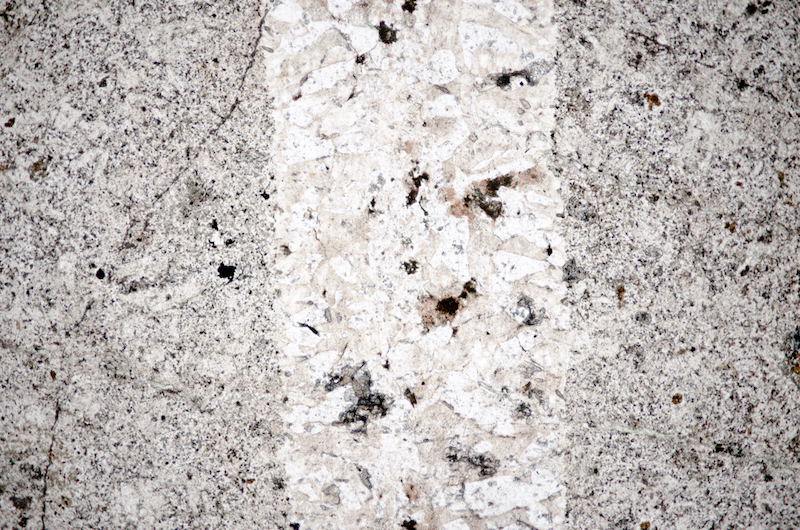
Section viewed in plane polarised light (FoV 4.6 x 3.0 mm)
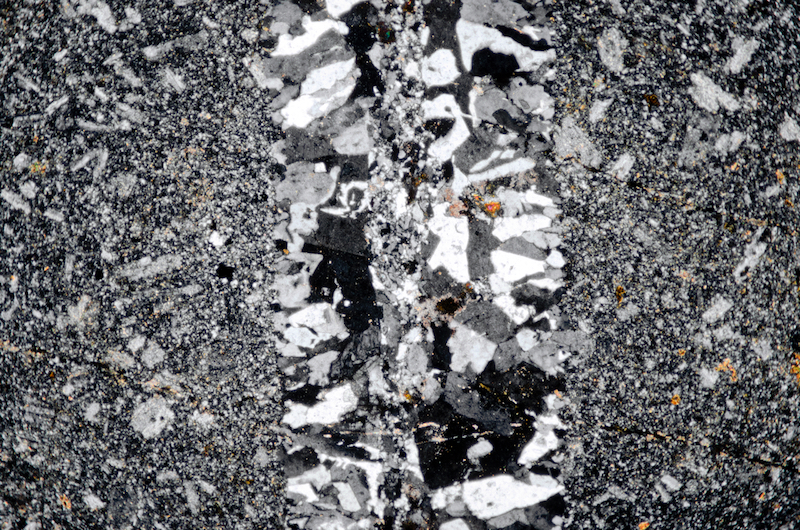
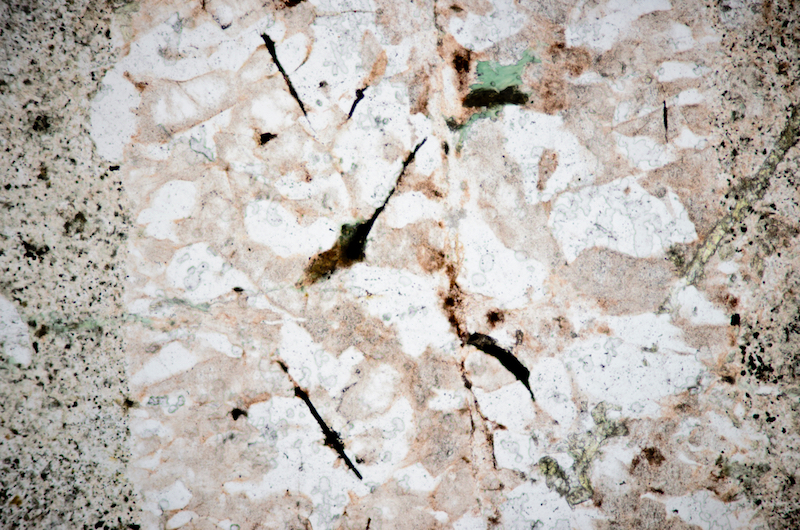
Rods of opaque iron-titanium oxide are seen along with epidote.
Section viewed in plane polarised light (FoV 2.3 x 1.5 mm)
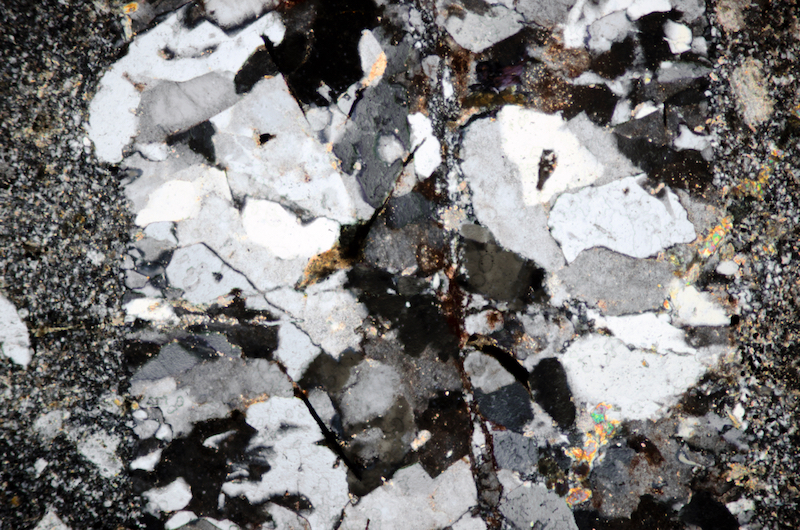
Epidote is see in the bottom right of the granitic vein extending along a narrow veinlet into the altered andesite and oddly, what looks like the fine-grained andesitic material appears in places at the centre of the vein.
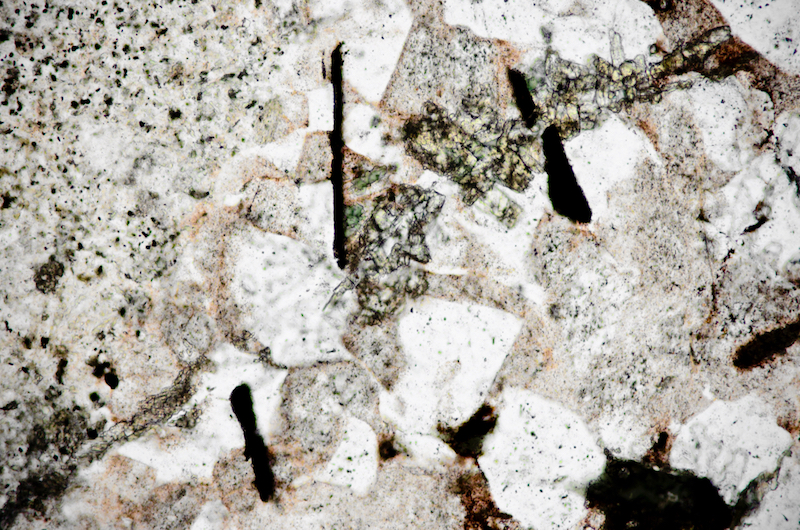
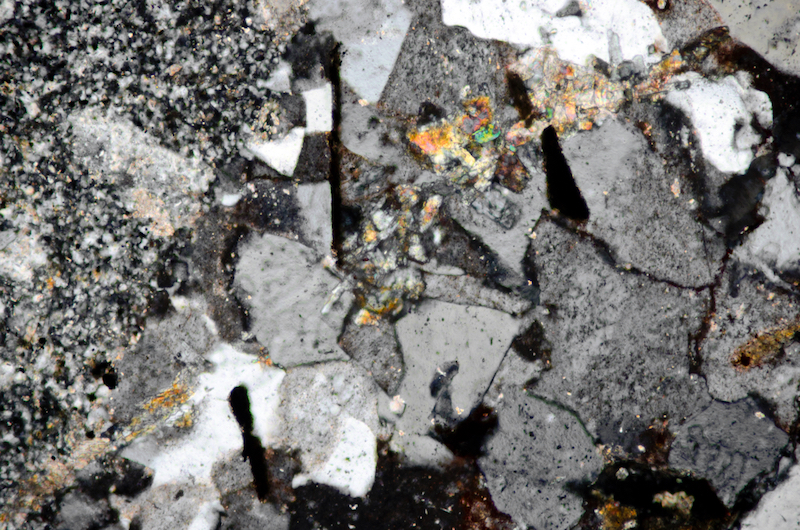

Section viewed in plane polarised light (FoV 1.2 x 0.8 mm)
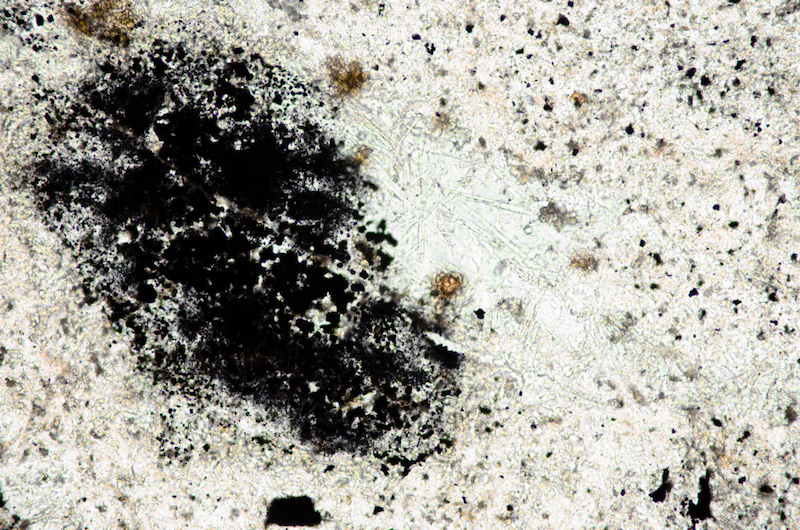
Section viewed in plane polarised light (FoV 1.2 x 0.8 mm)

More intensely altered andesite or tuff
More dark rock that thin sections show to be extremely altered so that carbonates, sericite and chlorite are abundantly present. Here too, it is impossible for us to be sure of the original rock type – most likely andesite but possibly tuff.
Specimen 9
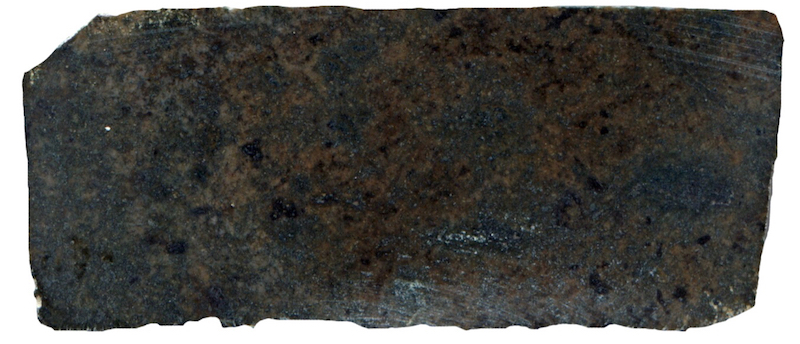
Prepared specimen in ordinary reflected light (44mm across)
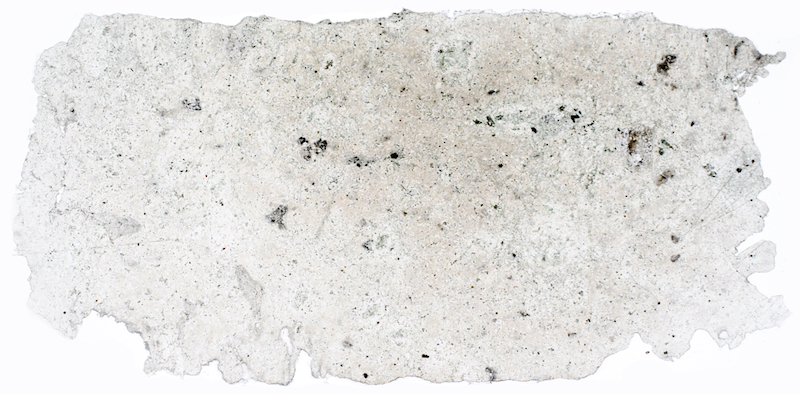

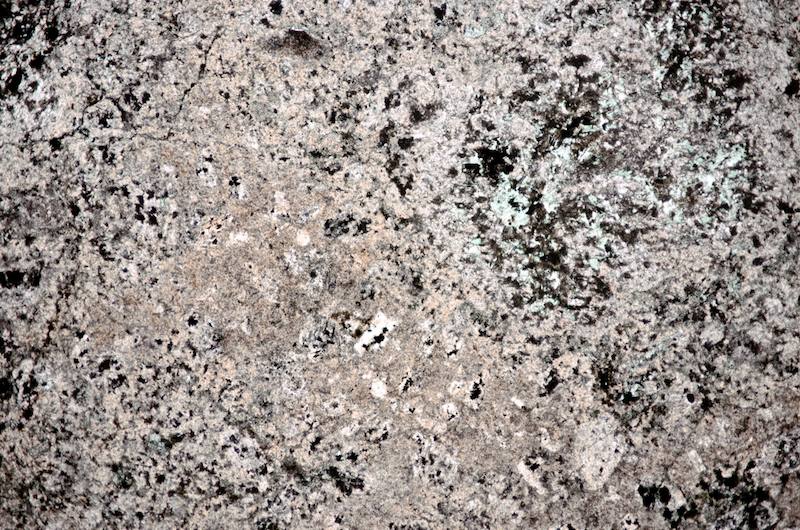
Section viewed in plane polarised light (FoV 4.6 x 3.0 mm)
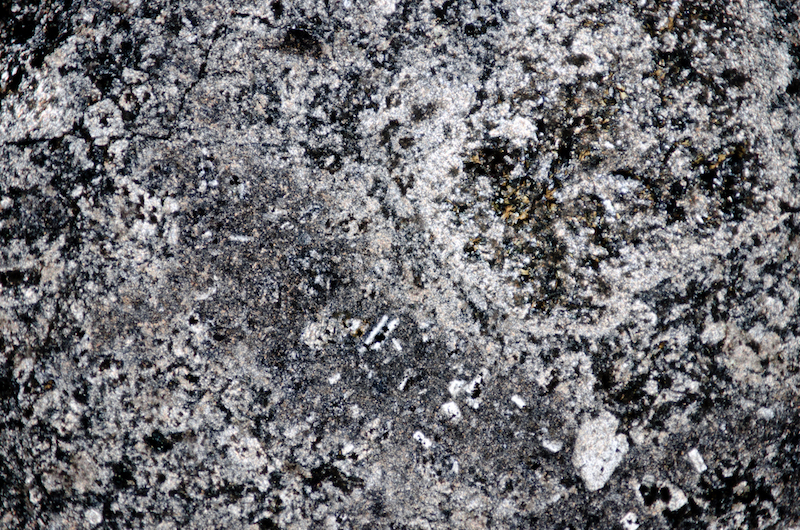
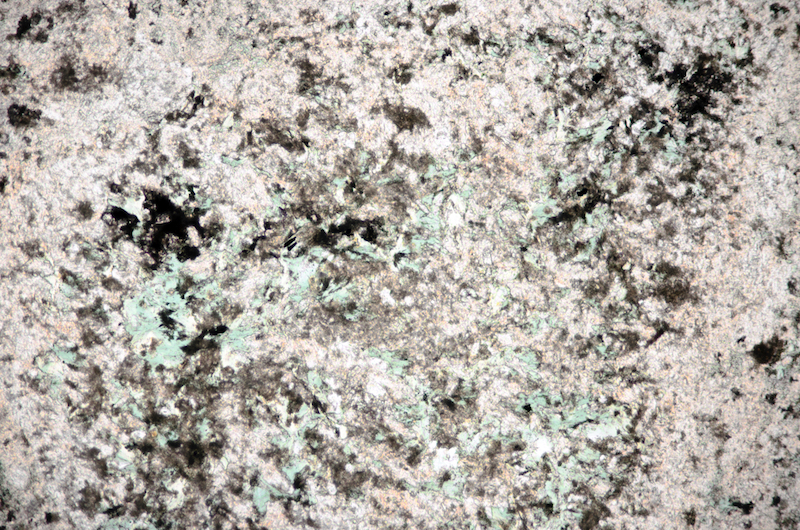
Section viewed in plane polarised light (FoV 2.3 x 1.5 mm)
Intermingled red andesite and black rock
The bright red rock in our next sample is andesite that has been extensively carbonatised so that patches of carbonate minerals appear everywhere and it is heavily stained with haematite. A very fine-grained highly mafic material has been intruded into the andesite which is heavily chloritised. The resulting rock looks quite chaotic under the microscope with only a few of its original minerals escaping alteration. There are remnants of plagioclase phenocrysts in the andesite and, we think, many tiny pyroxene grains with, in places, zircon crystals in the mafic material. We find it impossible to classify this material – perhaps it is andesitic or possibly an extremely fine-grained ‘Marginal’ dioritic rock.
Specimen 10
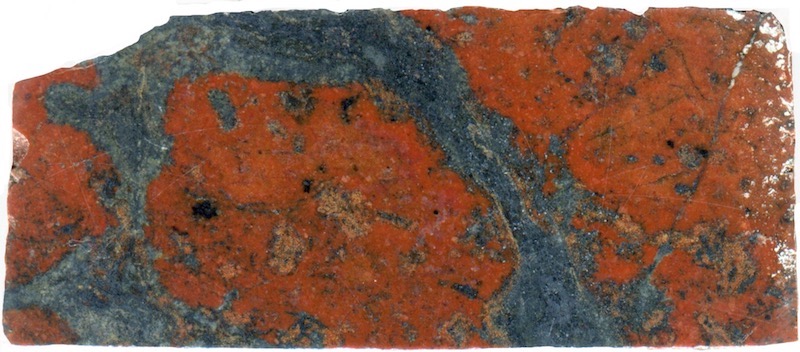
Low Bleakhope (NT935154) Prepared specimen in ordinary reflected light (44mm across)
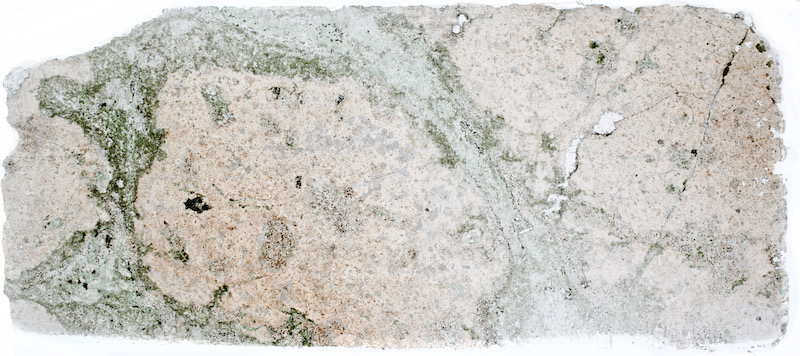
(44mm across)

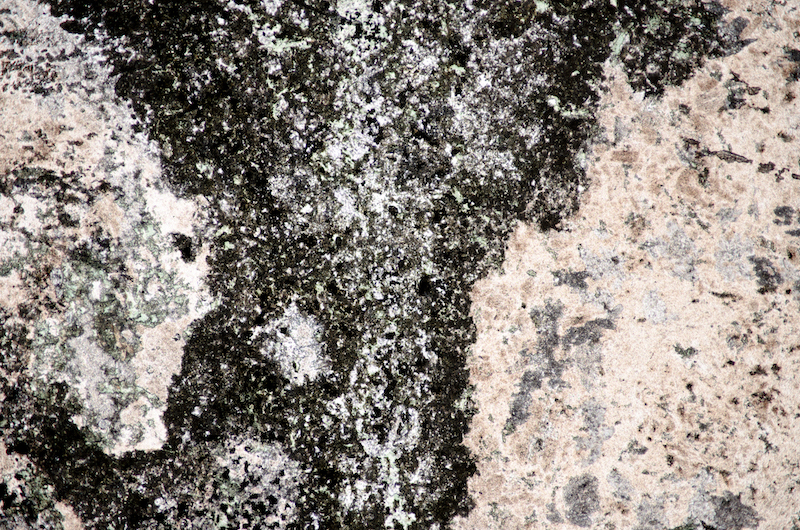
Section viewed in plane polarised light (FoV 4.6 x 3.0 mm)
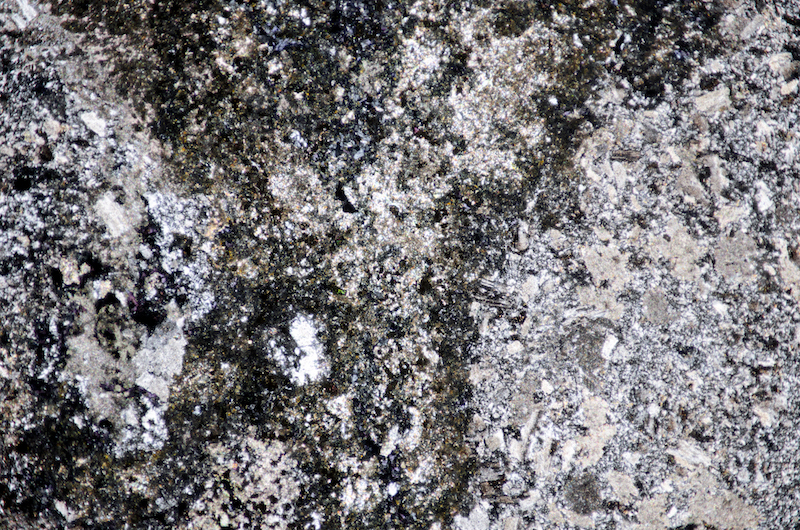
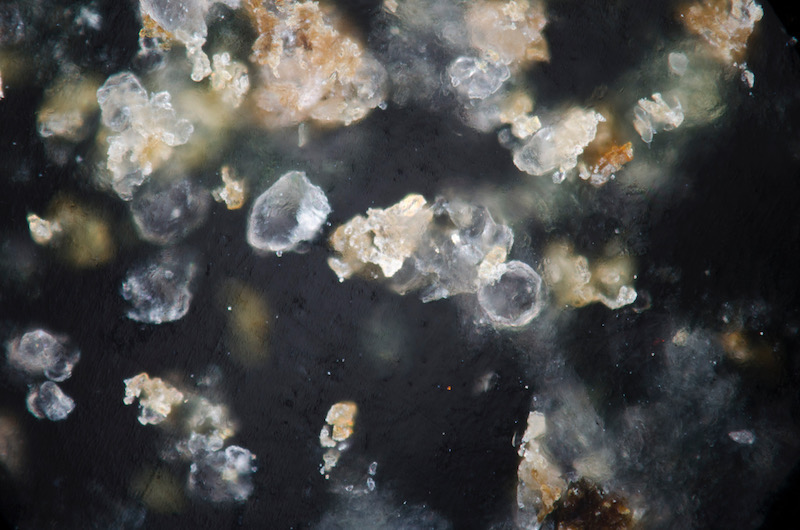
Viewed in reflected light with crossed polarising filters(FoV 0.5 x 0.3 mm)
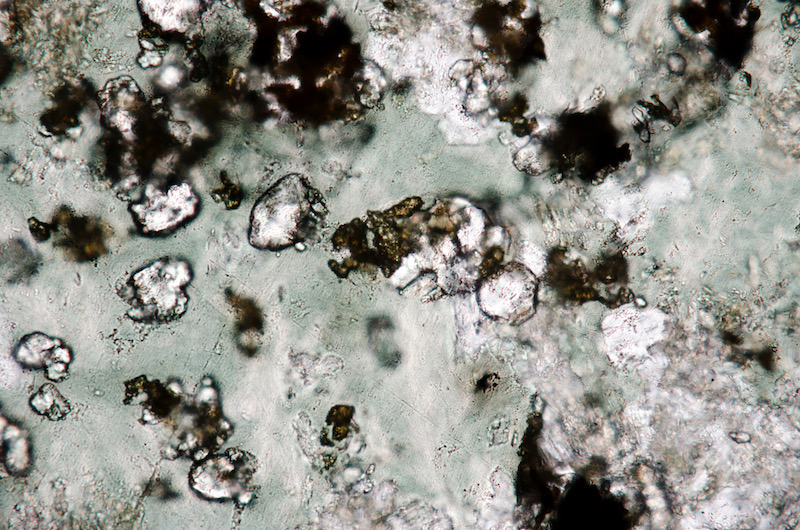
The clear crystals have the look of zircon and the yellow tinted crystals, pyroxene. It is evident that the very fine-grained black material has been heavily chloritised.

Section viewed with crossed polarising filters (FoV 1.2 x 0.8 mm)
Brecciated rock with quartz veining NT935154

Close to the eastern limit of the quartz-porphyry dyke (shown above), a very dark rock is brecciated and cemented with quartz. Perhaps there was a pre-existing fracture here that permitted the dyke’s intrusion or possibly the fracture was a result of the intrusion.
Specimen 11
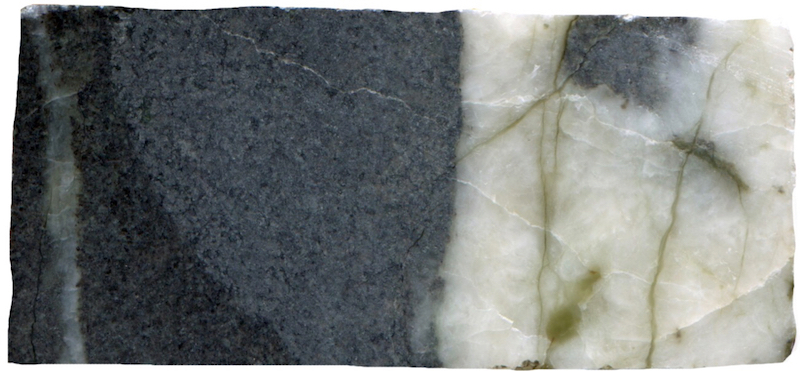
Prepared specimen in ordinary reflected light (43mm across)

(15mm across)
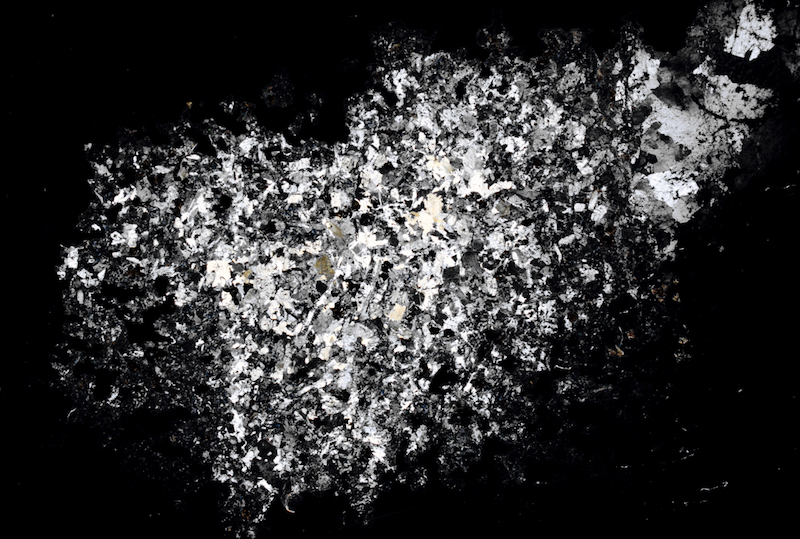
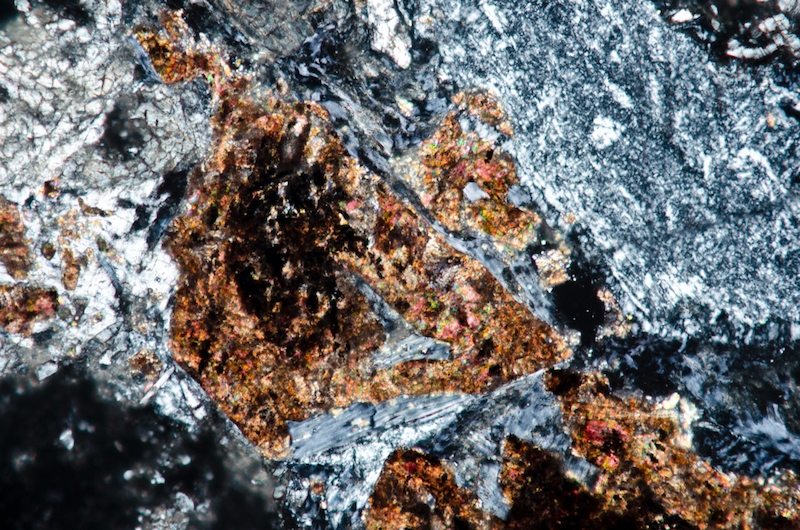
The dark rock in the sample shown above has a profusion of altered, grey-brown ortho- and clinopyroxene crystals that show only a white to yellow interference colours when viewed in thin section with crossed polarising filters. Along with these are occasional embayed granular clinopyroxene aggregates that contain so much opaque oxide material that, at first sight, they appear to be entirely magnetite crystals. It is only with more thinning that sufficient ‘crud’ is removed to reveal their transparency and their higher order interference colours. They are surrounded by a good deal of chlorite that appears to wrap around them. There is no sign of twinned plagioclase crystals.
It is difficult to say whether the quartz or the mafic material preceded the other. The mass of quartz has tiny veinlets running through it composed of extremely fine-grained quartz.
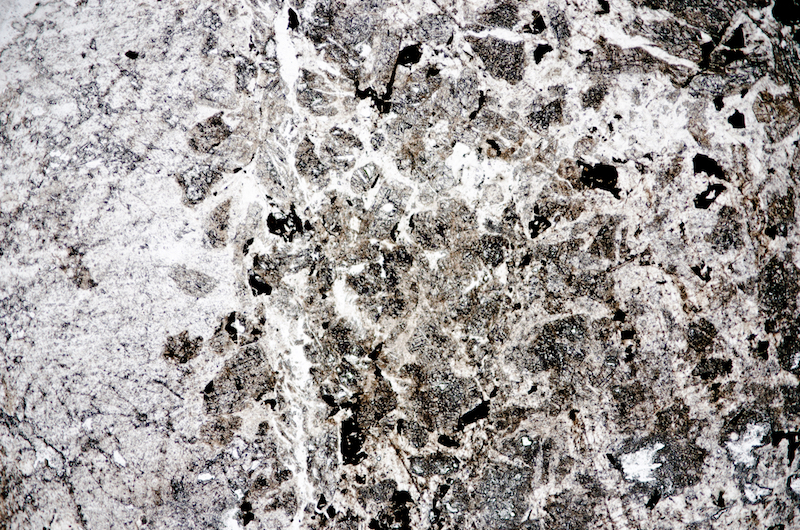
Section viewed in plane polarised light (FoV 4.6 x 3.0 mm)
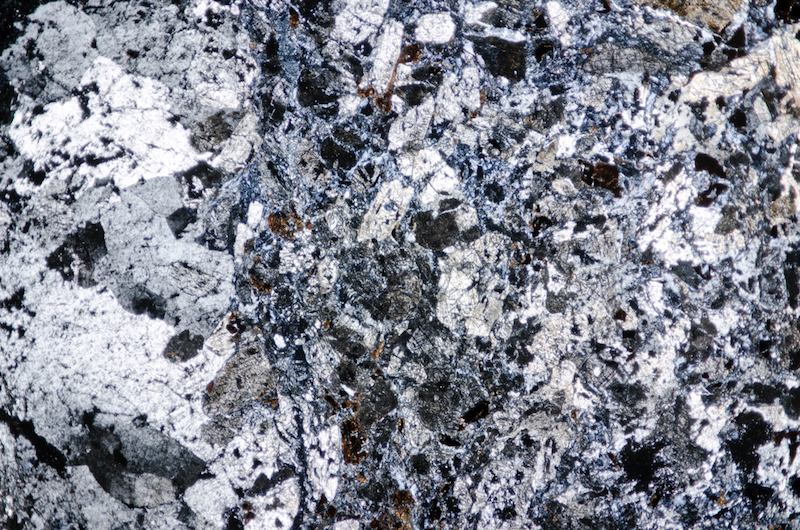
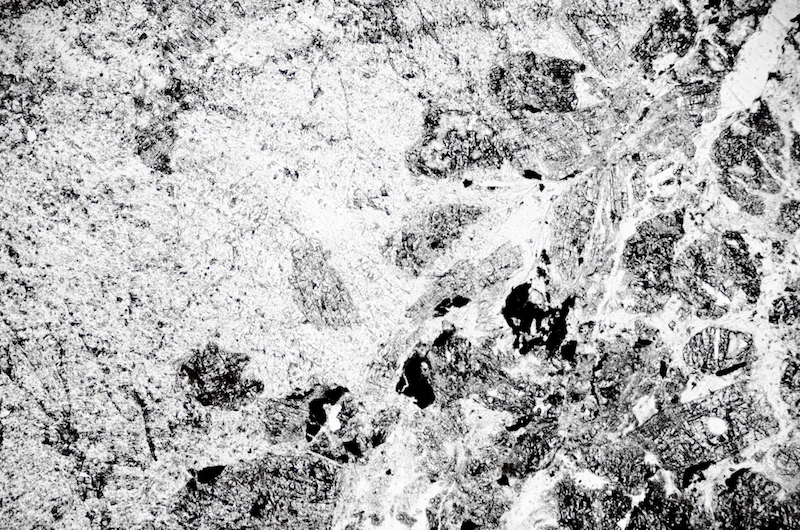
Section viewed in plane polarised light (FoV 2.3 x 1.5 mm)
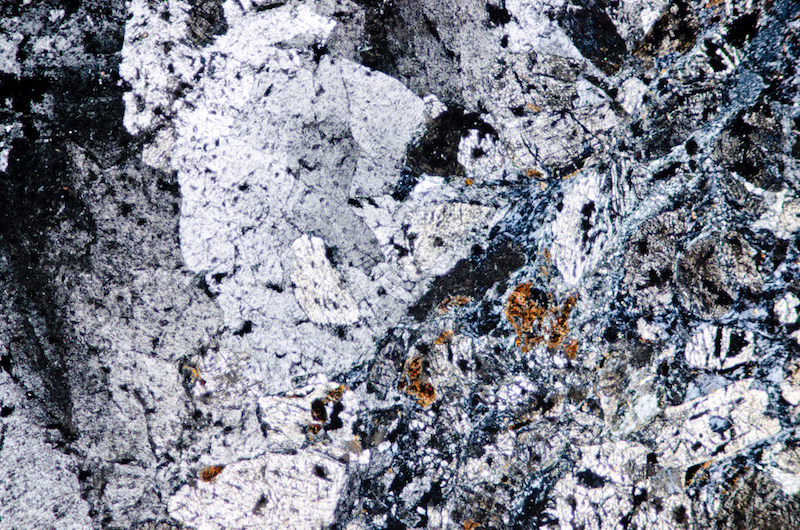
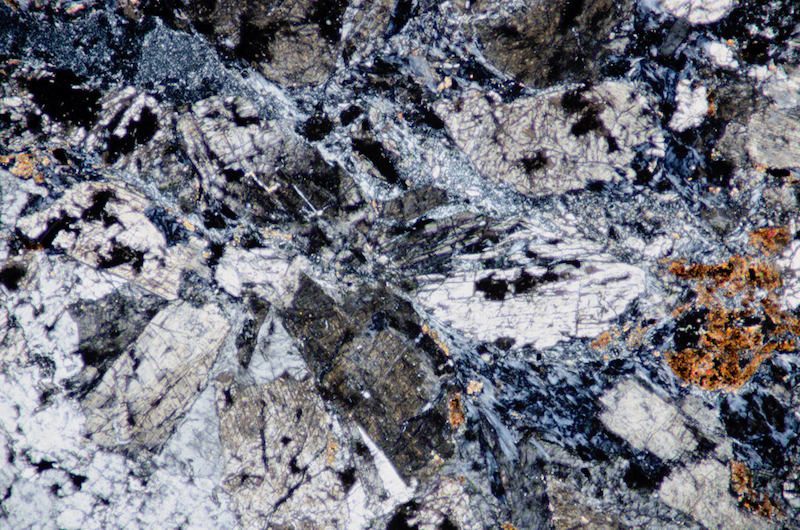
Section viewed with crossed polarising filters (FoV 1.2 x 0.8 mm)
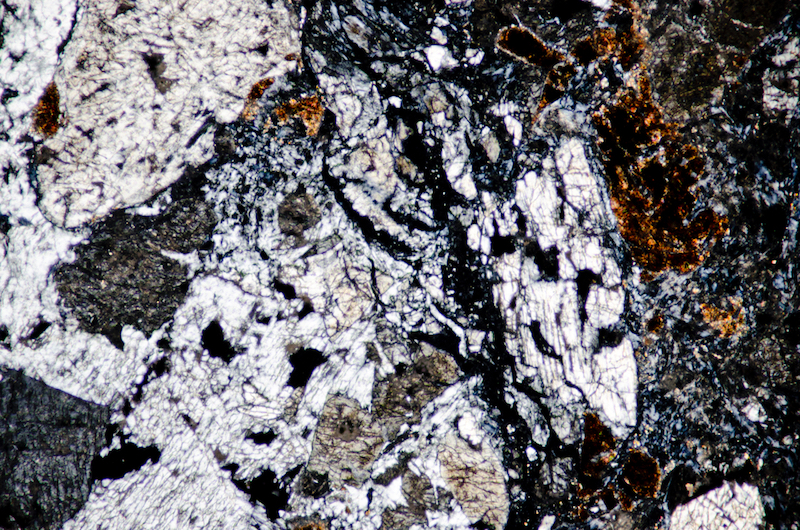
Section viewed with crossed polarising filters (FoV 1.2 x 0.8mm)
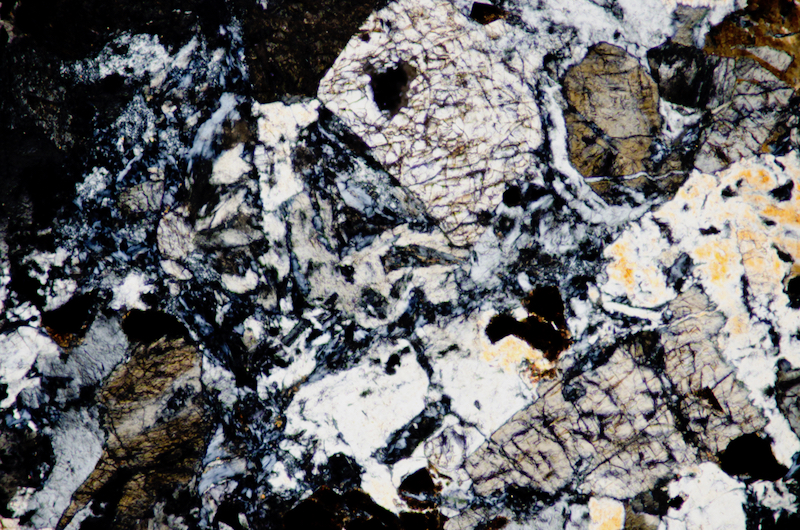
The quartz is slightly thicker than 30 microns and so has a yellow interference colour) Section viewed with crossed polarising filters (FoV 1.2 x 0.8 mm)
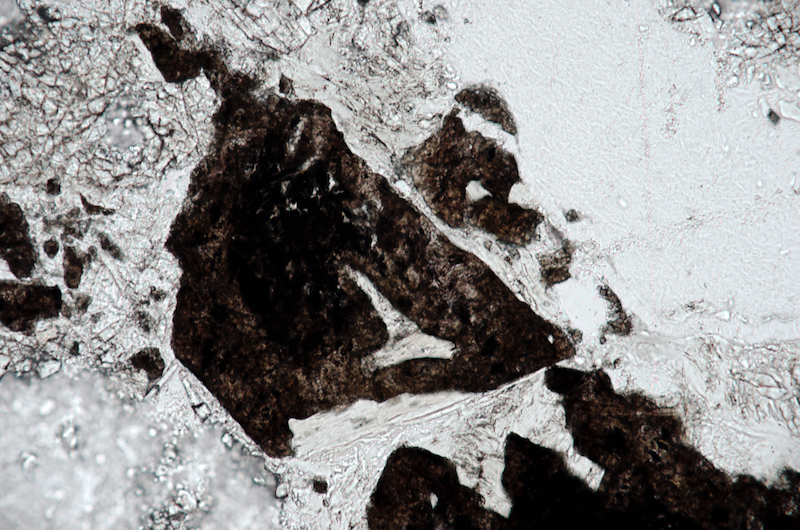
Section viewed in plane polarised light (FoV 0.5 x 0.3 mm)

Section viewed with crossed polarising filters (FoV 1.2 x 0.8 mm)
Quartz-porphyry dyke at Low Bleakhope NT935154
A quartz-porphyry dyke has been mapped crossing the river at low Bleakhope just before its sharp bend northwards. In thin section, characteristic rounded quartz phenocrysts appear with plagioclase and biotite phenocrysts in a relatively coarse ground that has areas of granophyric texture.The presence of this dyke and, given the appearance of quartz crystals in the rock, perhaps that of the other two dykes we’ve seen on this excursion, has been associated with the large Biddlestone intrusion of quartz-porphyry to the south of the Cheviots.
Specimen 12
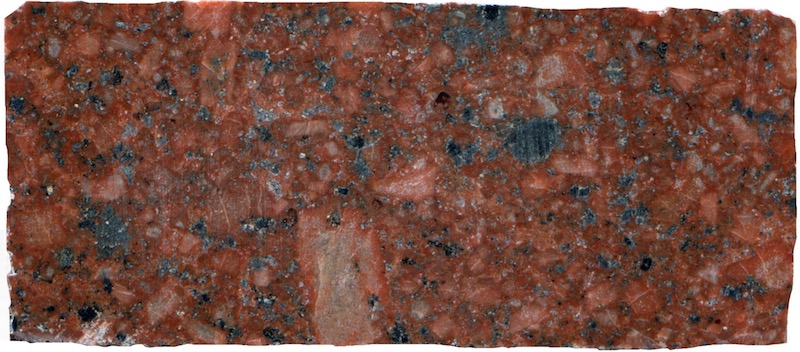
Prepared specimen in ordinary reflected light (40mm across)
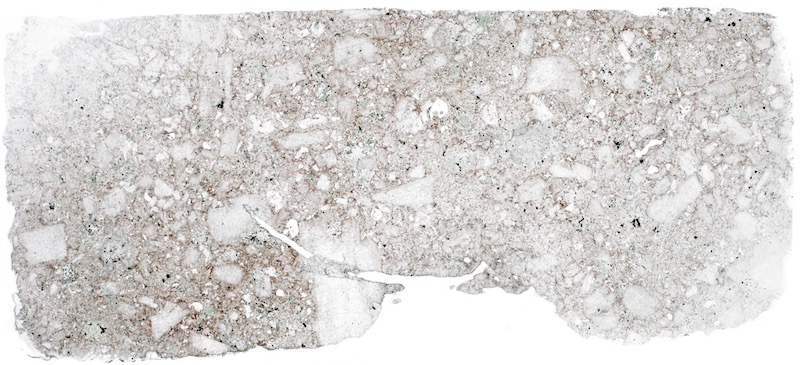
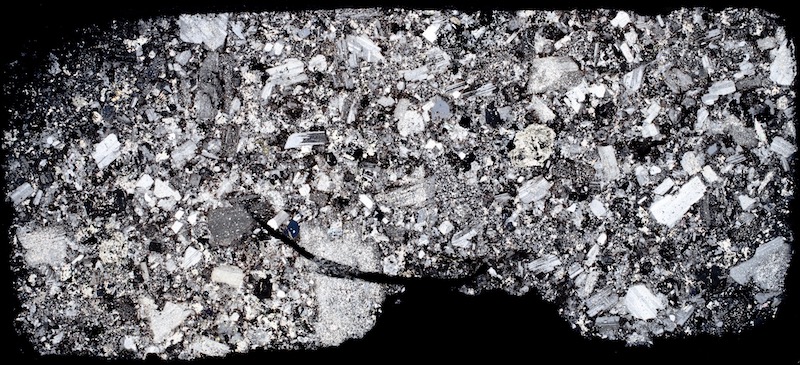

Section viewed in plane polarised light (FoV 4.6 x 3.0 mm)

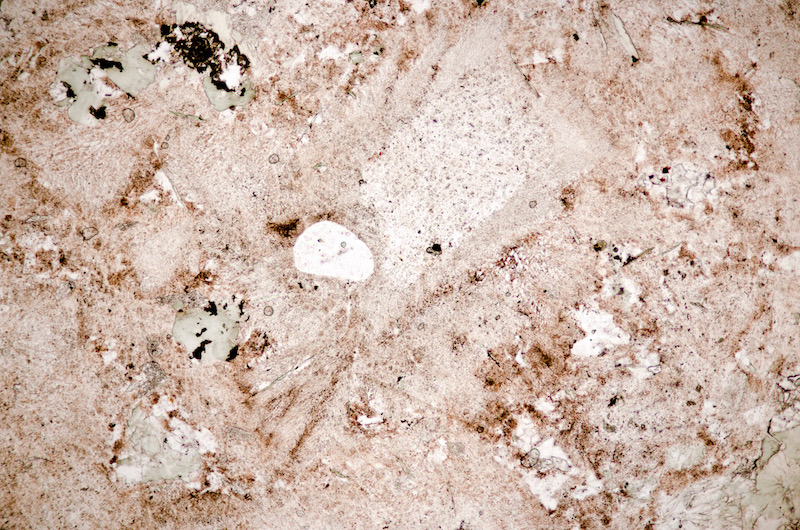
Section viewed in plane polarised light (FoV 2.3 x 1.5 mm)
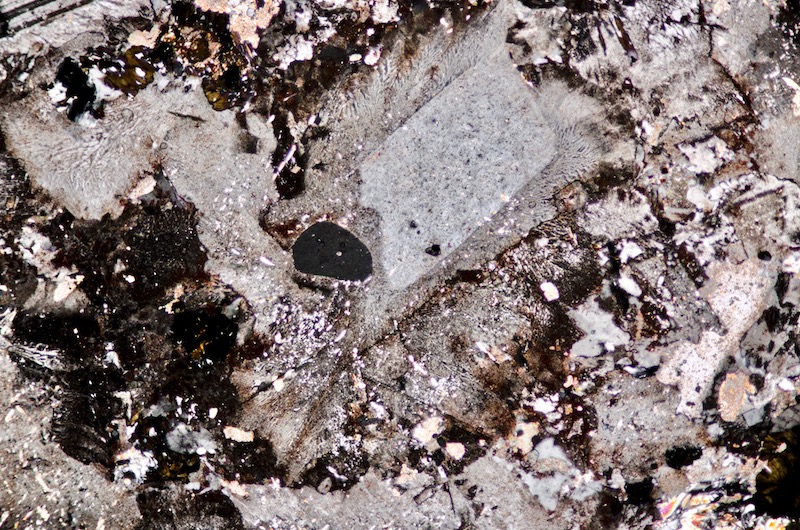
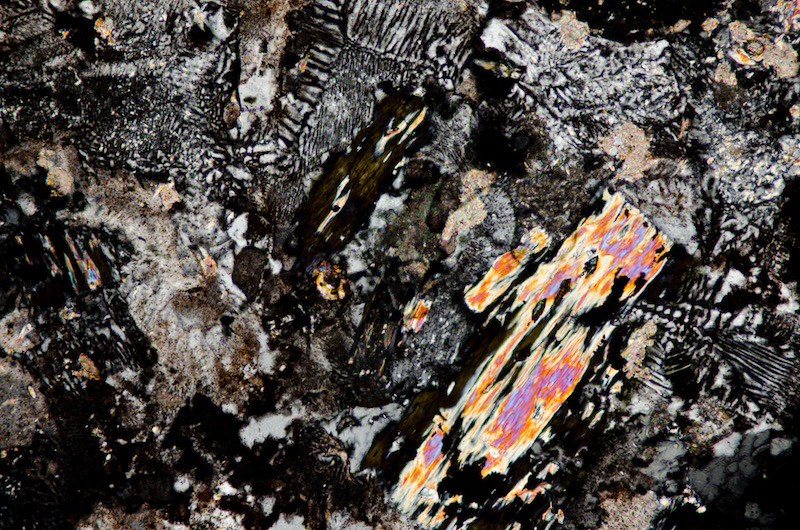
Section viewed with crossed polarising filters (FoV 1.2 x 0.8 mm)
Altered andesite Low Cantle

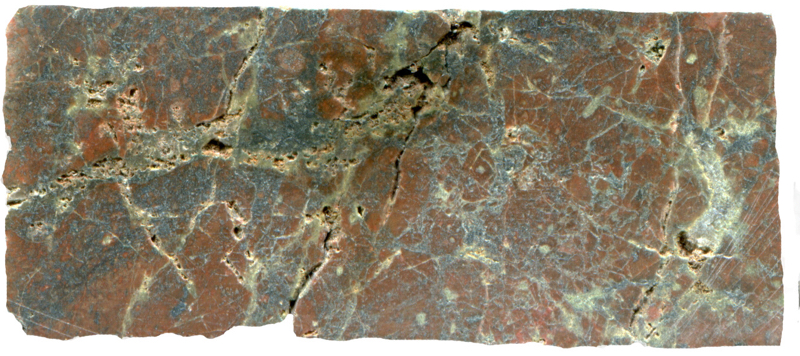
Exposures of altered andesite at the base of Low Cantle at Low Bleakhope, in the banks and bed of the river, as well as in the outcropping crags above.
Specimen 13 and 14
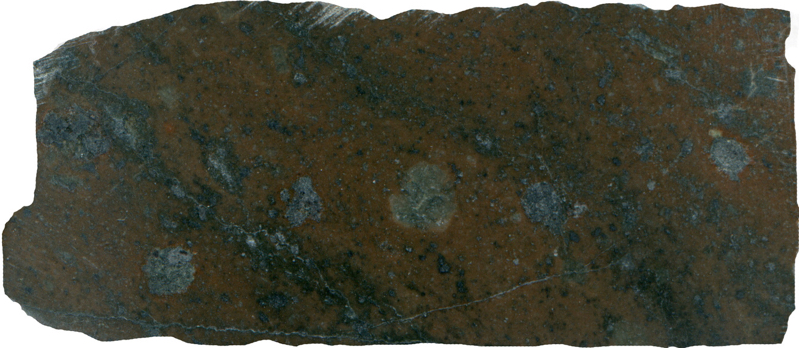
This sample is from a bedrock exposure in the north bank of the river. Prepared specimen in ordinary reflected light (47mm across)
Sample from one of the crags on Low Cantle. Prepared specimen in ordinary reflected light (47mm across)

From Low Bleakhope, we continue on the farm track that takes us over the river, past the house and out-buildings at High Bleakhope and through the trees to the edge of the open land at NT920161 where it is joined by the footpath to High Cantle that we will take later.
BGS maps show a pyroxene-porphyry dyke crossing the river here but access isn’t easy and although the steep rocky banks to the river do suggest a change in rock to a tougher kind, all the exposures we investigate are ‘Marginal’ granite.
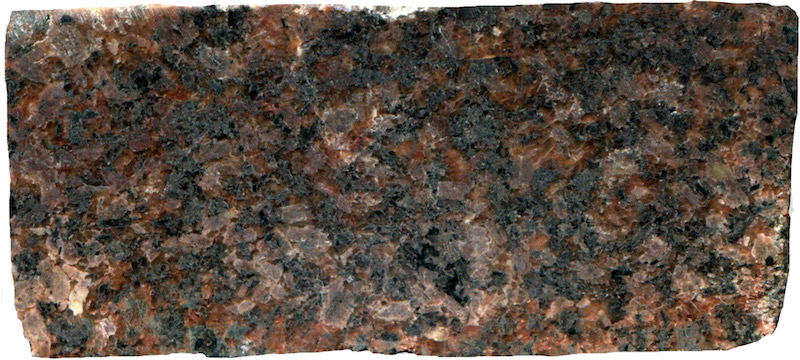
Prepared specimen in reflected light (45 mm across)
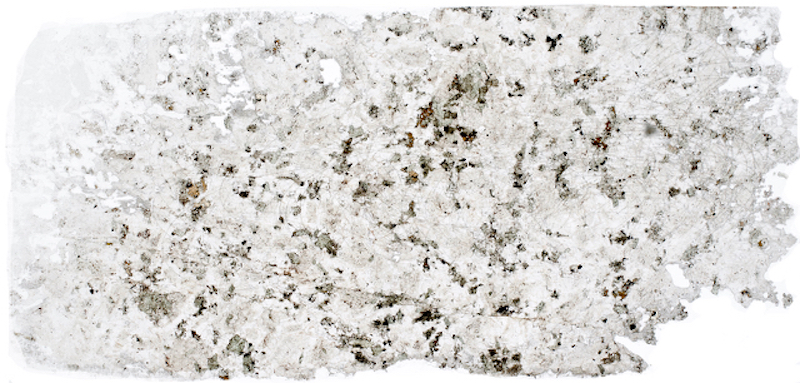
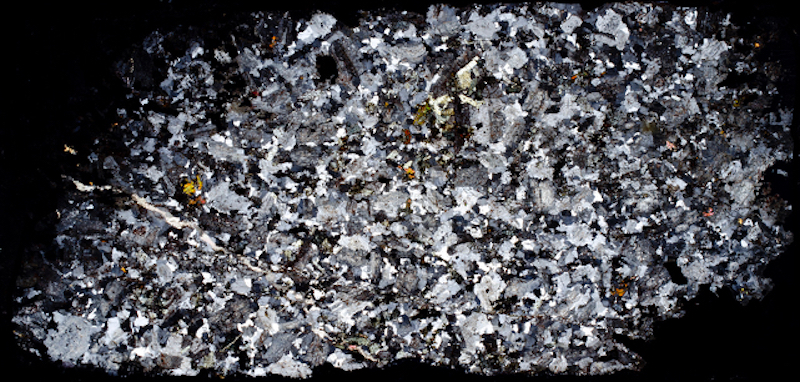

Section viewed in plane polarised light (FoV 4.6 x 3.0 mm)
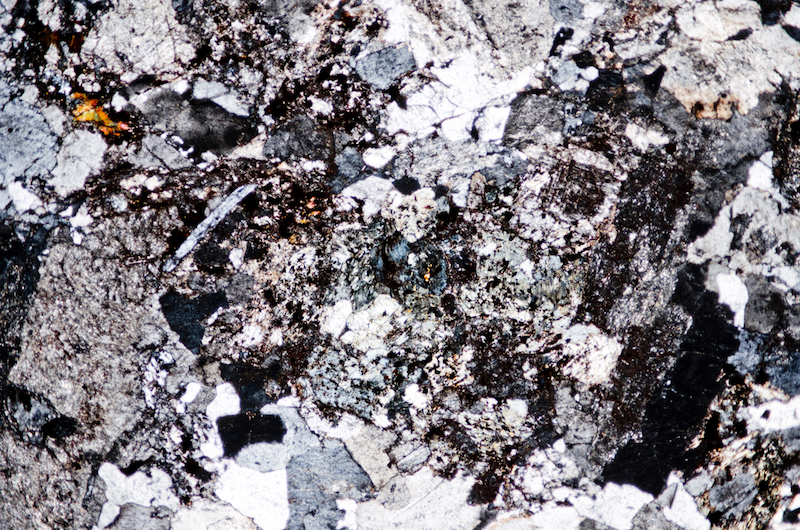
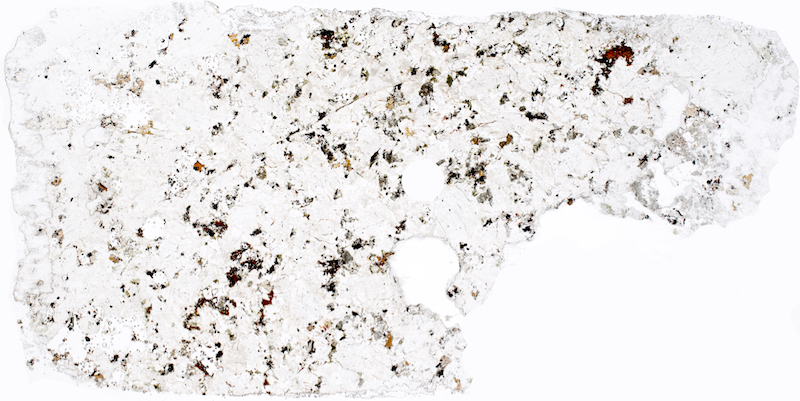
It’s a short walk along the track to the mouth of the Ainsey Burn, a small stream that flows from the south-west, down through Cheviot lavas and tuff to join the Breamish at NT918163. Here, the survey shows two intersecting pyroxene-porphyry (andesite) dykes along with a quartz-porphyry dyke. The latter is fairly clear to see in the south-eastern bank of the burn and, on account of its regular jointing, in the track that crosses the burn – but the pyroxene-porphyry dykes elude us; we see only Marginal granite.

Specimen 1

Prepared specimen in reflected light (45 mm across)

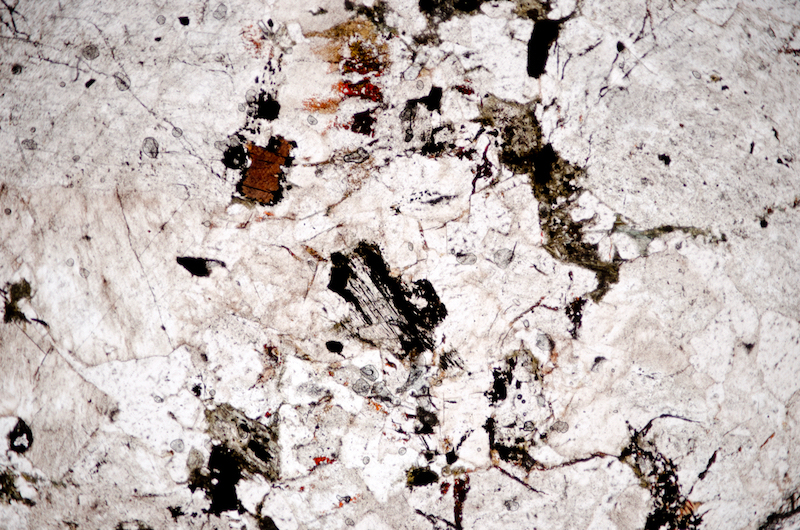
Section viewed in plane polarised light (FoV 4.6 x 3.0 mm)

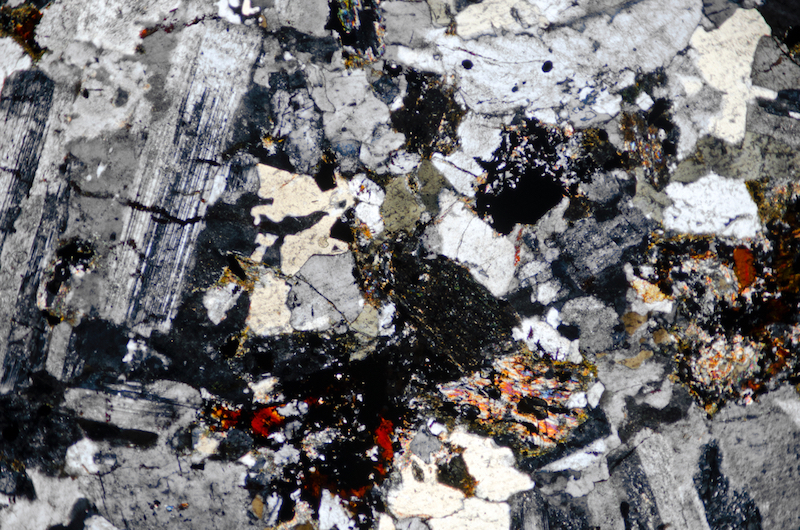
Section viewed with crossed polarising filters (FoV 4.6 x 3.0 mm)
Small waterfall
Pressing on up the burn, we enjoy the little waterfall at the point before the water flow takes an abrupt turn from the east to the north, perhaps on account of its encounter with much more resistant rock. We continue for a short distance to see the felsic dyke that outcrops in the bank of the burn at NT917162.

Specimen 2
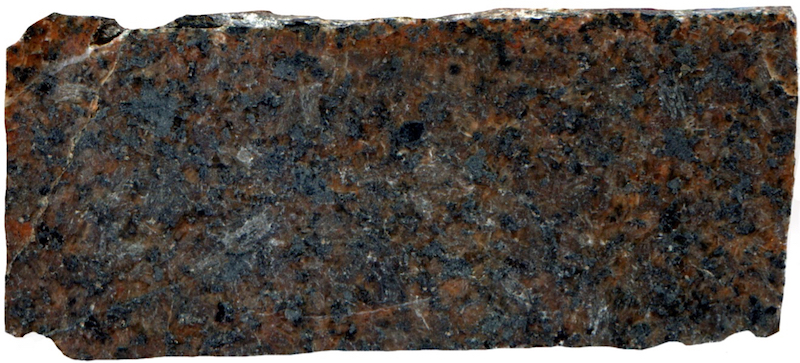
Prepared specimen in reflected light (45 mm across)


Section viewed in plane polarised light (FoV 4.6 x 3.0 mm)
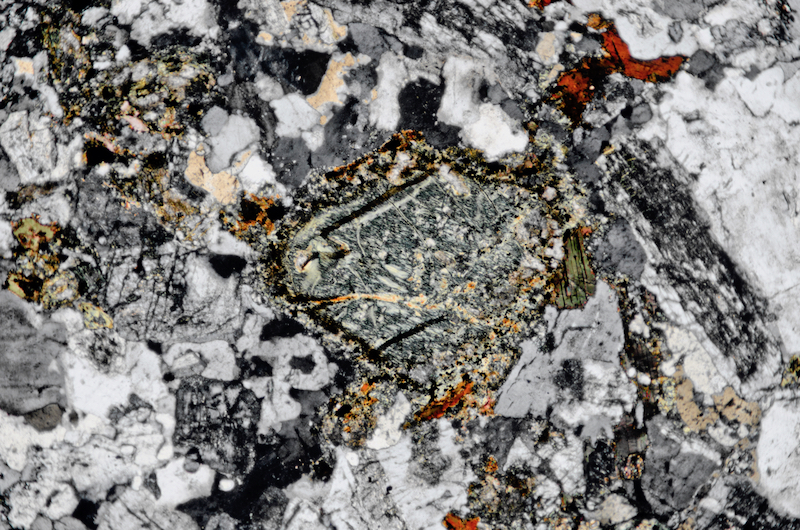
Felsite Dyke
The thin section of the junction between the felsite and the quartz-monzonite is interesting on account of the two chilled margins that we see. Perhaps this represents two injections of felsite. The first injection freezing against the Marginal quartz-monzonite and the second chilling more slowly against the first. Both the outer and he inner bodies of felsite carry quartz phenocrysts. There are patches of granophyric texture in the coarser-grained felsite.
What remains of the primary biotite in the ‘Marginal’ rock is very highly pleochroic ranging from a light pink to a deep brown. Most of it has been altered to a yellow non-pleochroic mineral that looks fibrous under crossed polarising filters with first order interference colours.
Specimen 3
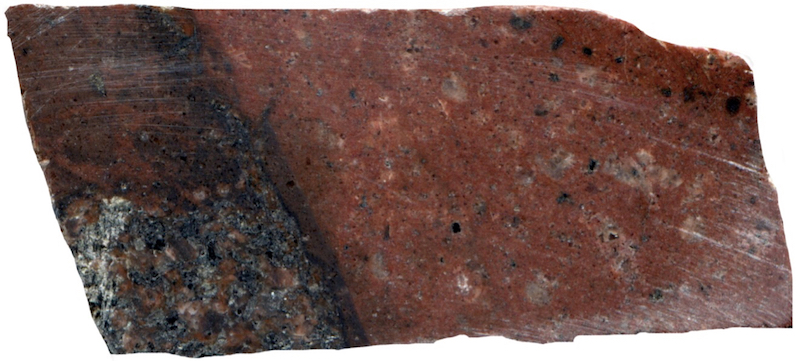
‘Marginal ‘ rock to left, dyke rock to right.
Prepared specimen in reflected light (45 mm across)
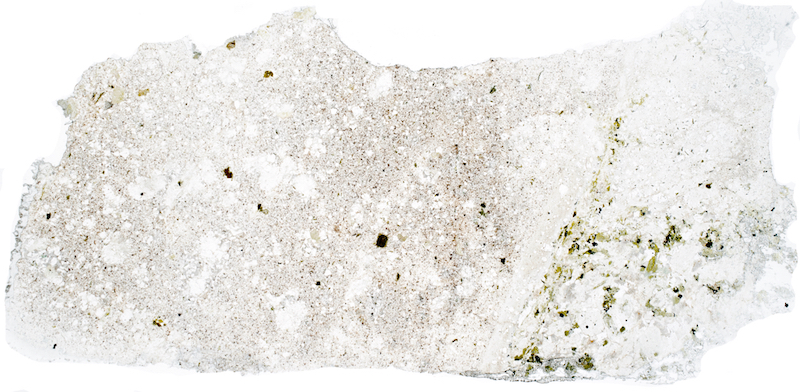
(41mm across)
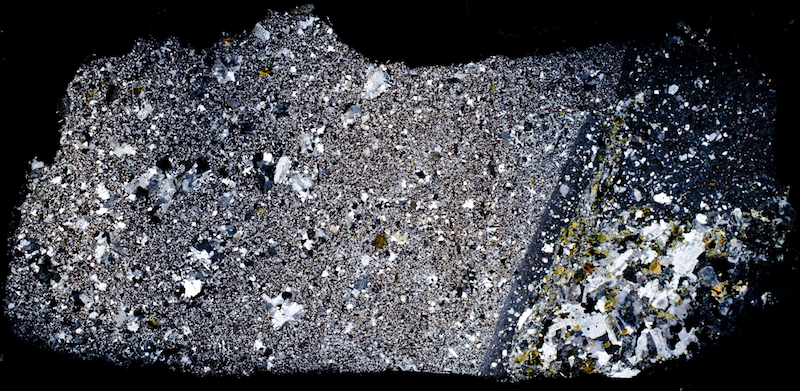
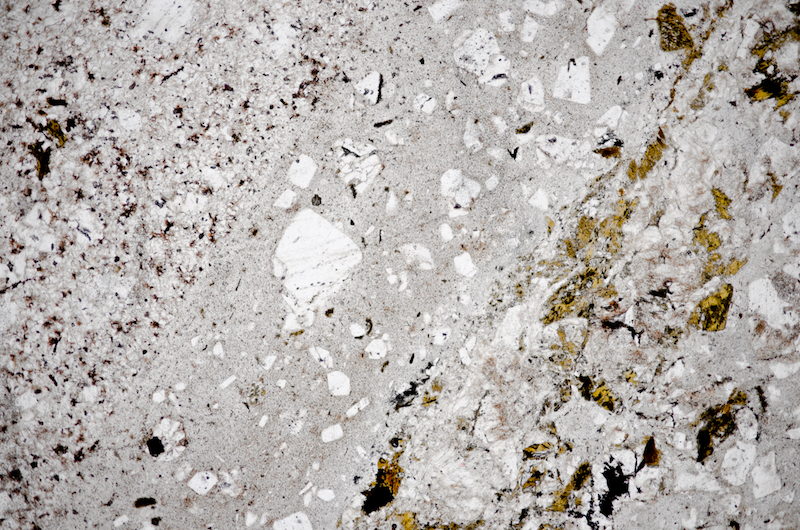
Section viewed in plane polarised light (FoV 4.6 x 3.0 mm)
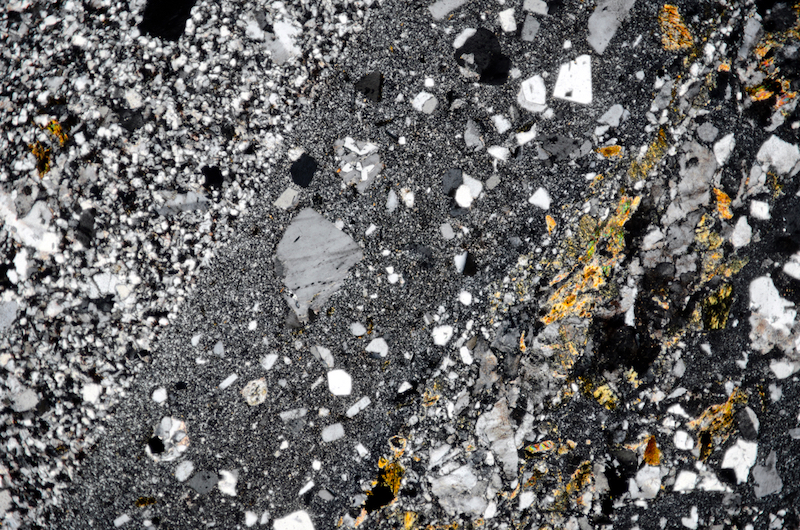
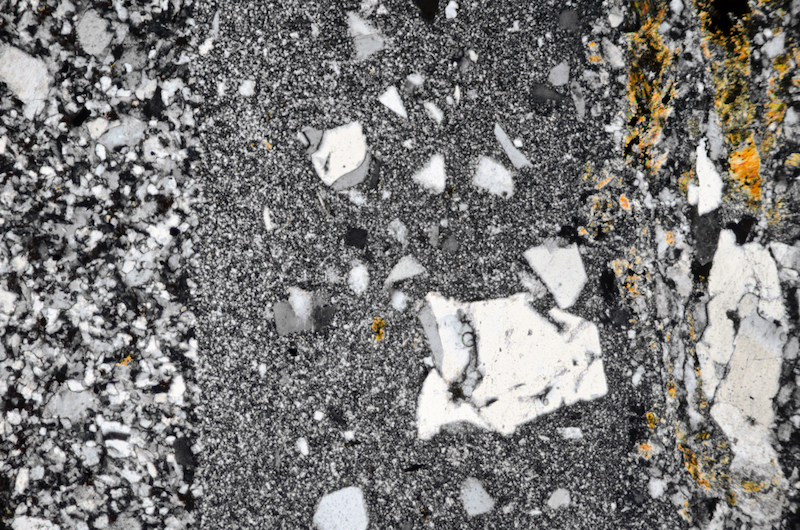
Section viewed with crossed polarising filters (FoV 2.3 x 1.5 mm)

Section viewed in plane polarised light (FoV 2.3 x 1.5 mm).

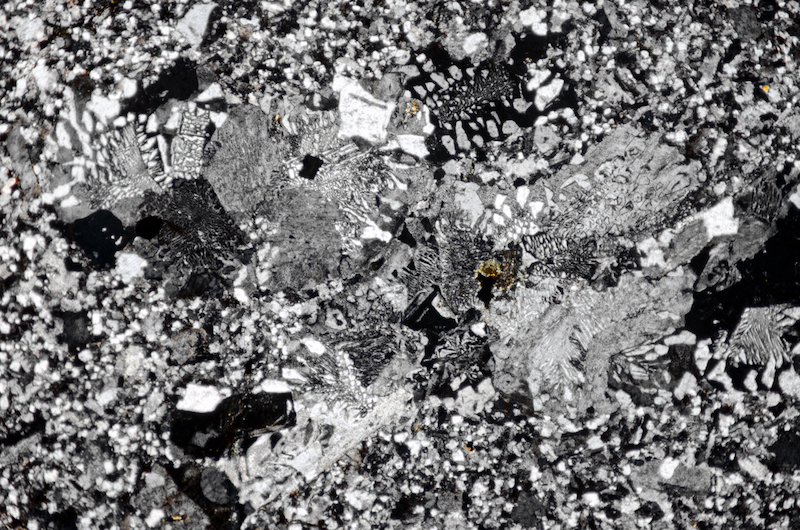
Section viewed with crossed polarising filters (FoV 4.6 x 3.0 mm)
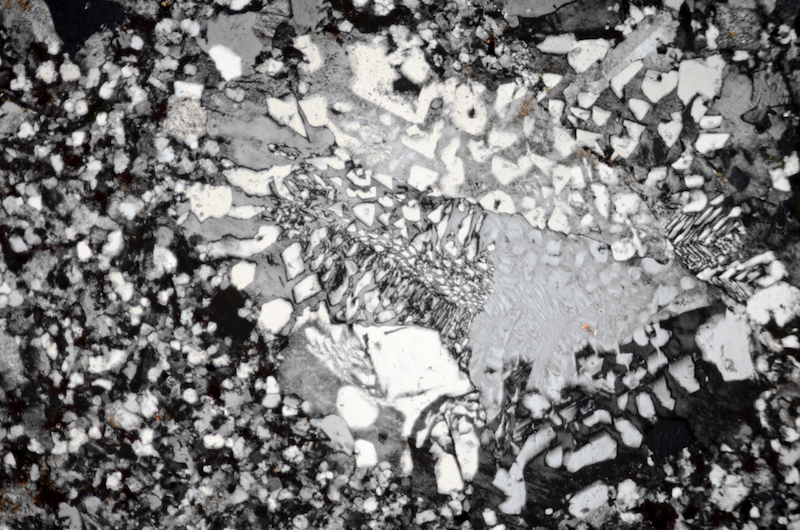
Section viewed with crossed polarising filters (FoV 2.3 x 1.5 mm)
This is a lovely, secluded valley, and it is tempting to carry on up to investigate the tuffs and/or agglomerates in relation to the andesite lava and still more dykes but we have to leave it for another day in order to retrace our steps to the base of Shiel Cleugh where we can either make our way back to the car via Low Bleakhope and Alnhammoor, or return via High Cantle and Linhope, or alternatively continue on up to Coldlaw Cairn and Shielcleugh Edge.
References
H. Kynaston, Notes on Contact Metamorphism round the Cheviot Granite, Edinburgh Geological Society, 1899.
Carruthers, R G, Burnett, G A, Anderson, W, and Thomas, HH,1932. The Geology of the Cheviot Hills (Based on the work of C.T. Clough and W. Gunn) HMSO
Al-Hafdh N.M. 1985. The Alteration Petrology of the Cheviot Granite. Thesis submitted for PhD. at Newcastle University.
British Geological Survey Online geology map http://mapapps.bgs.ac.uk/geologyofbritain/home.html