Location 1. Hawsen Burn: burn-side outcrops at NT951227
Location 2. Small outcrop in the stream bed at NT948228
Location 3. Craggy outcrop at NT946229
Location 4. Intensely altered andesite at NT945230
Map showing the excursion route, locations and igneous rock types


Both the Hawsen Burn and the Lambden Burn skirt a portion of the Cheviot pluton’s surface periphery and so we expect exposures along their two courses to tell us something about the granite/lava junction. In the lower Hawsen Valley, where it adjoins the Harthope Valley, Al Hafdh identified the occurance of his ‘Woolhope’ granite – the evolved type of granite that we have been calling our ‘High Cheviot’ type. If we do find it outcropping here on the valley floor, perhaps we will need to jettison our geographically descriptive name and revert to the petrologically descriptive ‘Evolved Granite’.
It’s interesting that the dark, mafic ‘Marginal’ type of granite that is associated with the pluton/lava boundary in the south, south east and north, at Low Bleakhope, Dunmoor Hill and Bellyside Hill hasn’t been recorded in these localities.
Higher up the Hawsen Burn, we will be walking through a crush zone associated with the intersection of two faults. Further crush zones occur along the Lambden Burn with more exposures that Al Hafdh recorded as ‘Woolhope’ granite.
On the return leg, we will detour up to Hawsen Crags where maps show a sizeable intrusion of mica-porphyry.

The granite outcrops close to the water on the left bank here.


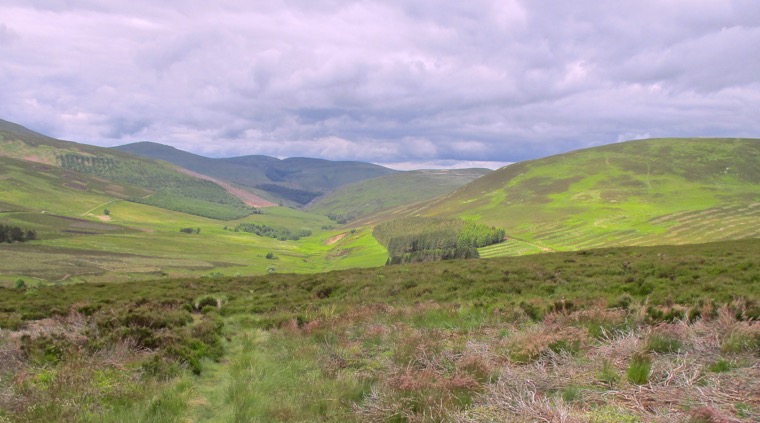
From the car parking space by the Harthope Burn we turn up the Hawsen Burn that flows down the approximate line of contact between the pluton and the surrounding andesitic lava that has been hardened to ‘hornfels’ by the pluton’s heat . The course of the Hawsen Burn also marks the line of an inferred fault. The intersection of this fault with a second fault higher up the burn gives rise to a ‘crush zone’ where the bedrock has been repeatedly broken and cemented together with quartz.
The burn itself is full of stones, cobbles and boulders that provide an overview of the rock types that occur along its course. There are examples of red and black andesite, pink and red porphyritic and none-porphyritic granitic rock, and quartz-rich rocks often veined with red haematite and sometimes black tourmaline.
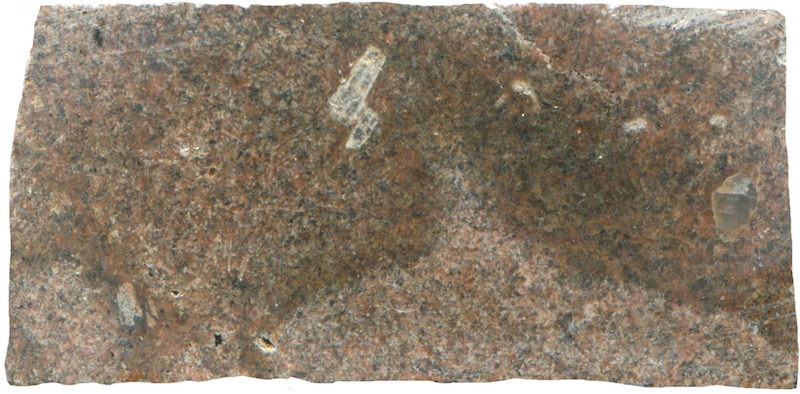
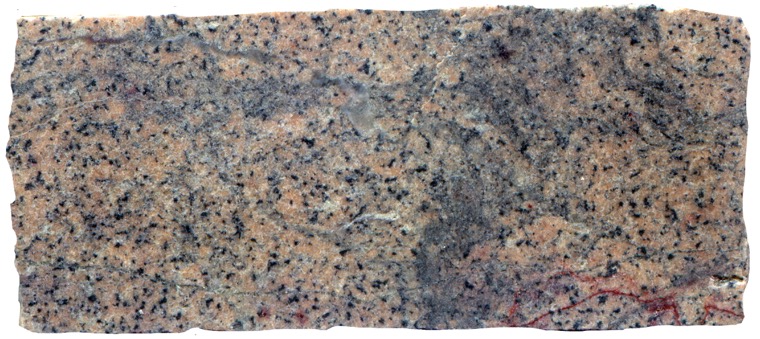
Our first location is at NT951227, one of the few places in the first section of the burn where the bedrock is exposed. The outcrops are small and low-lying on both sides of the burn where it takes an abrupt corner, perhaps channeled by the more resistant rock. In situ, the rock appears pink-red and relatively medium-grained but even at the scale of this small exposure, hand samples reveal variation in its appearance.
Al Hafdh shows this area to be dominated by the fine-grained, evolved granite that he refers to as his ‘Woolhope’ type. We wonder if this really is the same type of rock as that which is scattered all around the higher reaches of Cheviot.
Specimen 1
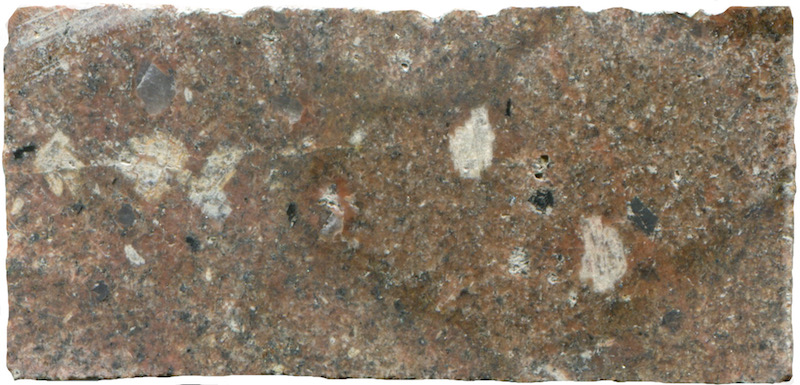
Prepared hand specimen viewed in ordinary reflected light

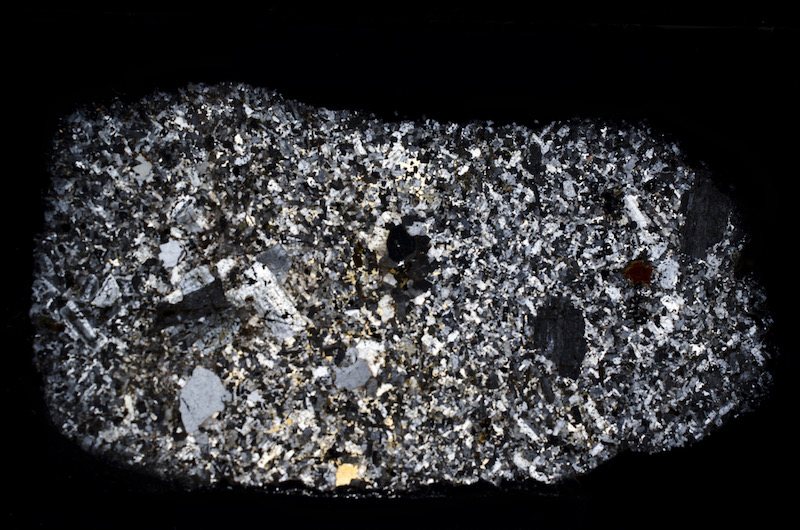
Specimen 2

Thin section viewed in plane polarised light (36mm across)
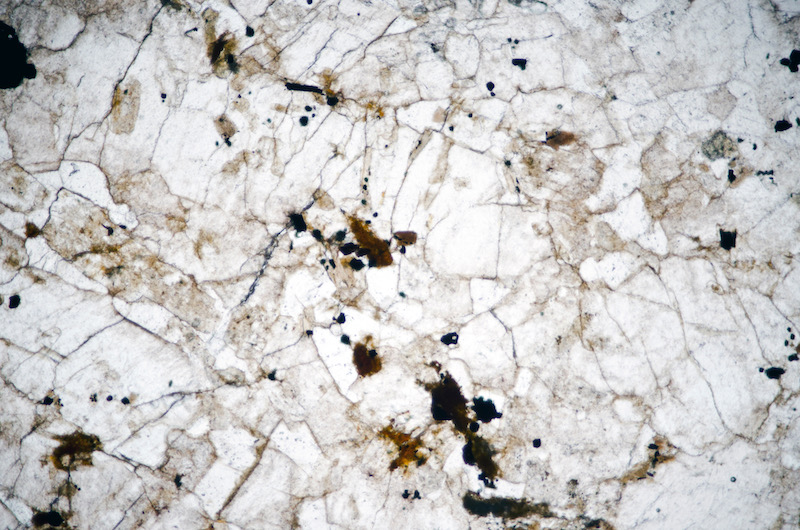
Section viewed in plane polarised light (FoV 2.3 x 1.5 mm)
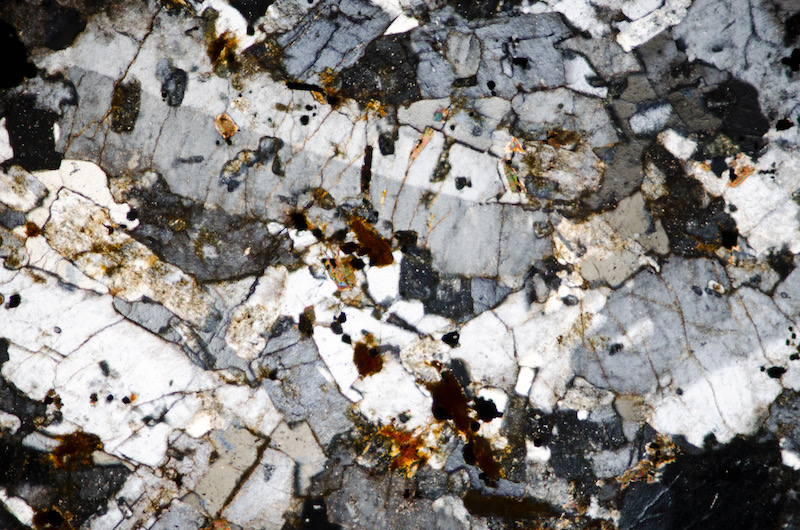
Hand samples of the rock we find at this location do resemble the rock we find at Woolhope Crag, in the cobbles and boulders scattered around the top of Cheviot and at Scotsman’s Cairn. Differences between them may have a lot more to do with the degree and kind of hydrothermal alteration that has affected them than with differences in the magma that gave rise to them. Much of the rock at Woolhope Crag and on upper Cheviot has been tourmalinised but tourmaline is absent at this location.
All of them share a low mafic content along with a relatively high quartz content. Plagioclase phenocrysts are present at this location, albeit albitised so that they have lost polysynthetic twinning, and in the rock on Cheviot and around Scotsman’s Cairn. We don’t see plagioclase phenocrysts in our samples of the granite at Woolhope Crag – we will have to look more closely at this on our next visit there.
Are these granites of the same type, then? It seems to us that they are.
Photomicrographs made at the same magnification comparing examples of our ‘High Cheviot’ rock
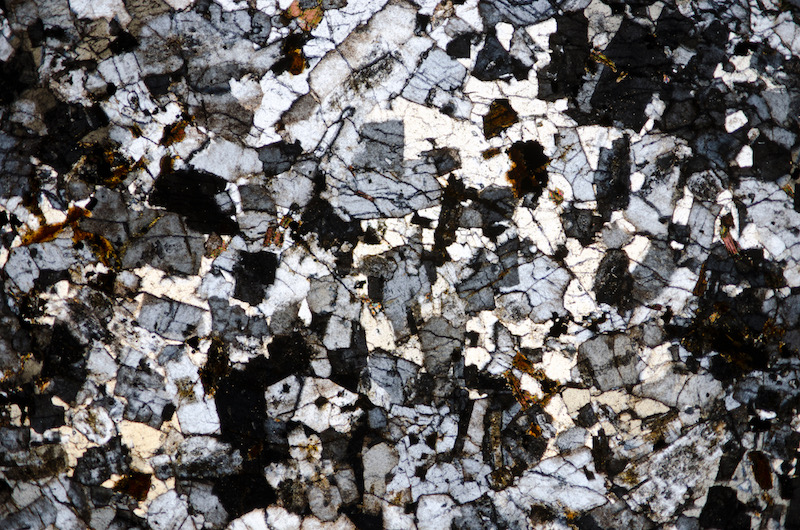
Plagioclase phenocrysts and tourmaline are absent. Section viewed with crossed polarising filters (FoV 4.6 x 3.0 mm)
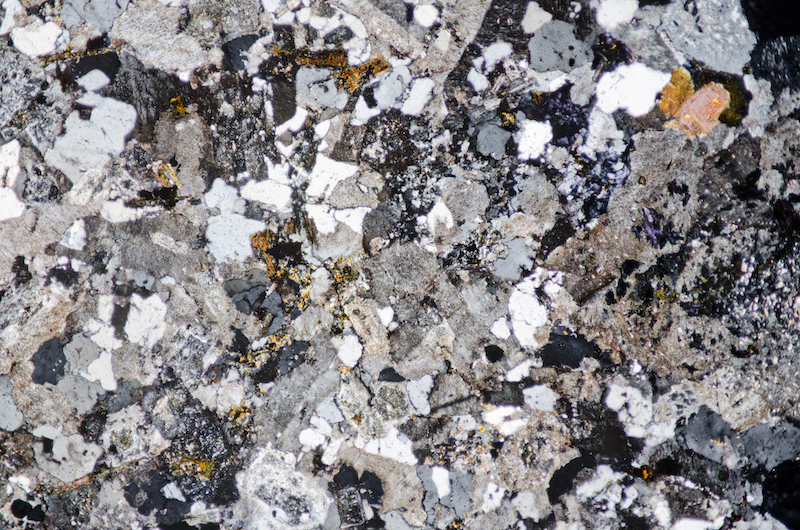
There is little plagioclase but a lot of alkali feldspar in the rock, chlorite, sericite and tourmaline are present. Section viewed with crossed polarising filters (FoV 4.6 x 3.0 mm)
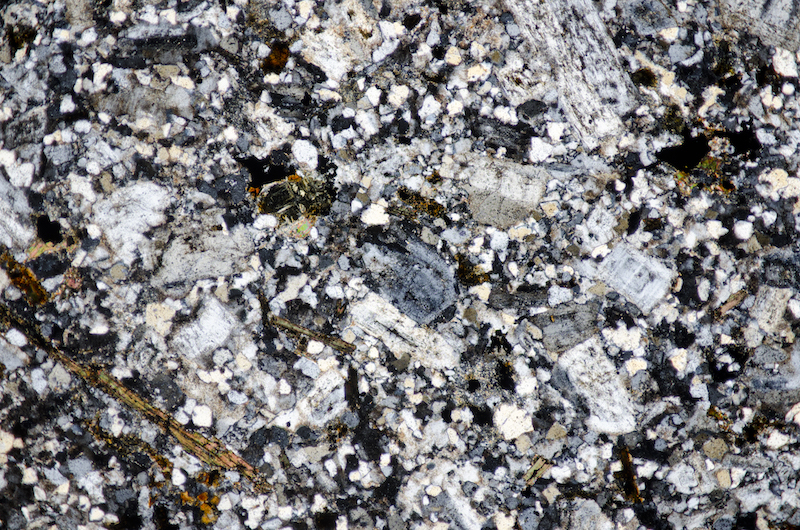
Contains plagioclase phenocrysts and rods of biotite. Section viewed with crossed polarising filters (FoV 4.6 x 3.0 mm)

Contains plagioclase phenocrysts, coarsely granophyric quartz, and tourmaline. Section viewed in plane polarised light (FoV 4.6 x 3.0 mm)
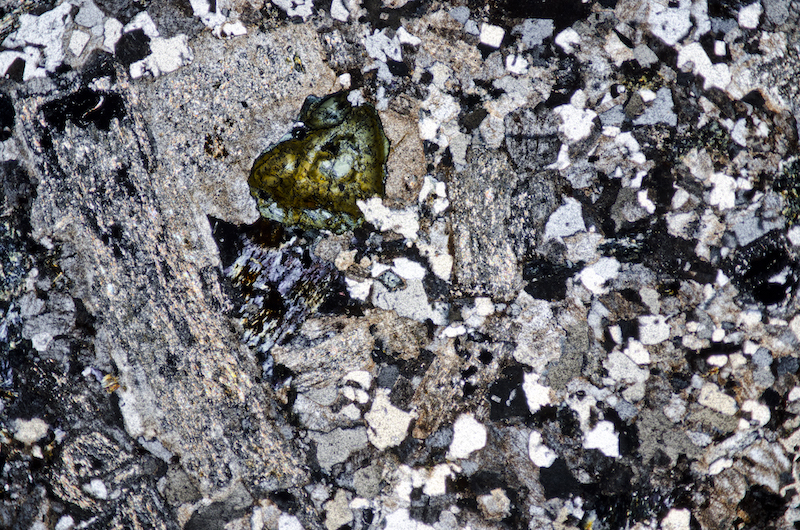
Contains plagioclase phenocrysts, coarsely granophyric quartz, and tourmaline. Section viewed in plane polarised light (FoV 4.6 x 3.0 mm)

Further up the burn, there’s another small exposure in the stream bed of what looks like bedrock. At first sight it looks like that at location 1 but in thin section it looks like something intermediate between the ‘High Cheviot ‘ and the ‘Central Belt’ rock types. There are plagioclase phenocrysts in the rock and it has a much higher mafic content. Along with the ubiquitous chlorite, there is also tourmaline. It’s clear that between types there is a spectrum of intermediates.
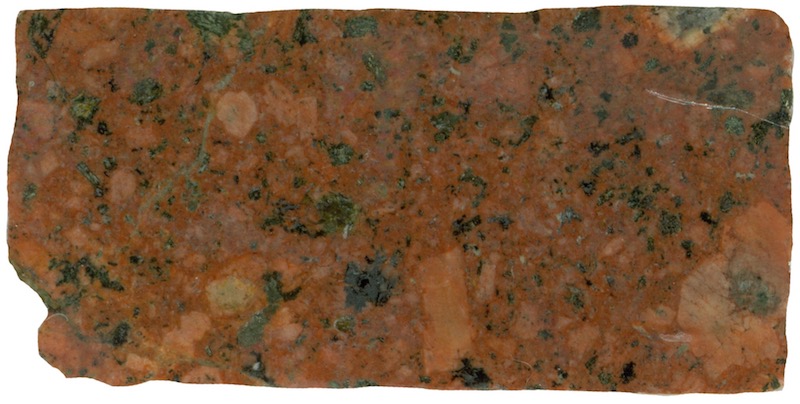
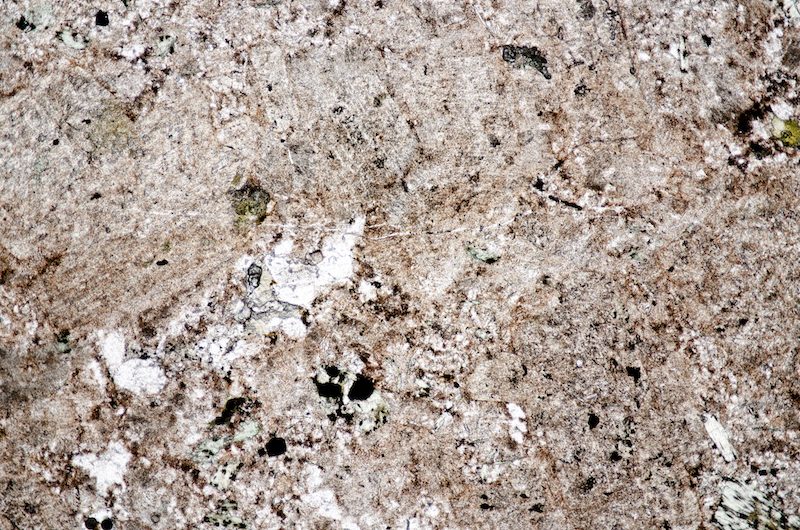
Section viewed in plane polarised light (FoV 4.6 x 3.0 mm)
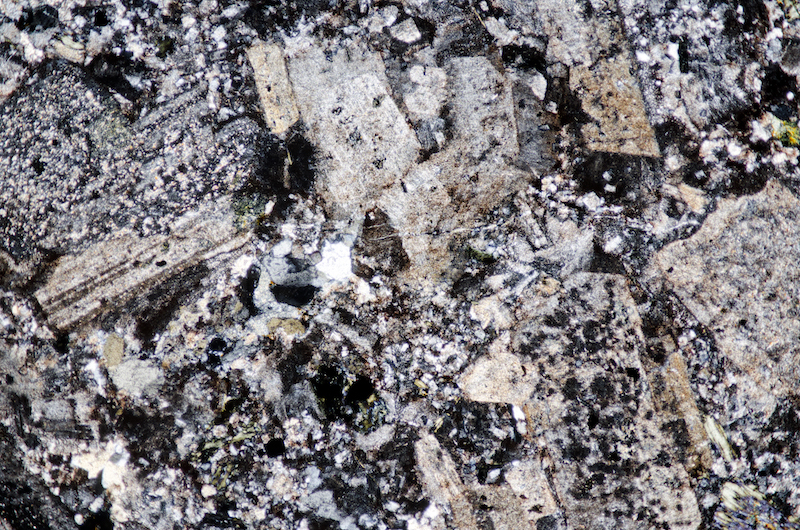

Section viewed with crossed polarising filters (FoV 2.3 x 1.5 mm)

Section viewed in plane polarised light (FoV 1.2 x 0.8 mm)

Hawsen Burn NT946229
Red to flesh-coloured rock is exposed in a small crag on the east bank of the burn. Thin sections reveal it is different again to the similar looking rock that we have seen downstream.
It comprises of two parts: a fine-grained quartz-feldspar mix that contains some white mica, or sericite, together with tourmaline, and a second part that is much larger-grained comprising feldspar with some beautiful perthitic texture, rounded quartz crystals, and a little biotite. There are no plagioclase phenocrysts in either part.
We think this might be best understood as a dyke-like structure in which the fine-grained material has carried along fragments of an older, larger-grained rock .
We wonder if this outcrop is related to the porphyry intrusion directly above on Cold Law.

Hawsen Burn NT946229 (40mm across)

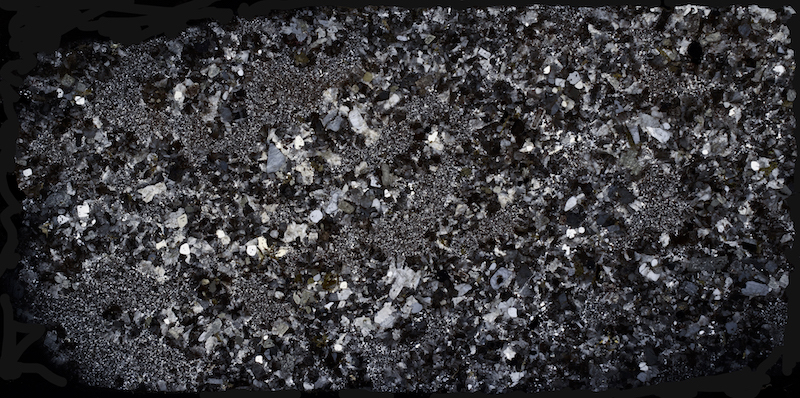

The medium-grained material appears to xenolithic.
Section viewed with crossed polarising filters.

Section viewed in plane polarised light (FoV 2.3 x 1.5 mm)


Section viewed with crossed polarising filters (FoV 2.3 x 1.5 mm)
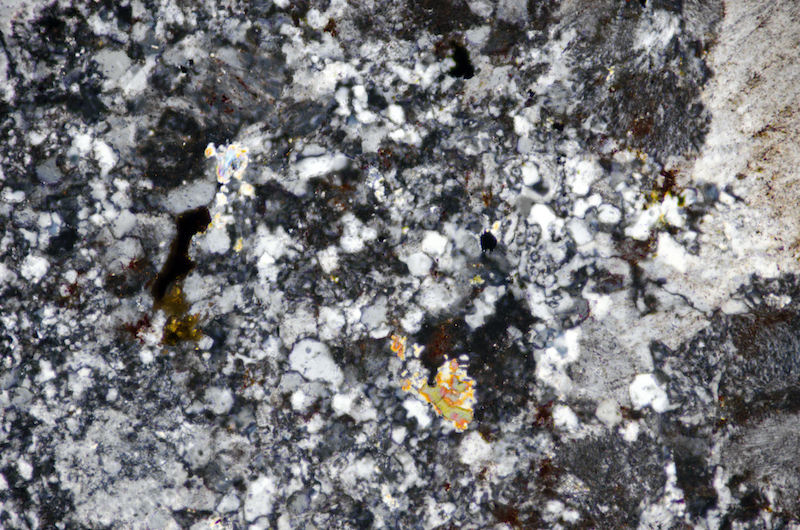
Section viewed with crossed polarising filters (FoV 1.2 x 0.8 mm)

The field of view is about 1.5 m
The andesite outcropping here and upstream as far as the crush zone is extremely altered and weak. Colin Scuton writes there are ‘thick veins and stringers of tourmaline and lumps of massive epidote’ in this rock but we didn’t see them here. Under the microscope we see a great deal of magnetite along with limonite and haematite and the remnants of plagioclase and biotite phenocrysts in the surviving, predominantly feldspar groundmass.
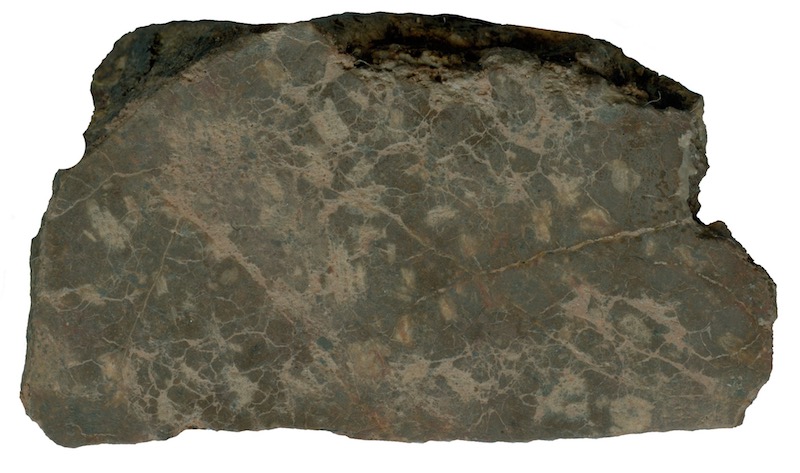
Prepared hand specimen in ordinary reflected light (42mm across)
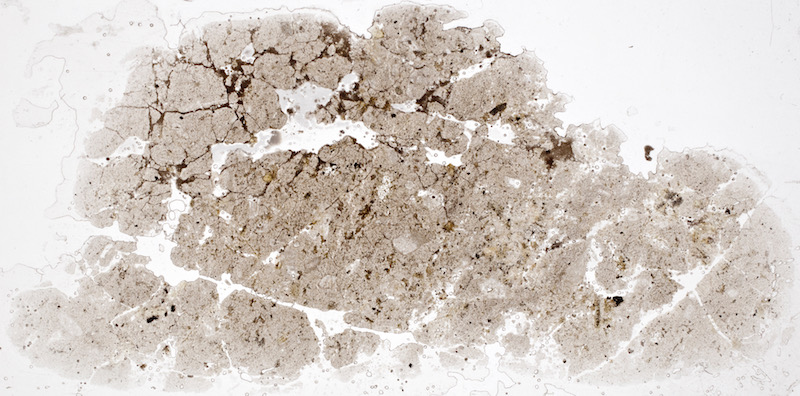
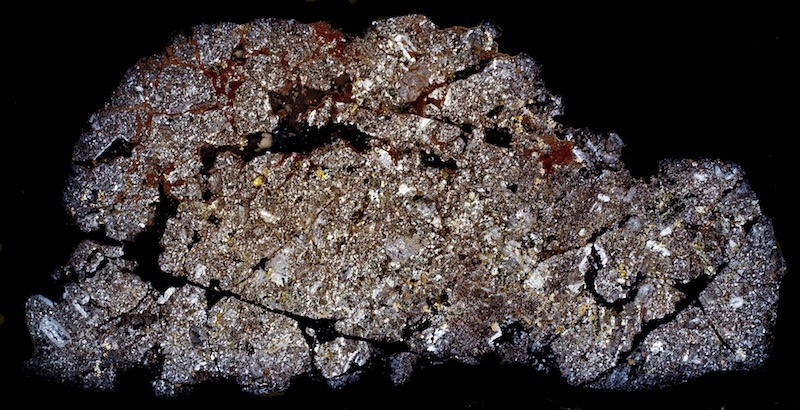

Section viewed in plane polarised light (FoV 2.3 x 1.5 mm)
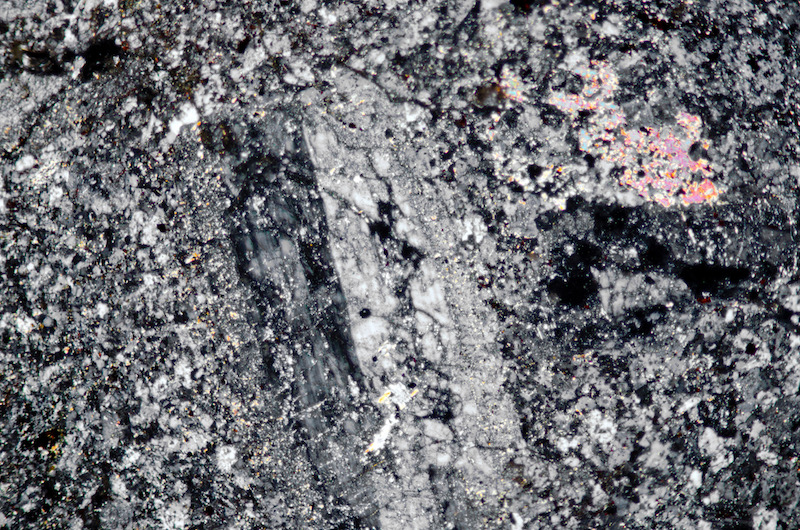
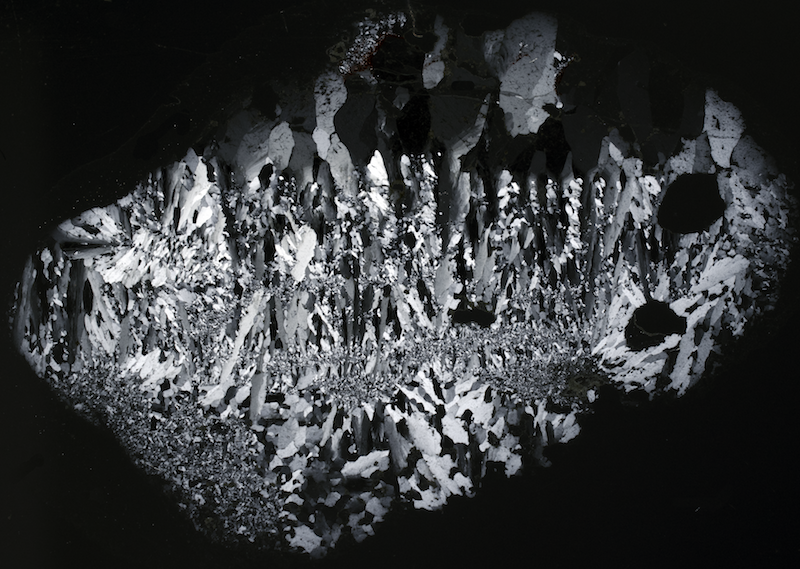
In this area, two faults intersect to form a crush zone where the rocks have been repeatedly stressed and broken by mechanical action along each fault and cemented and re-cemented by quartz deposited in the process of intense hydrothermal alteration. Many of the quartz-rich rocks are rich in tourmaline, it’s black veins and stringers contrasting sharply with the white silica. These minerals are often accompanied by the more oxidised states of iron oxide – haematite and limonite that contribute rich golden oranges and reds to the rocks.
Specimen 1
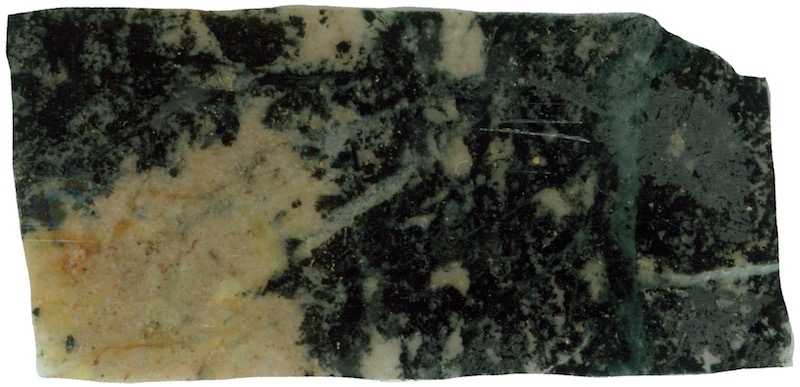
Prepared hand specimen in ordinary reflected light. (42mm across)
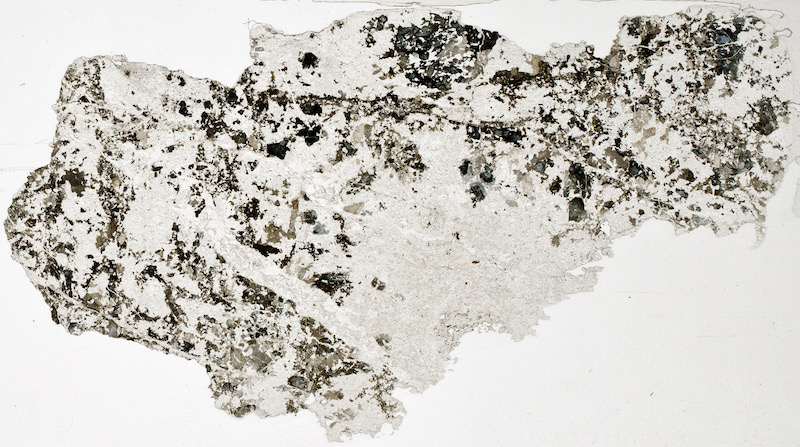

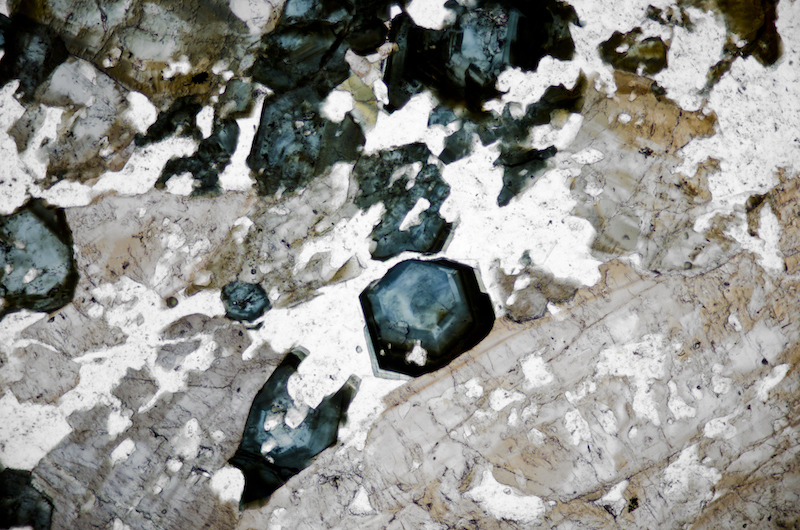
Section viewed in plane polarised light (FoV 2.3 x 1.5 mm)
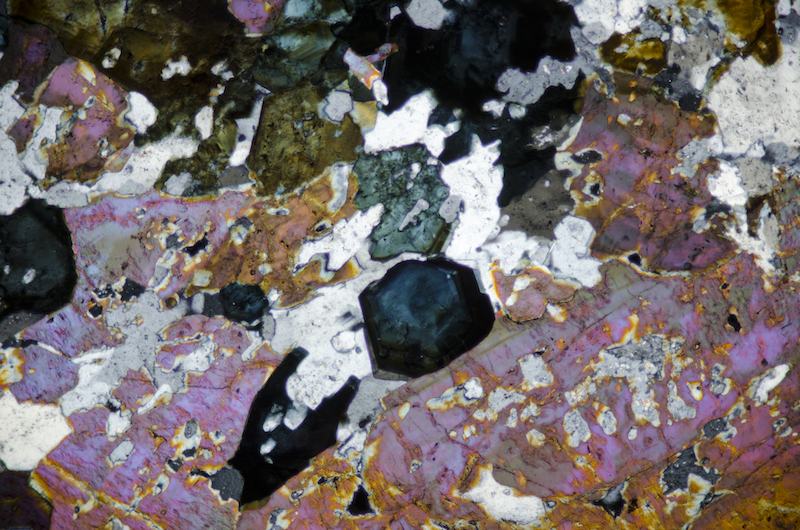
(FoV 2.3 x 1.5 mm)
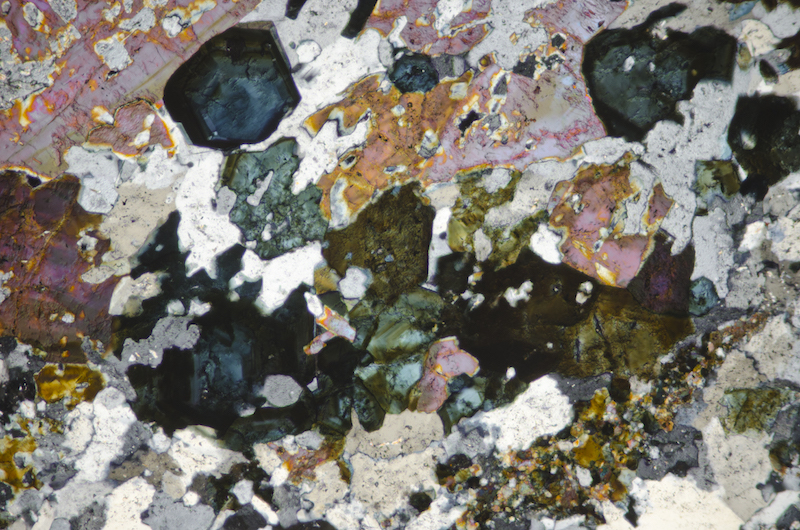
Some of the quartz occurs as inclusions within many of the tourmaline crystals suggesting that the quartz crystallised in advance of the tourmaline. Section viewed with crossed polarising filters (FoV 2.3 x 1.5 mm)
Specimen 2
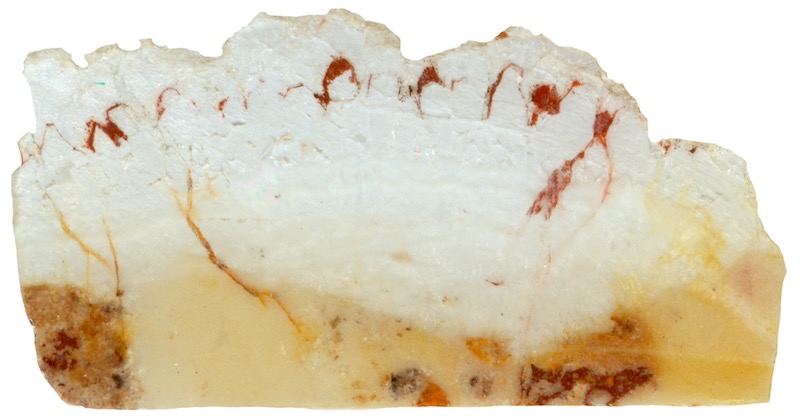
Prepared hand specimen in ordinary reflected light (45 mm across)

At this point the Hawson Burn is hedged in by small cliffs of altered andesite. It is the red, haematite-rich variety that also contains tourmaline.

Prepared hand specimen in ordinary reflected light (42mm across)

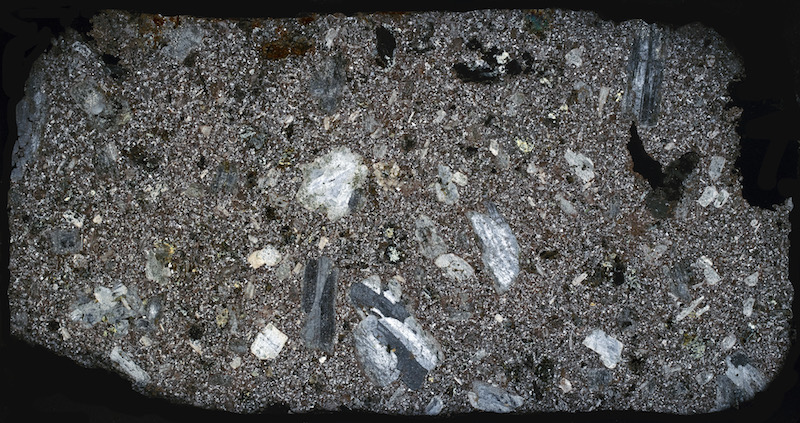
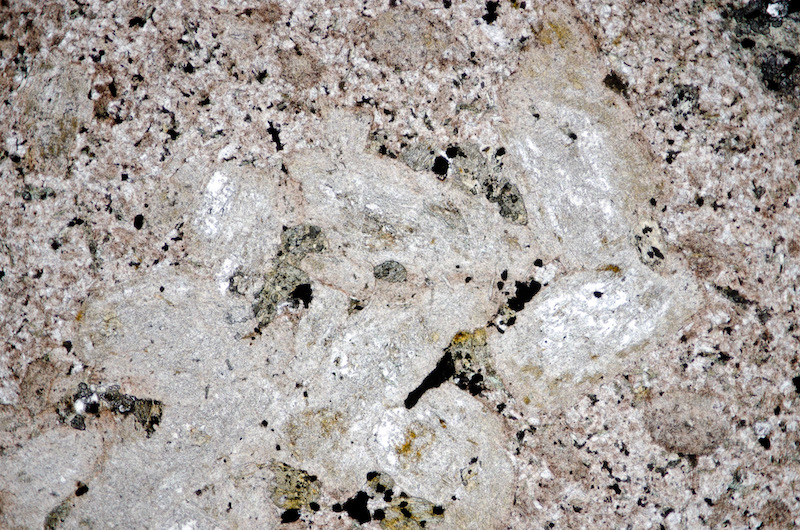
Section viewed in plane polarised light (FoV 4.6 x 3.0 mm)
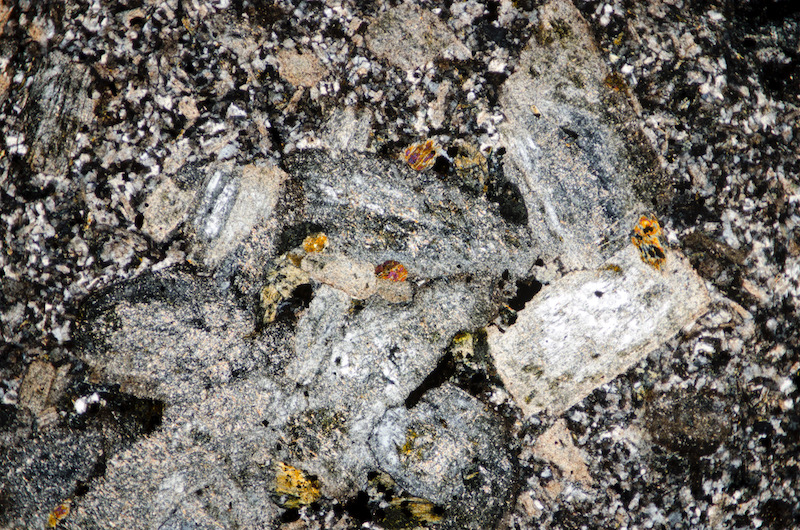
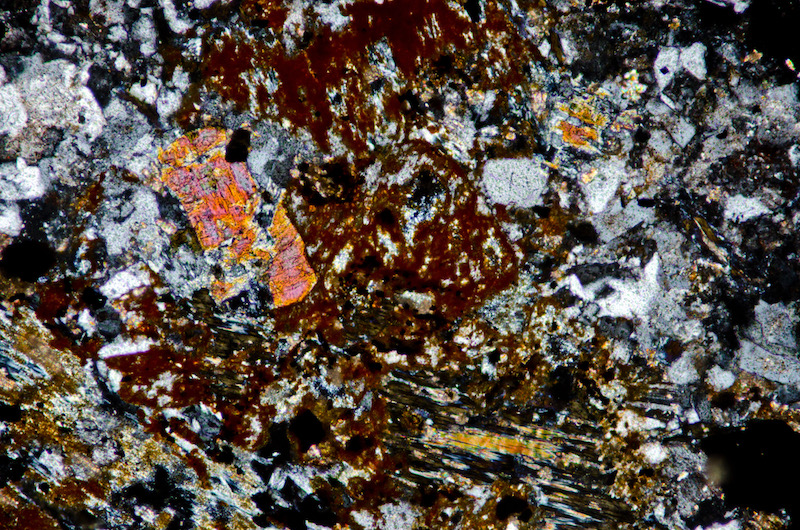
Section viewed with crossed polarising filters (FoV 1.2 x 0.8 mm)

The path that will take us over to location 7 runs parallel to the Hawsen Burn just 30 metres or so to the north. So, we scramble up to it and continue west, over the side of Broadhope Hill and down towards the isolated Lambden Valley. There are no outcrops up here and the path is indistinct so we make our way as best we can.
We are heading for the screes and outcrops of red rocks at the base of Preston Hill; the location of more of what Al-Hafdh identifies as evolved ‘Woolhope’ granite. We decide to avoid the path through the plantations around NT926231 because it is largely concealed by fallen trees and overgrowth. Instead, we take the farm track at NT928231 for a couple of hundred metres heading north-west and then take the turn west at NT927233 thereby skirting the northern edge of the triangular plantation and rejoining the path at the western point of the plantation.
From here we continue for another 100 metres or so and then drop down to the outcrops that lie just above the Lambden Burn.
The BGS online map shows dyke-like extensions of the pluton that intrude into the andesite lavas. There is a lot of scree but amongst it there are a few small outcrops of bedrock.
As is often the case in these junction zones, there is a substantial range in the appearance of the rocks over a short distance – in this case about 100 metres. Once again, here at the periphery of the pluton there is a good deal of silica veining evidencing movement in the rocks and the circulation of hydrothermal fluids.
In thin section, most of the rock turns out to be andesite with one outcrop of granitic rock that has similarities to that found on high Cheviot containing plagioclase and biotite phenocrysts.


Prepared hand specimens in ordinary reflected light
Specimen 1
The first specimen is the one and only specimen of granitic rock that we take. It has numerous plagioclase and some biotite phenocrysts in a fine to medium grained ground in which some of the quartz and feldspars have pronounced micrographic textures. All of the feldspars have been made turbid with iron oxide.
The specimen includes fragments of hornfelsed andesite that looks to have been recrystallised with many small grains of iron-titanium oxide and biotite present.
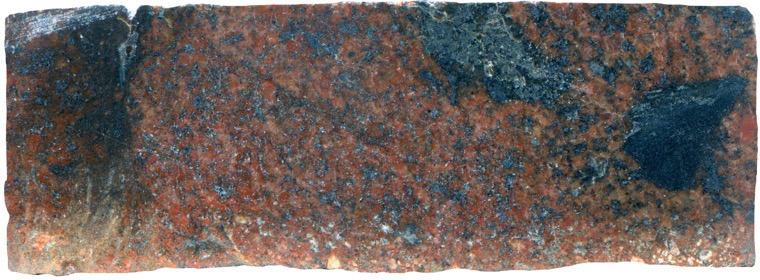
Prepared hand specimen in ordinary reflected light.
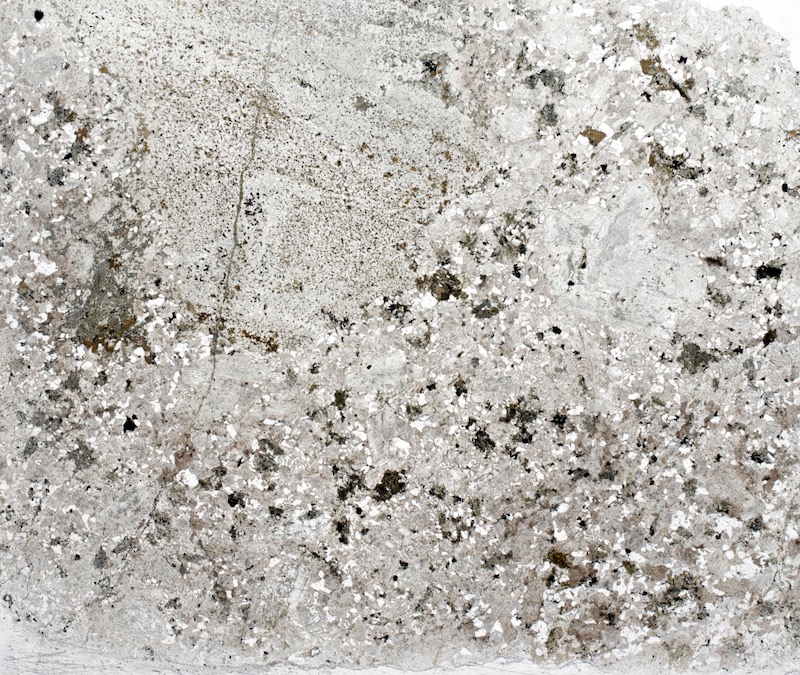
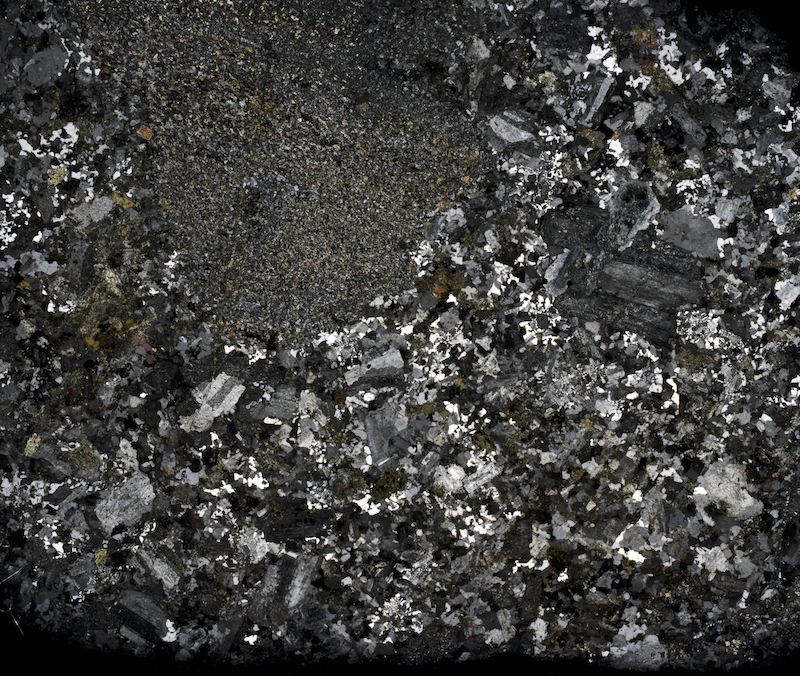
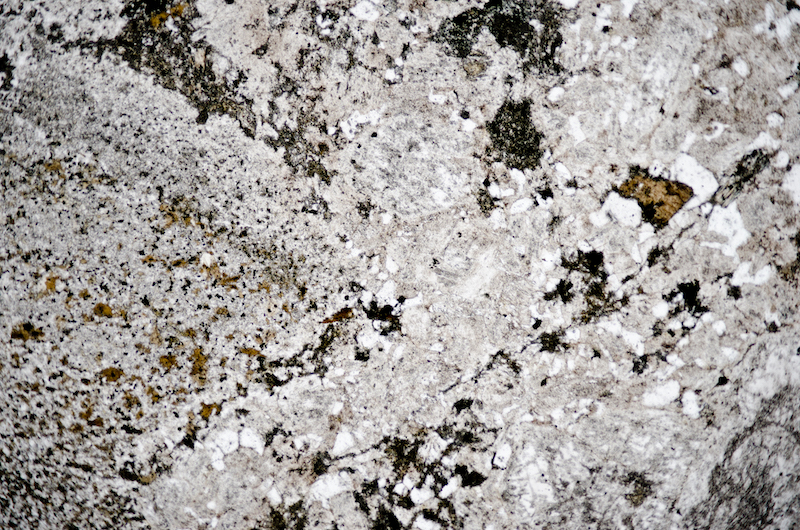
Section viewed in plane polarised light (FoV 4.6 x 3.0 mm)
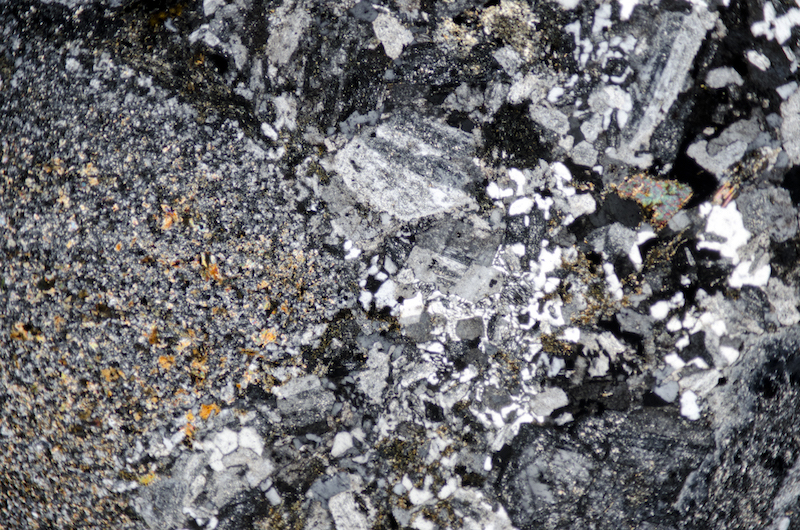

Section viewed with crossed polarising filters (FoV 2.3 x 1.5 mm)
Specimen 2
The second specimen is similarly brecciated and cemented with quartz stringers although the lithic fragments are not so obviously andesite. There is no sign of biotite in them, only one very altered plagioclase phenocryst and they do contain some quartz although this could be due to alteration.
The sample also contains a very small amount of tourmaline.
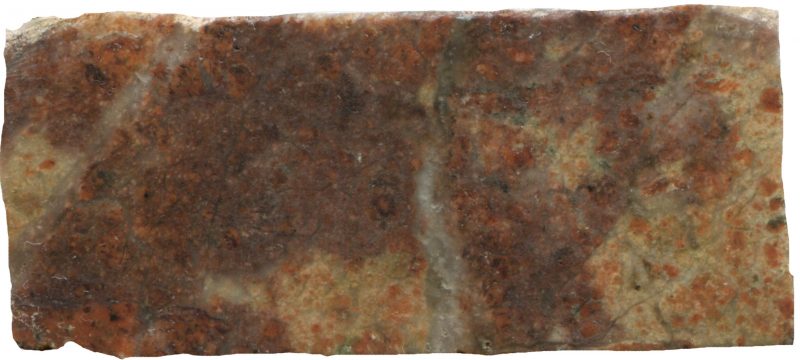
Prepared hand specimen in ordinary reflected light (48mm across)
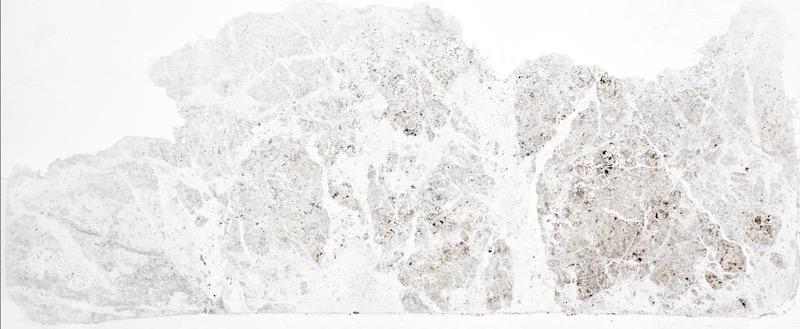
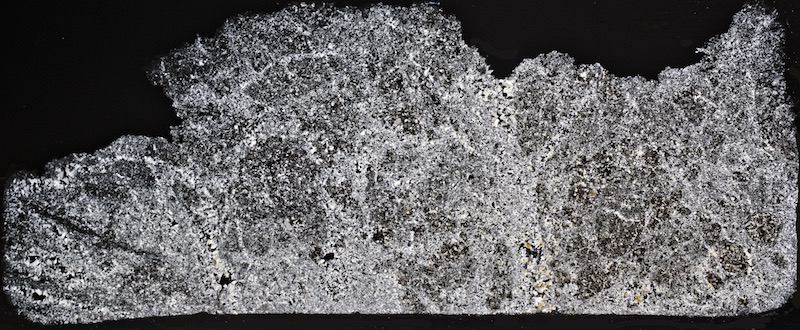
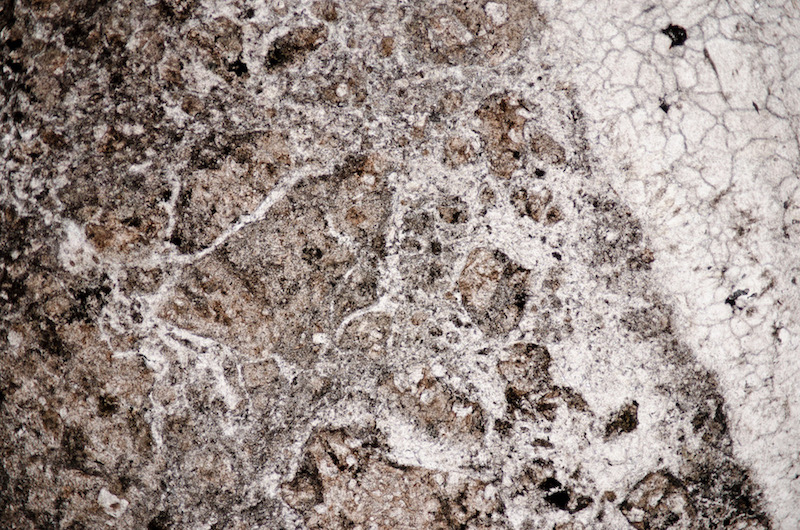
Section viewed in plane polarised light (FoV 4.6 x 3.0 mm)

The section has been left slightly thick so as to reveal the quartz in the lithic fragments

Section viewed in plane polarised light (FoV 4.6 x 3.0 mm)
Specimen 3
More andesite that has been fractured and cemented with silica. This one has some bright golden yellow staining associated with one silica veinlet and a very nice example of zoning in a basal section of a plagioclase crystal.

Prepared hand specimen in ordinary reflected light. (55mm across)

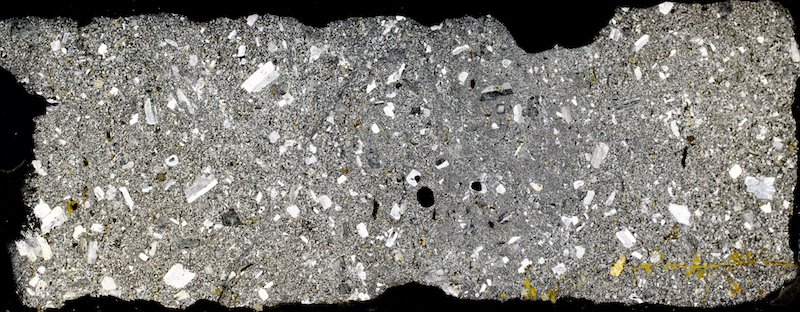
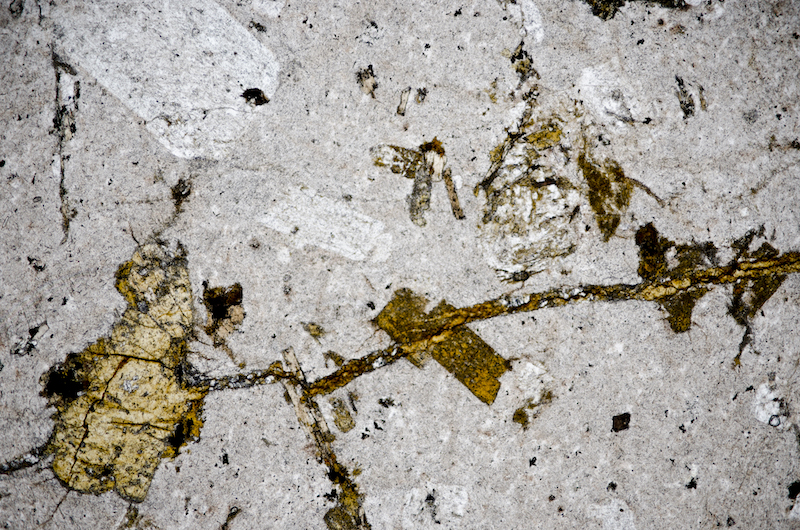
Section viewed in plane polarised light (FoV 4.6 x 3.0 mm)
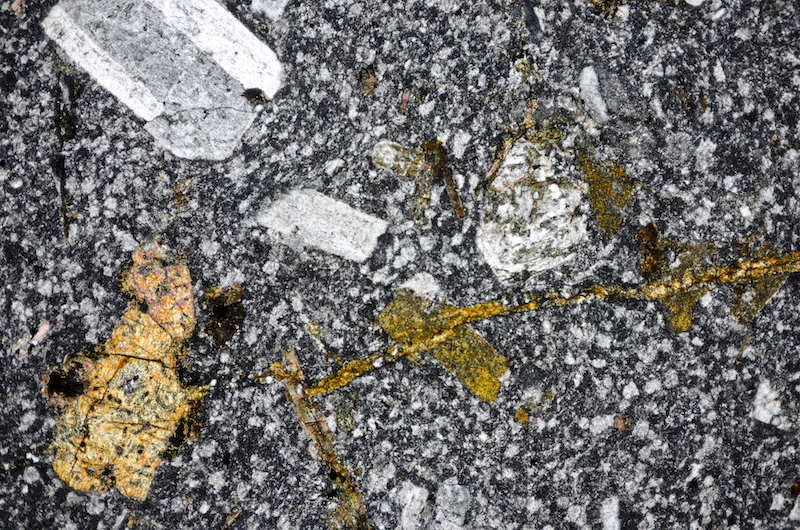
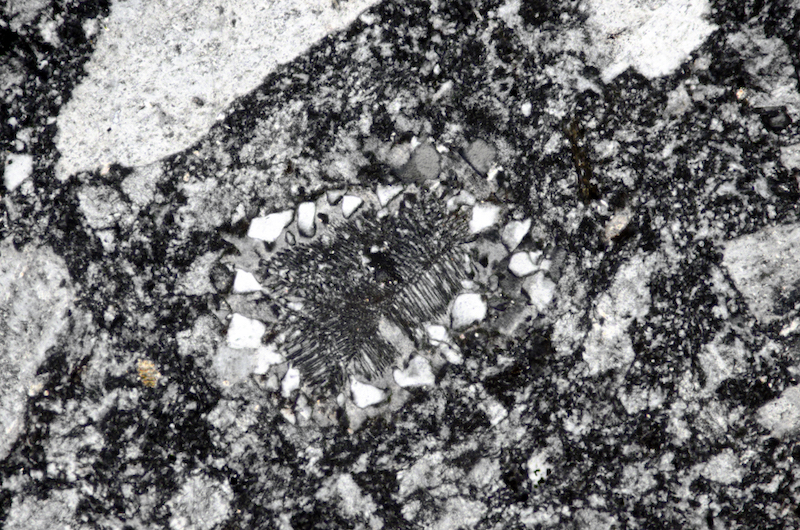
Section viewed with crossed polarising filters (FoV 1.2 x 0.8 mm)
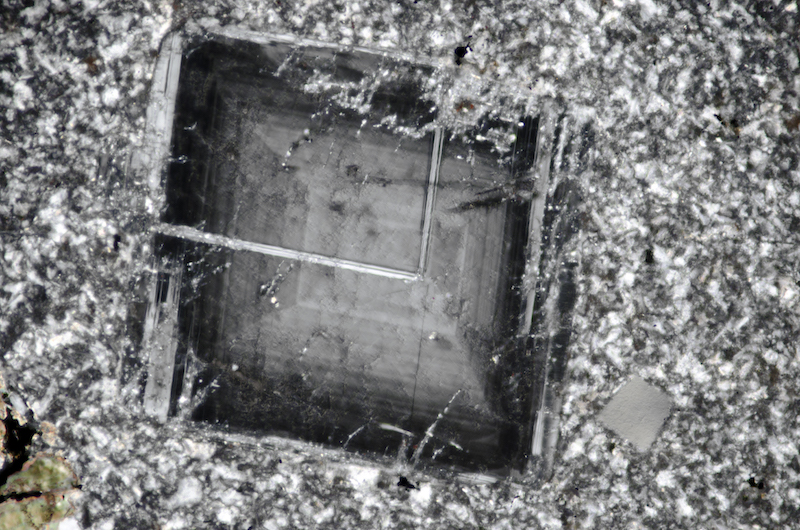
Section viewed with crossed polarising filters (FoV 1.2 x 0.8 mm)
Specimen 4. Fractured, silica veined, chloritised andesite.
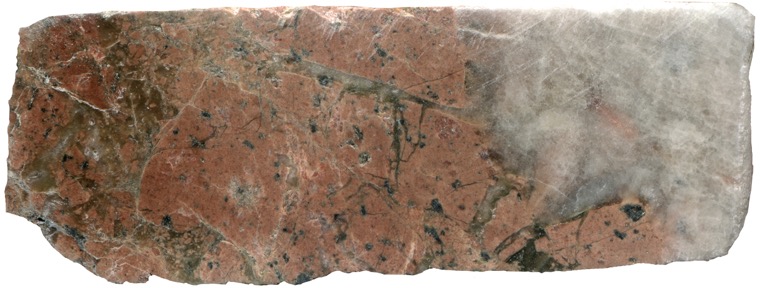
Prepared hand specimen in ordinary reflected light
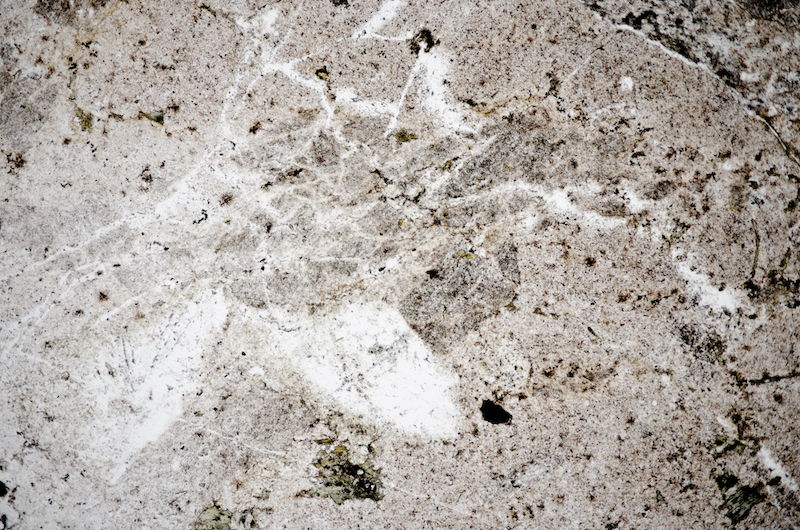
Section viewed in plane polarised light (FoV 4.6 x 3.0 mm)
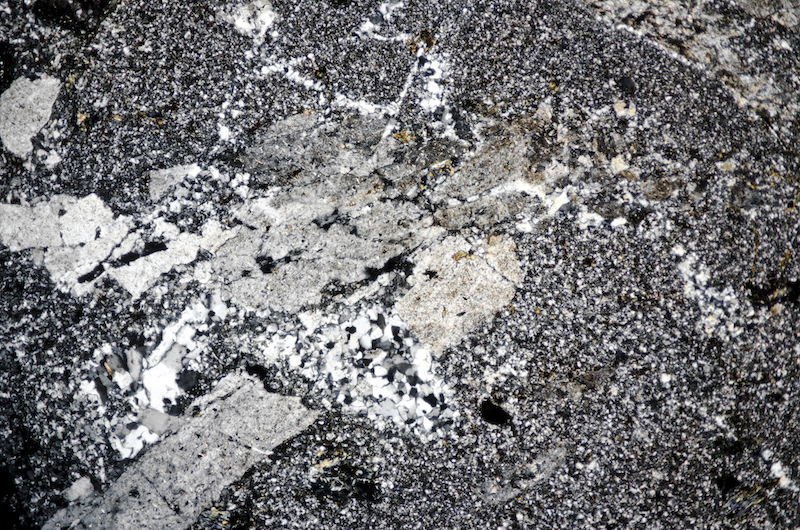
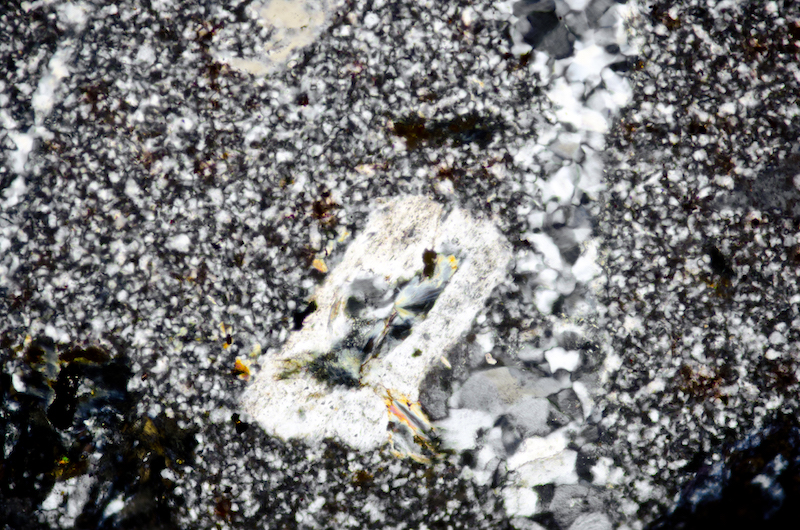
Section viewed with crossed polarising filters (FoV 1.2 x 0.8 mm)

Having crossed from the north to the south bank of the burn, we head across open country in the direction of Woolhope Crag aiming to explore for exposures in the upper Lambden Burn.
We pick up the forestry track and head east until we arrive at the small plantation. The stones in the burn are typically red and felsic looking – similar in appearance to the evolved granite that we have already seen today. We head upstream and enjoy this delightful little woodland and, near it’s southern end, find a good exposure of bedrock that we sample.
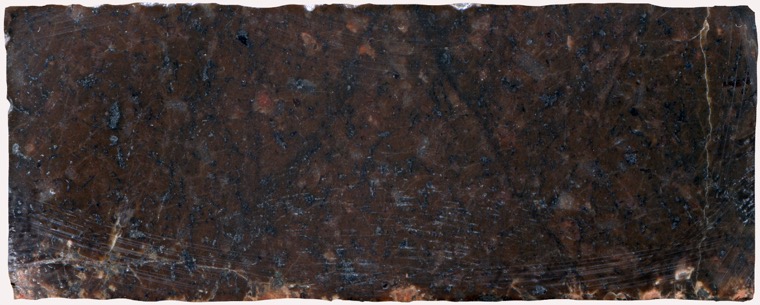
In the hand it is surprisingly dark and thin sections reveal a profusion of dark specks that are mostly tourmaline. The rock has been intensively altered with sericite scattered throughout and large patches of white mica occurring in association with silica veining.
Much of the dark material is tourmaline. Prepared hand specimen in ordinary reflected light (48mm across)


Section viewed in plane polarised light (FoV 4.6 x 3.0 mm)

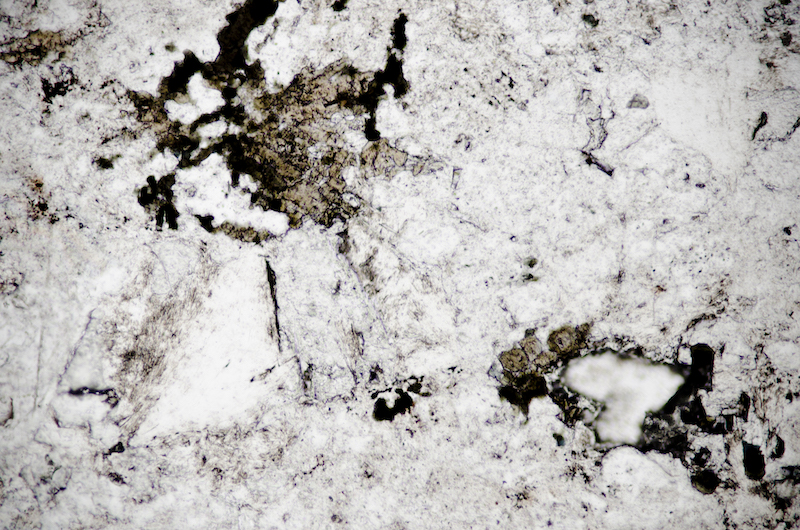
Section viewed in plane polarised light (FoV 1.2 x 0.8 mm)

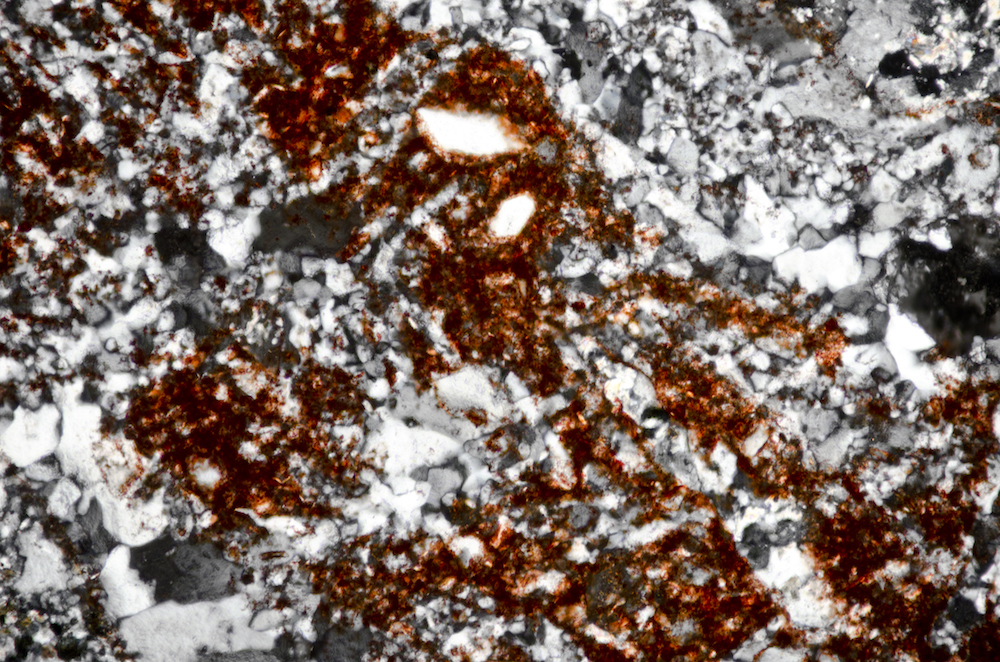
Section viewed with crossed polarising filters (FoV 1.2 x 0.8 mm)
We start our return leg of the excursion by following the forest track east and then north to finally cut across rough land again to meet the track leading over to the Hawsen Valley.
With the Hawsen Burn below us, we leave the path and follow the track that leads directly up to Hawsen Crags.
The crags are andesite, both the red and the black types each containing the usual pyroxene and andesine plagioclase phenocrysts. One thin section reveals a biotite crystal included in plagioclase and also a plagioclase crystal included in biotite suggesting their crystallisation overlapped.
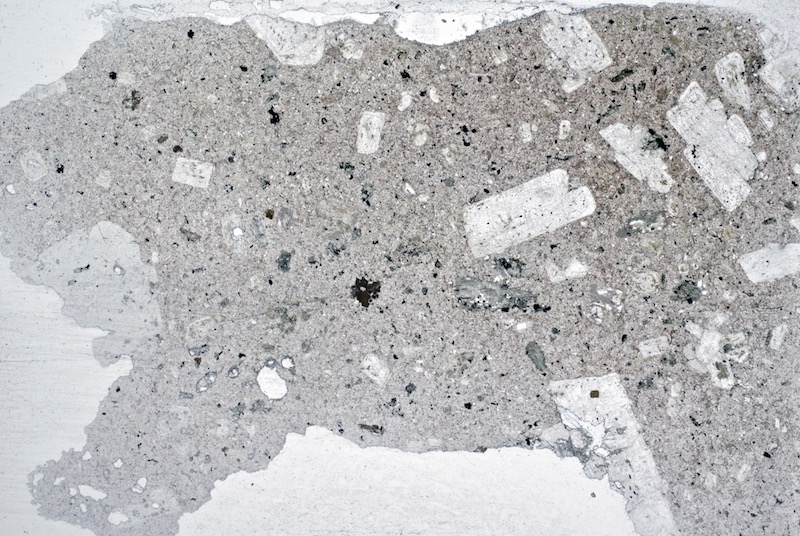
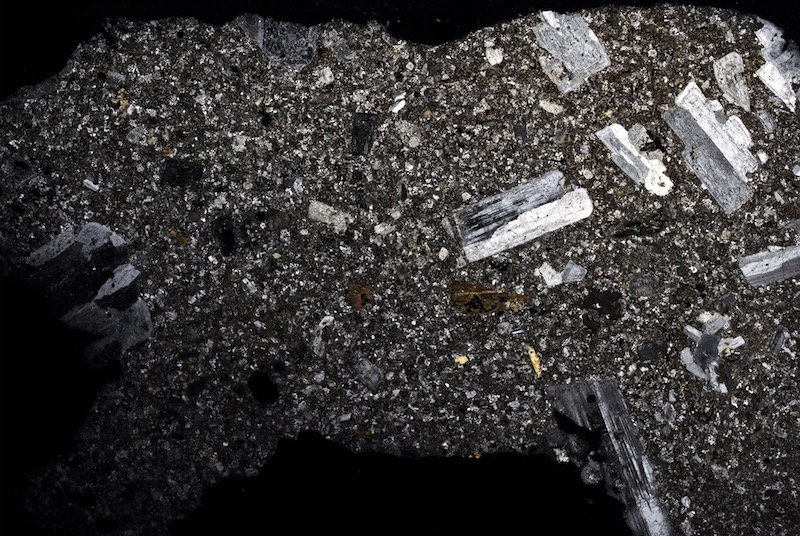
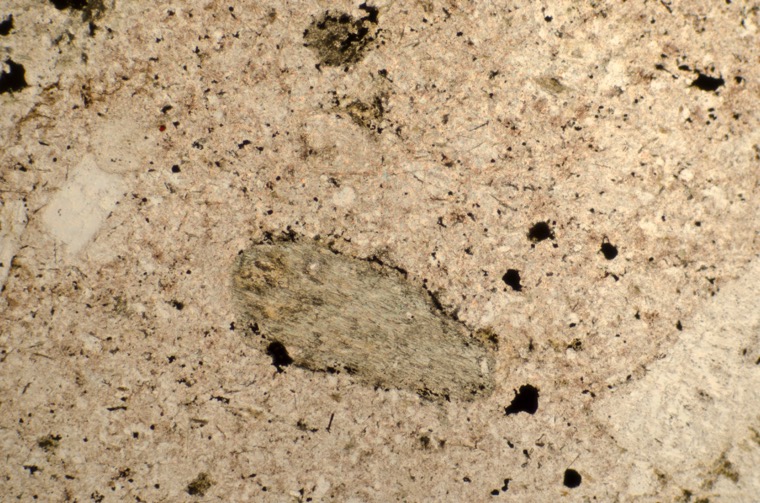
Section viewed in plane polarised light (FoV 2.3 x 1.5 mm)
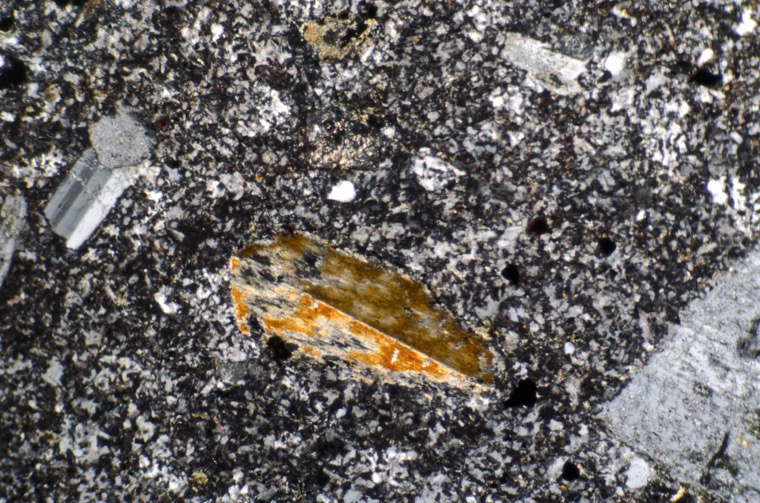
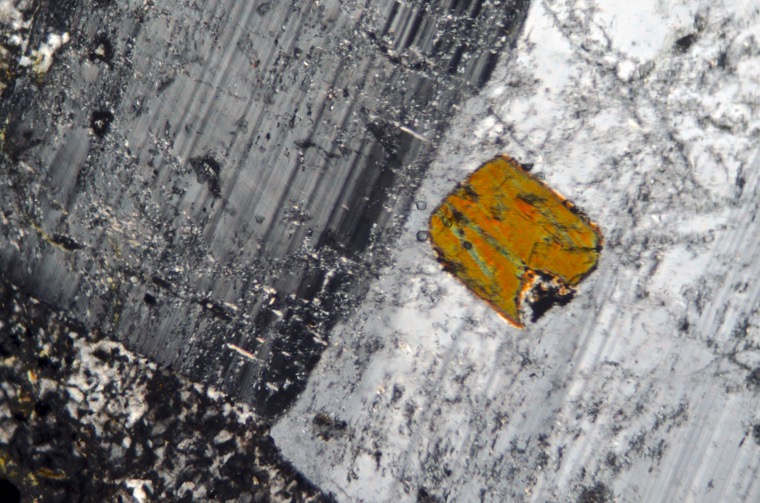
Section viewed with crossed polarising filters (FoV 1.2 x 0.8 mm)
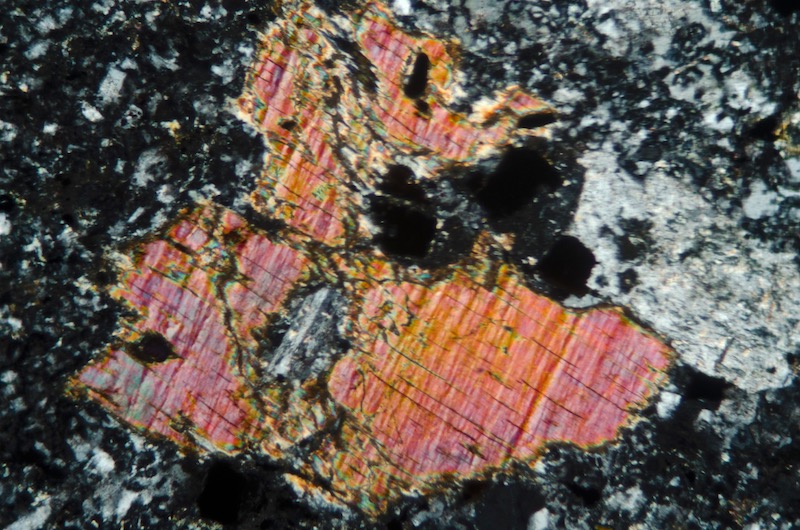
Section viewed with crossed polarising filters (FoV 1.2 x 0.8 mm)
We head due west in search of an outcrop of the mica-porphyry intrusion that is shown on the BGS map. In the event, we make do with a cobble of what looks like the stuff, collected from a number of them scattered around the head of Butterwell Syke.
Thin sections reveal a very quartz-rich rock, very different from the porphyry and quartz-porphyry we’ve seen elsewhere. Perhaps the high quartz content is related to the intense sericitic alteration the rock has been subjected to, but perhaps it reflects its original composition. Clearly we need to return here and search Cold Law for outcrops.
The rock has many rafts of what look like plagioclase xenocrysts or even, in some cases, small xenoliths, usually surrounded by quartz and feldspar in a granophyric texture.
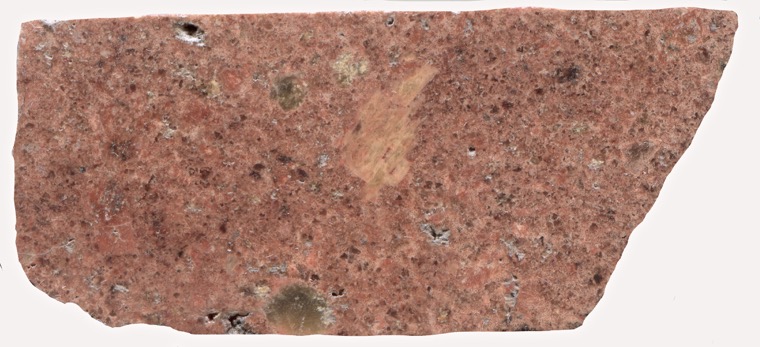
Prepared hand specimen in ordinary reflected light (42mm across)
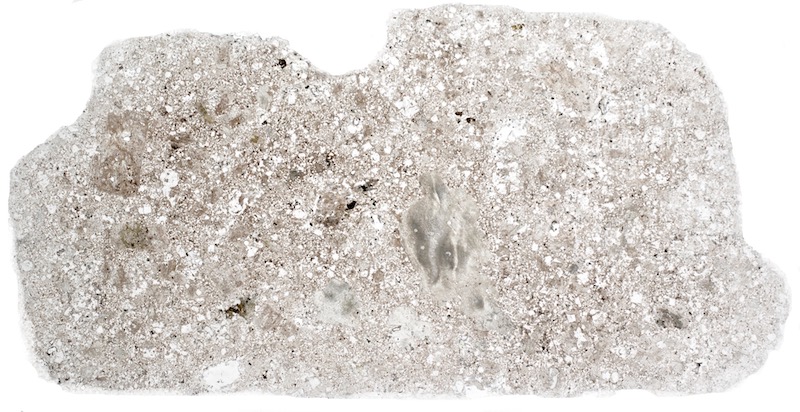

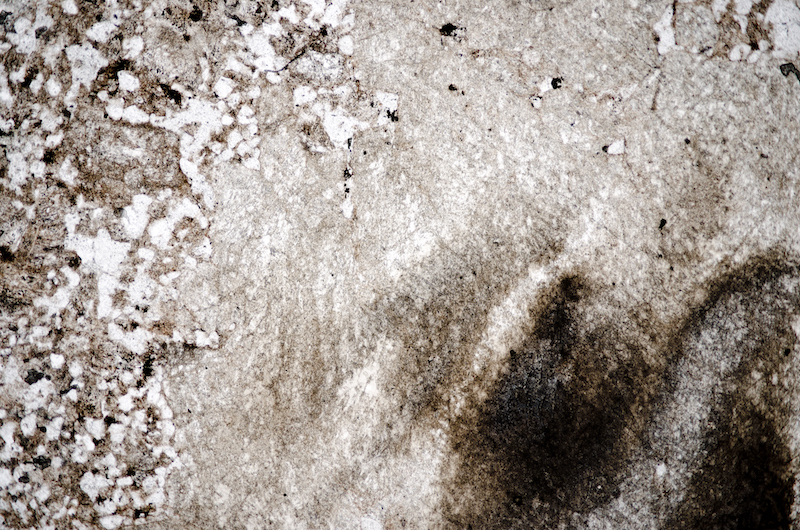
Section viewed in plane polarised light (FoV 4.6 x 3.0 mm)
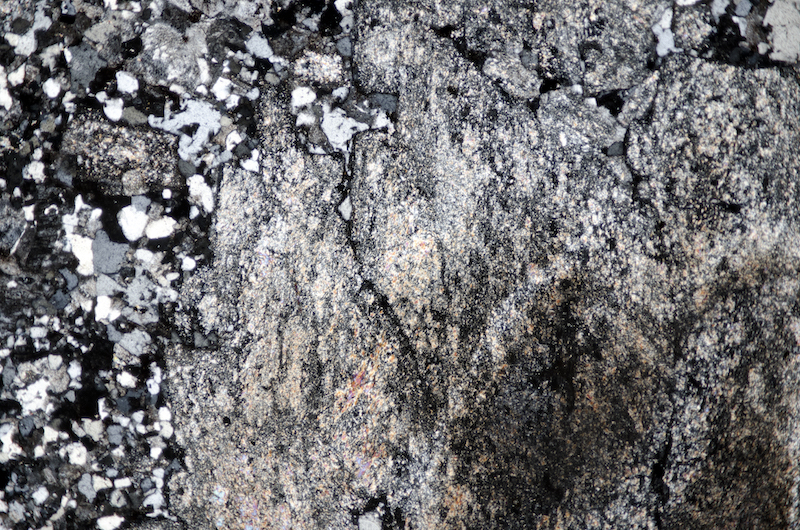
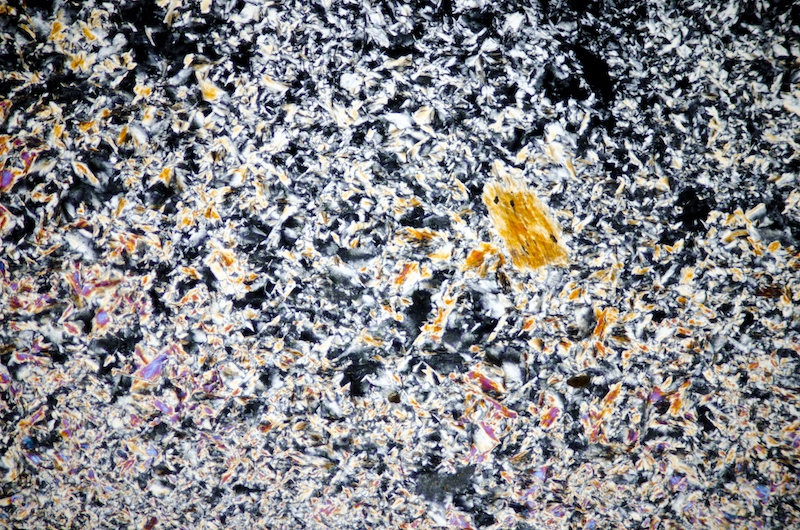
The biotite has been altered to white mica. Section viewed with crossed polarising filters (FoV 2.3 x 1.5mm)

Section viewed in plane polarised light (FoV 2.3 x 1.5 mm)
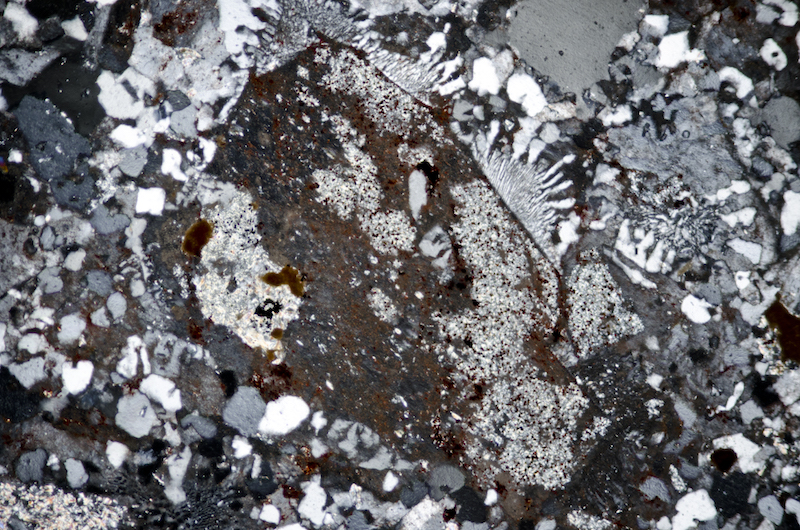
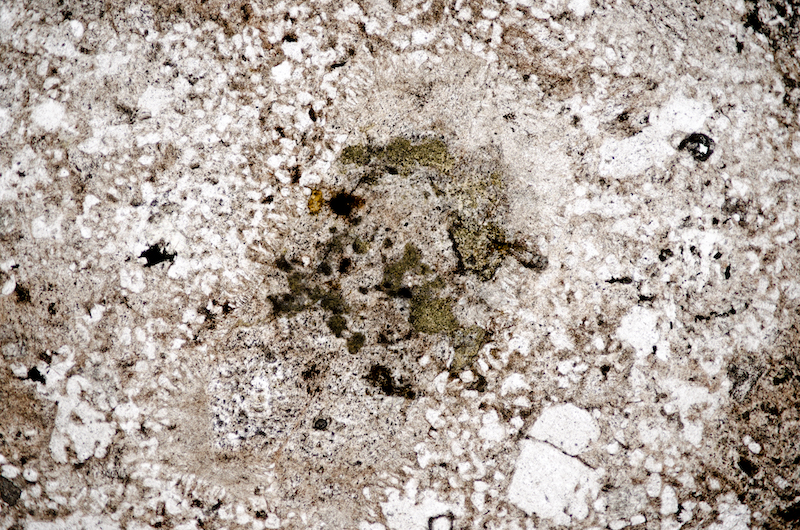
Section viewed in plane polarised light (FoV 4.6 x 3.0 mm)
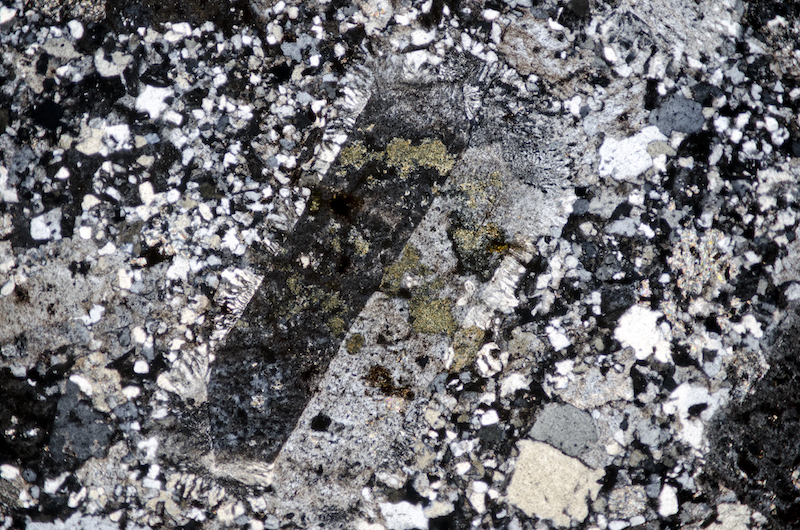
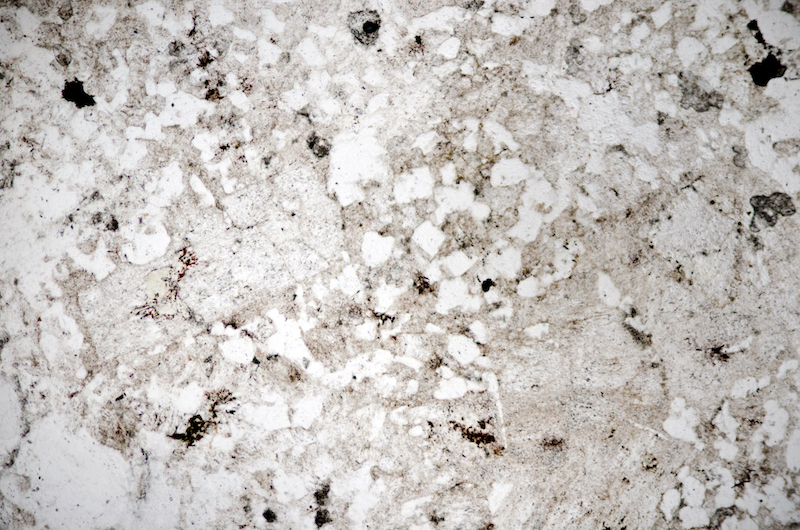
Section viewed in plane polarised light (FoV 2.3 x 1.5 mm)


The rock resembles a porphyry dyke but it may be an outcrop of the pluton
We follow Butterwell Syke down to the valley bottom, cross the Hawsen Burn and pick up the track on the west bank that takes us to location 11, a small outcrop that we have noticed.
At first we think it is probably more of the evolved granite, certainly the BGS map shows this area to be granitic, but thin section reveals it to be more like a mica-porphyry dyke. No dyke is shown on the map so perhaps it is another variant on the evolved, less mafic, type.
There are large plagioclase phenocrysts or, quite likely, xenocrysts that are almost completely sericitised as were those at location 10, and there would also have been biotite – but this has been altered to white mica (also sericite). There is a good deal of perthite and there is a little quartz that may be an alteration product as it is in close association with the tourmaline that appears in the rock.
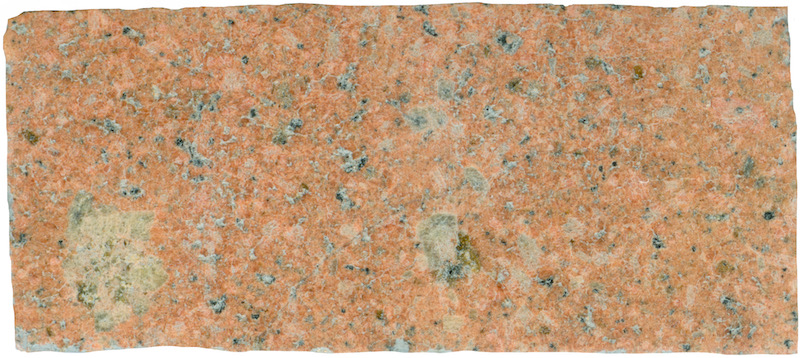
Prepared hand specimen in ordinary reflected light (48mm across)
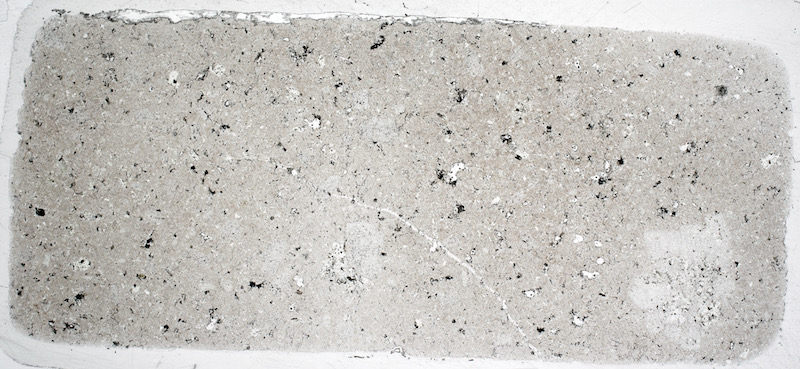
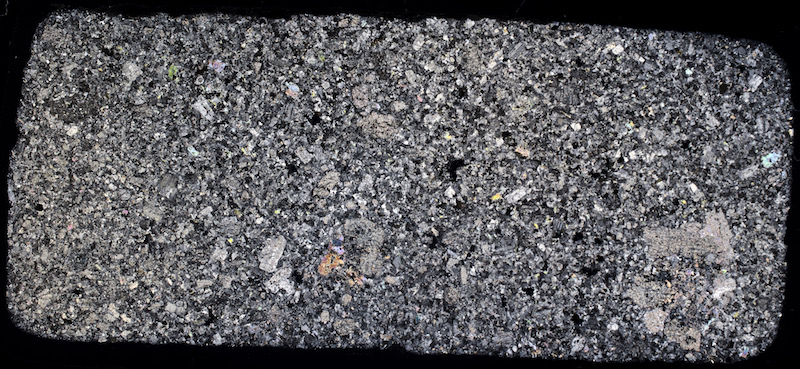

Section viewed in plane polarised light (FoV 4.6 x 3.0 mm)

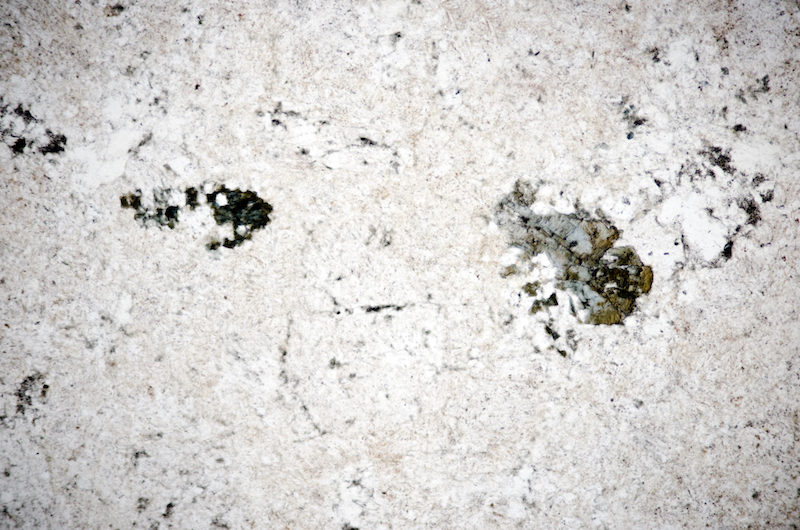
Section viewed in plane polarised light (FoV 2.3 x 1.5 mm)
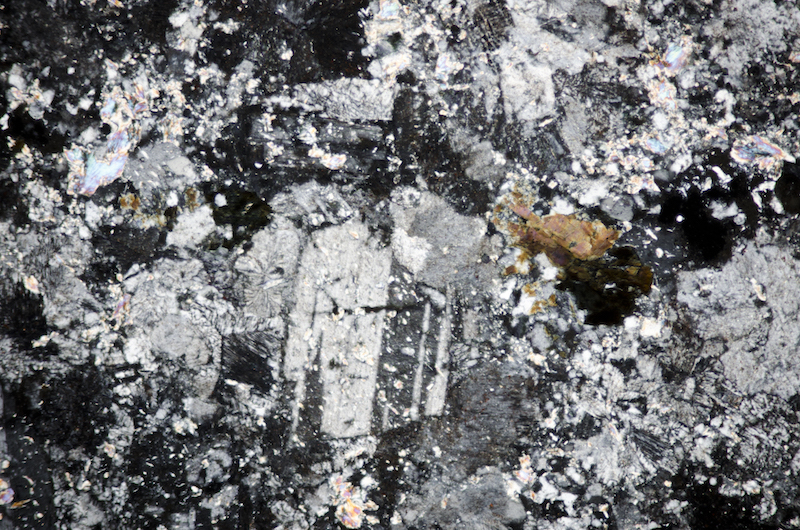
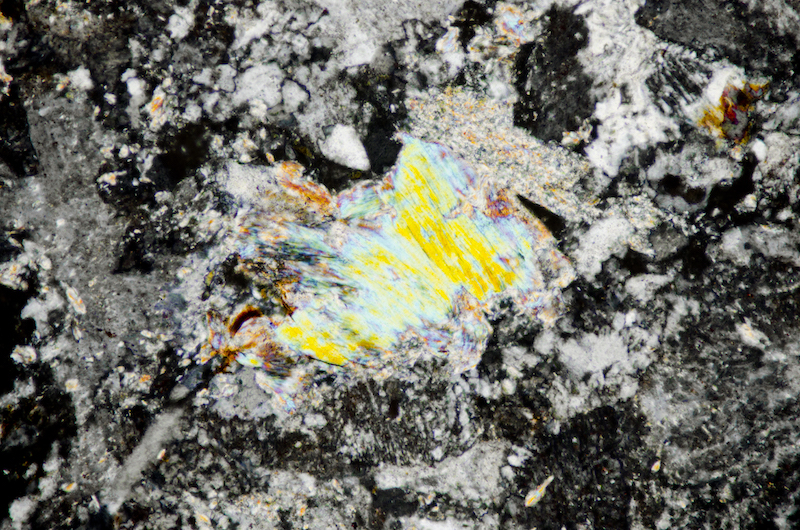
Section viewed with crossed polarising filters (FoV 1.2 x 0.8 mm)

Section viewed in plane polarised light (FoV 4.6 x 3.0 mm)
Return to car
Leaving location 11, we follow the track down to the road to Langleeford where we turn left and return to the car.
References
N.M. Al-Hafdh, 1985. The Alteration Petrology of the Cheviot Granite. Thesis submitted for PhD. at Newcastle University.
J. G. Mitchel, K. M. Storetvedt, D. A. Robson, M. C. Abranches, and P. R. Ineson, 1993, Evidence for Carboniferous thermochemical overprinting in the Cheviot Complex, Scottish Journal of Geology 29, (1), 55-68,
C. Scruton (ed) 1995, Northumbrian Rocks and Landscape: a field guide, Yorkshire Geological Society.
British Geological Survey,/strong> Online geology map http://mapapps.bgs.ac.uk/geologyofbritain/home.html