Map showing the excursion route, locations and igneous rock types


There are no exposures of bedrock on this well-worn walk up Cheviot other than that at Woolhope Crag which we will take in on the return leg. However, there are many loose rocks lying on and around the footpath and we think it is probable that the rock types we find amongst them represent the rocks types that underlie the peat.
We are aiming to continue our investigation of the fine to medium-grained sub-equigranular, ‘sugar textured’, felsic granite that Al-Hafdh called the ‘Woolhope’ type.
We believe it is the predominant type in the stones, cobbles and boulders that litter the top of Cheviot and we know that it outcrops at Woolhope Crag – but how constant is its composition and are we justified in following Al-Hafdh in recognising it as a distinct type?

Loose granitic rock, much of it with quartz veins, litter the footpath up to Cheviot
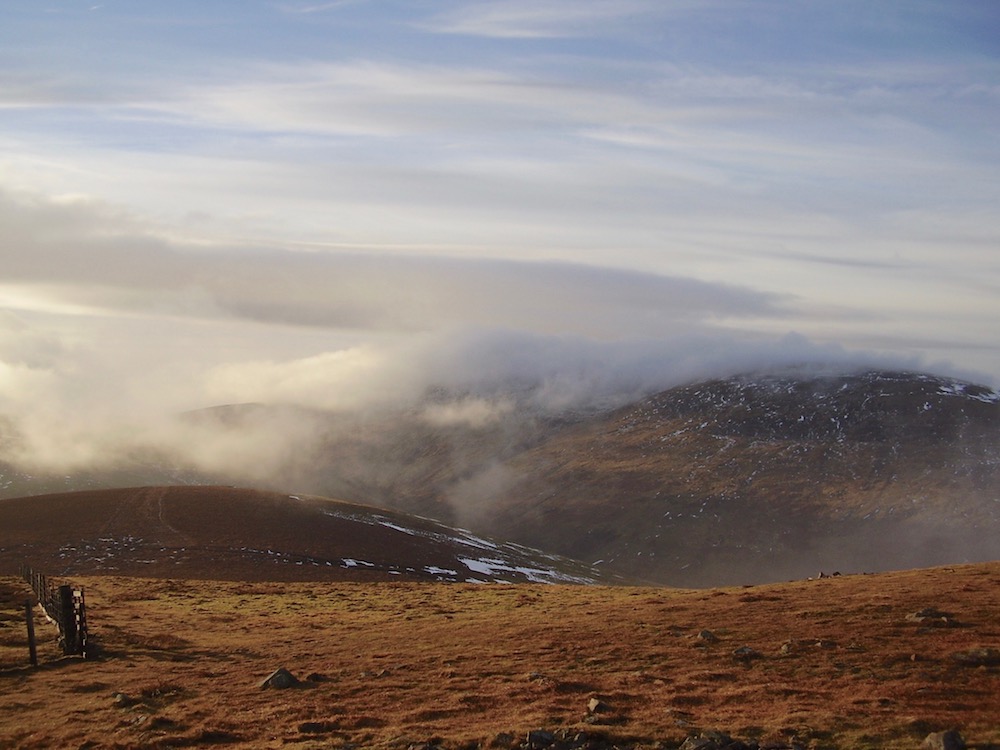
Hedgehope is visible (centre) to the south-east.
From location one on Scald Hill to location two at the large boulder to the left of the path up to Cheviot, erosion along the footpath has exposed many stones and cobbles. Amongst them, we find many with tourmaline and quartz that is often stained orange-red by haematite. Sometimes the tourmaline is in lumps, sometimes in stringers criss-crossing the rock but it is always in association with quartz.
The presence of silica veining with haematite in the fractures and faults in the Cheviot complex has been associated with tectonic processes in the Hercynian, occurring between 325and 300 Ma.
These physical and chemical processes, constituting the last phase of igneous activity, are thought to have enabled the fluid transport and deposition of silica through the lava, granite and dyke rocks. This caused widespread mineralogical changes in the rocks including the low-temperature oxidation of their iron-titanium oxides to haematite and also their re-magnetization.
Specimen 1
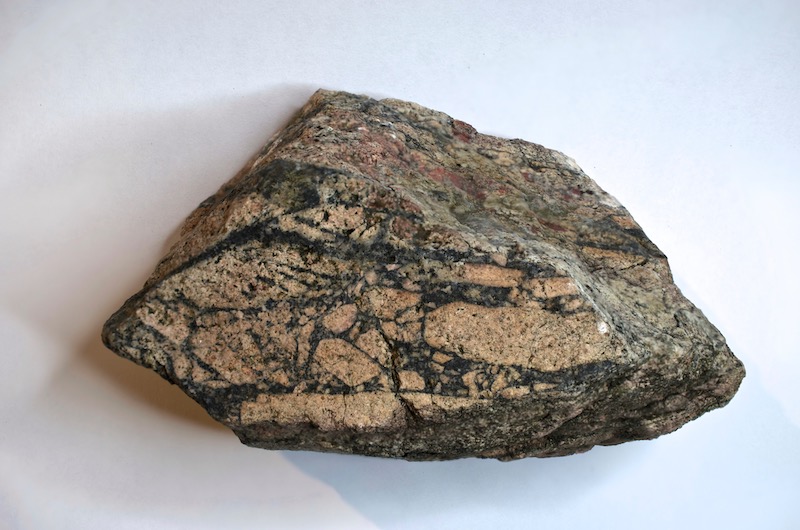
Hand sample


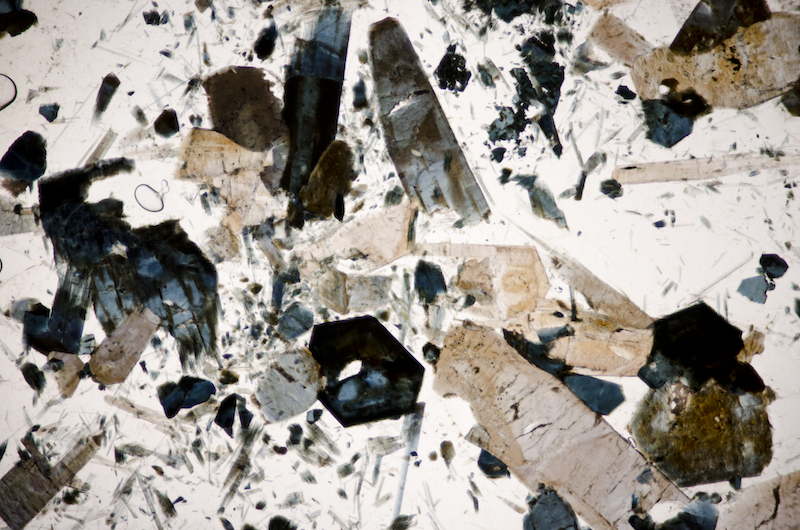
Section viewed in plane polarised light (FoV 4.6 x 3.0 mm)
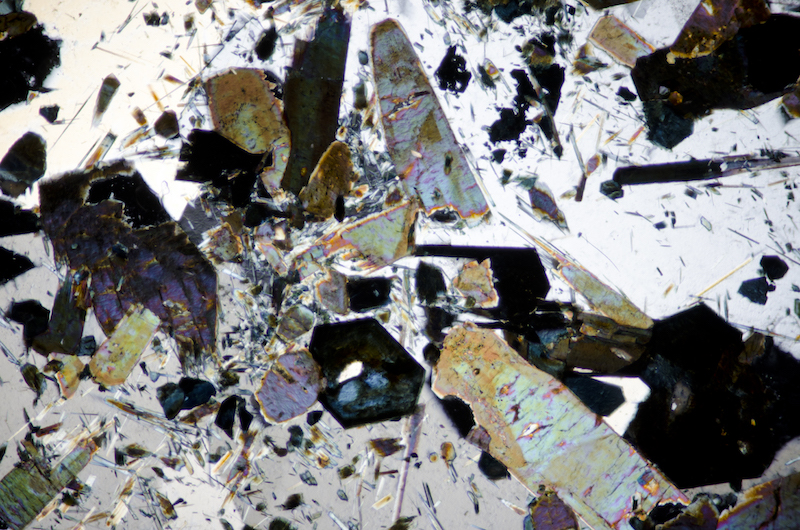

Specimen 2

Prepared hand specimen

Thin section viewed with crossed polarising filters (40mm across)
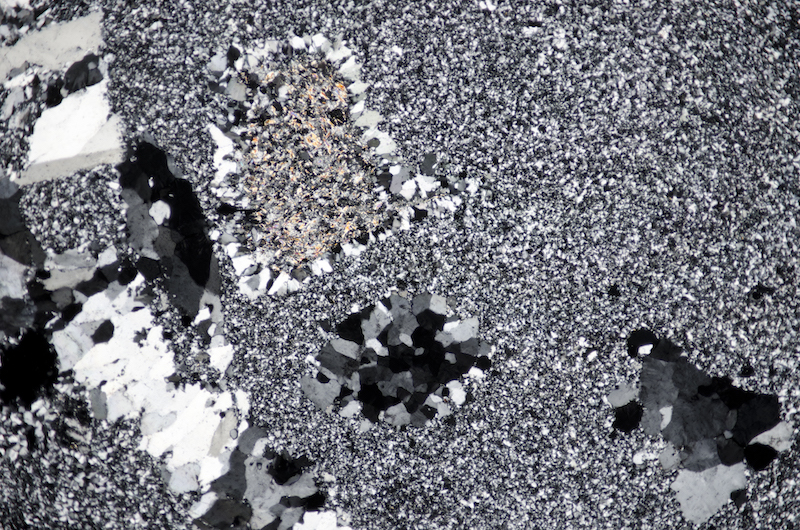
Section viewed with crossed polarising filters (FoV 4.6 x 3.0 mm)
Along with the quartz and tourmaline dominated rocks there are many pieces of red to grey granitic rock amongst the debris on the path.
Thin sections reveal that some of it is the sub-equigranular, alkali feldspar-rich ‘Woolhope’ type of Cheviot granite.
Other samples are of a different type, being more porphyritic in character with plagioclase phenocrysts in a fine-grained groundmass.
A third type of rock is much coarser grained and more mafic – so much so that we thought it might be the ‘Marginal’ type appearing here because of this location’s proximity to the roof of the magma chamber. In thin section, this rock is more akin to the ‘Central Belt’ rocks we see in the Harthope Valley below.
Specimen 3

There is an interesting alignment of biotite needles in this specimen.
Prepared hand specimen in ordinary reflected light (45mm across)


Section viewed in plane polarised light (FoV 2.3 x 1.5 mm)
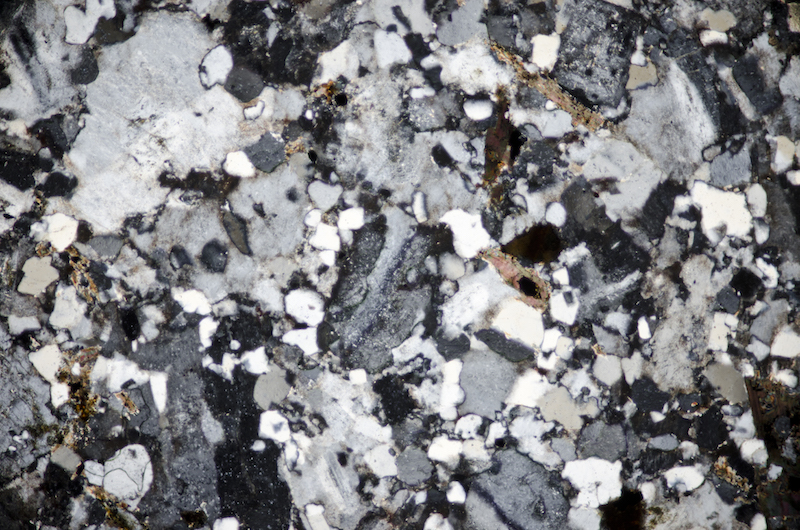
Specimen 4
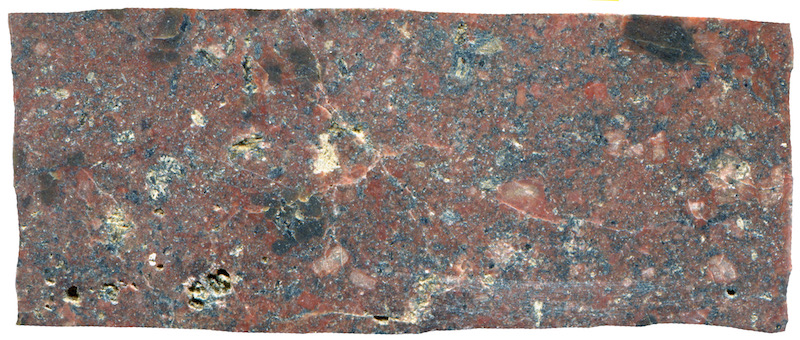
Prepared hand specimen in ordinary reflected light (50mm across)
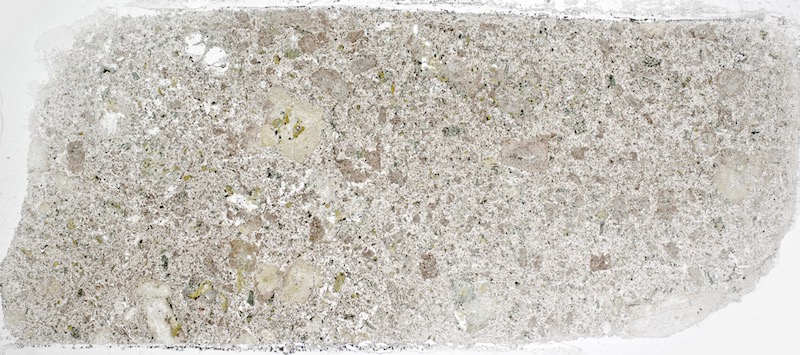

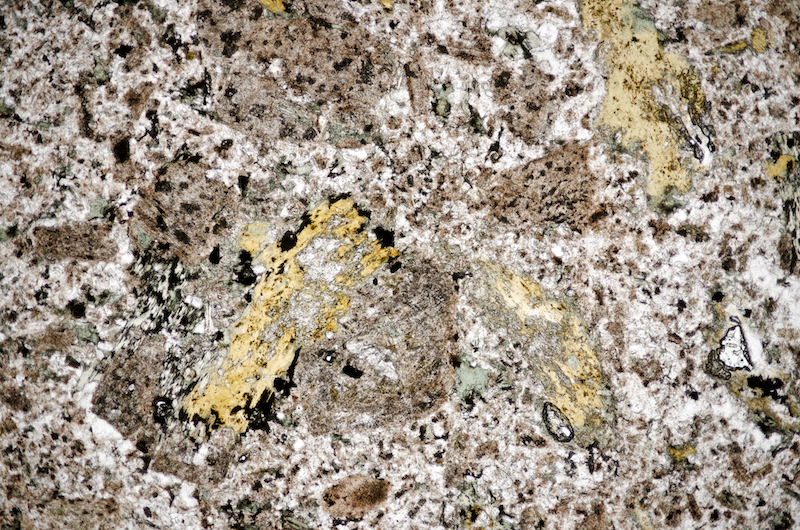
Section viewed in plane polarised light (FoV 4.6 x 3.0 mm)

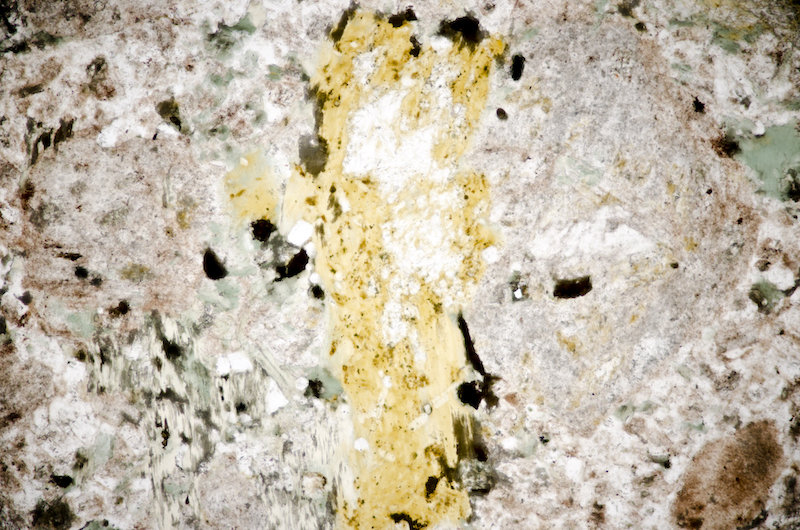
Section viewed in plane polarised light (FoV 1.2 x 0.8 mm)
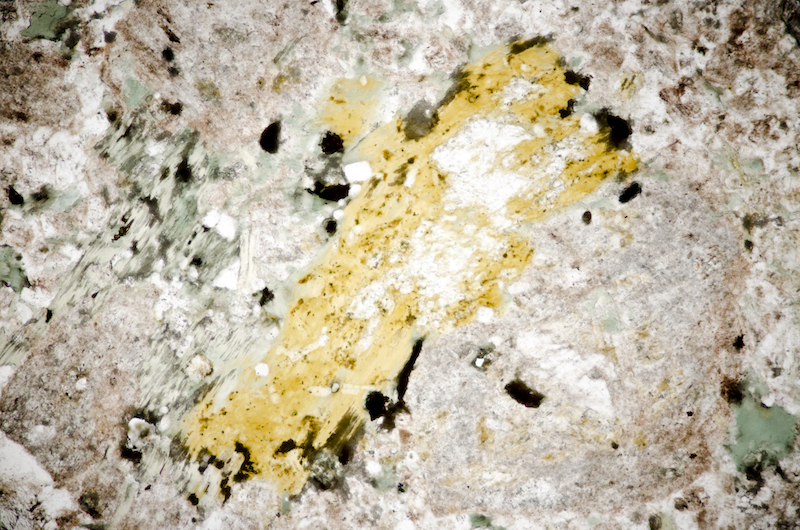
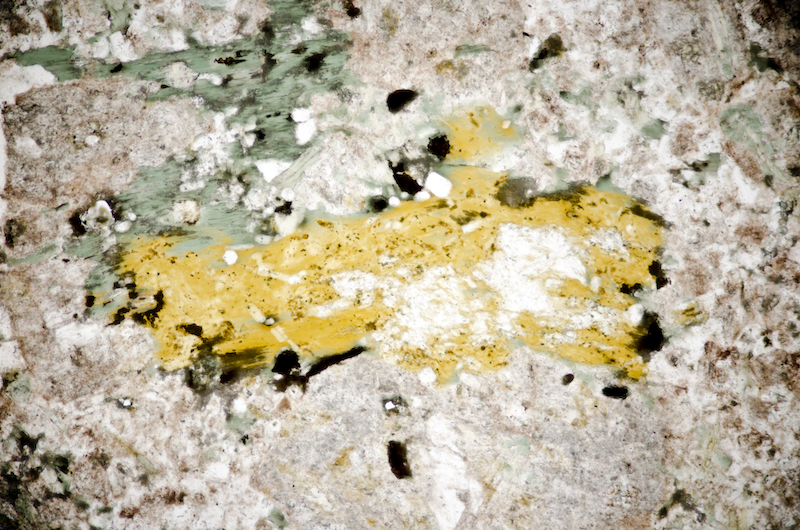
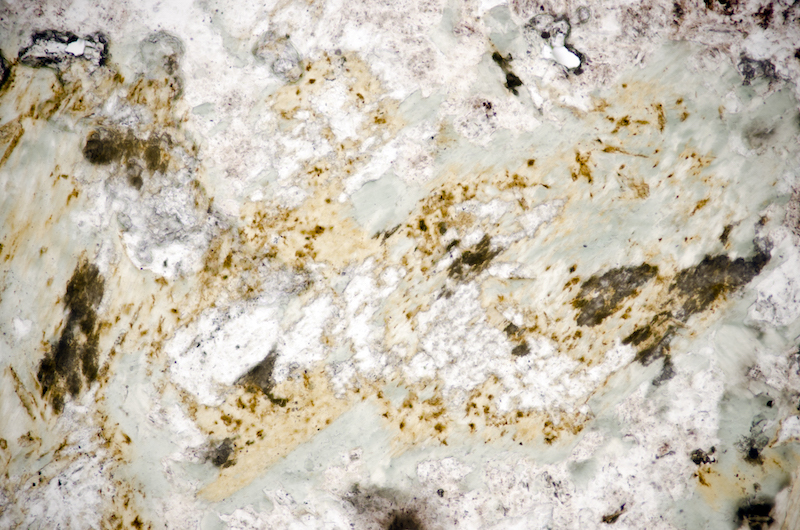
Section viewed in plane polarised light (FoV 2.3 x 1.5 mm)
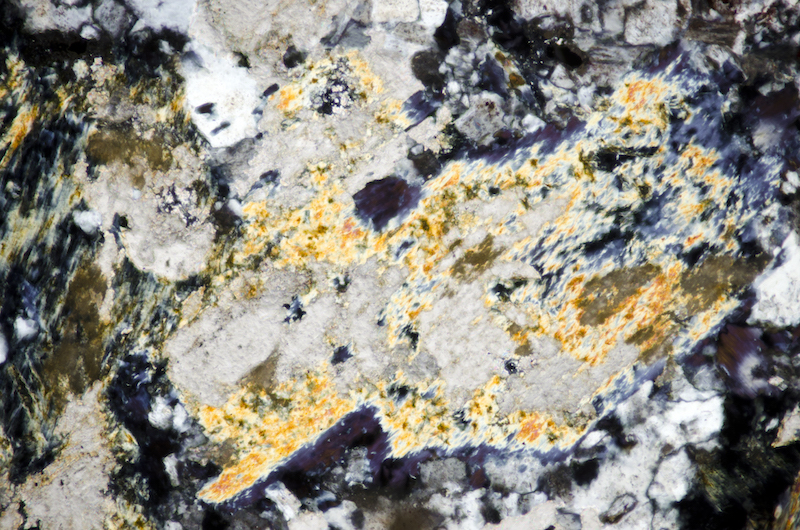
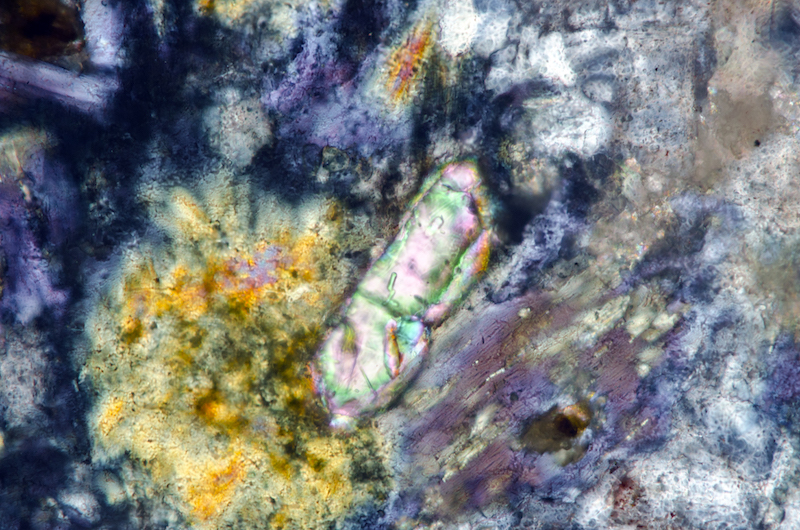
Section viewed with crossed polarising filters (FoV 0.5 x 0.3 mm)
Specimen 5

Prepared hand specimen in ordinary reflected light (45mm across)
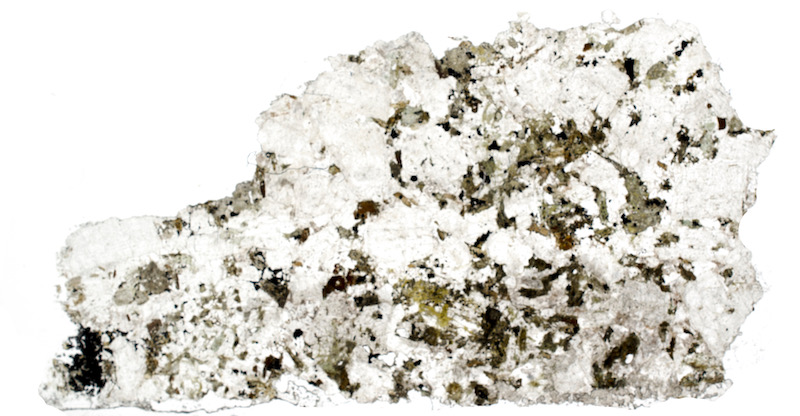
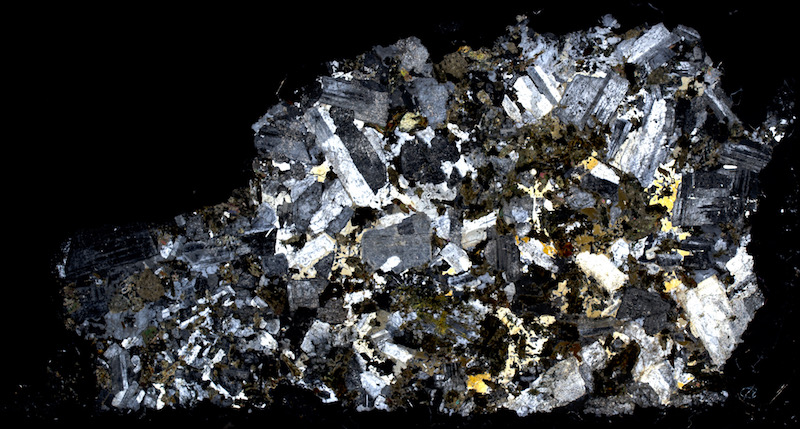

Section viewed in plane polarised light (FoV 4.6 x 3.0 mm)
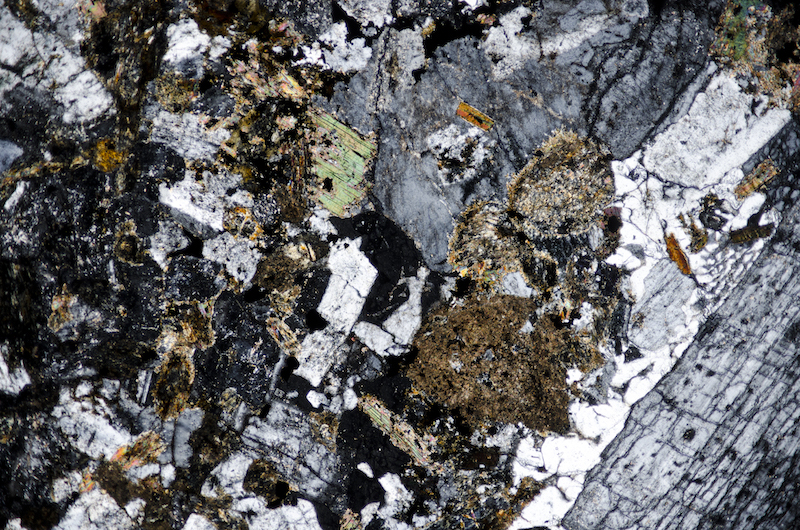

Section viewed with crossed polarising filters (FoV 4.6 x 3.0 mm)
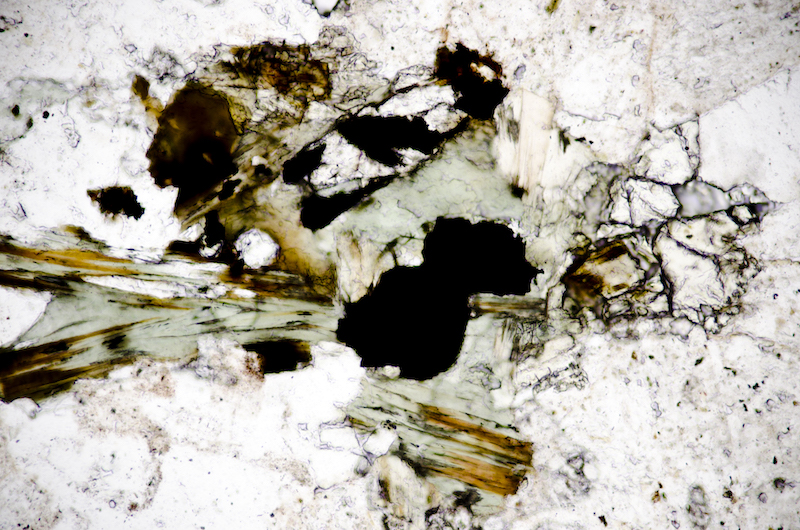
Section viewed in plane polarised light (FoV 1.2 x 0.8 mm)
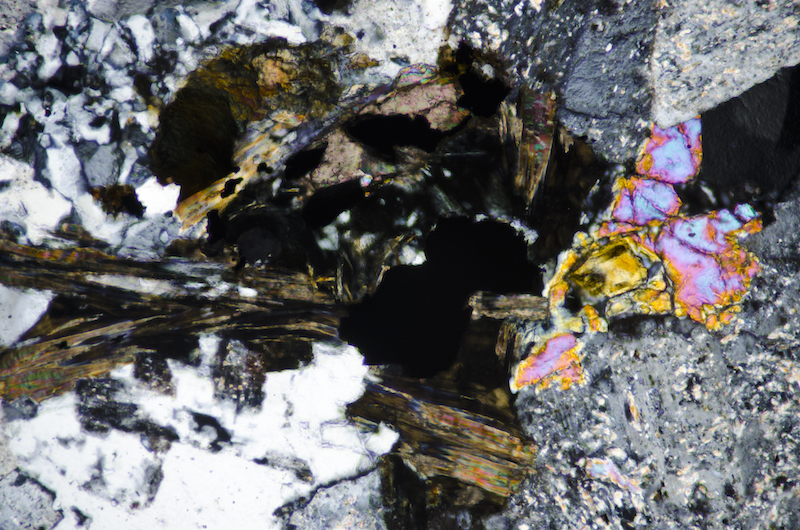
The mineral with high relief shows moderately high birefringence.

Section viewed in plane polarised light (FoV 2.3 x 1.5 mm)


The path runs alongside the fence in the background.
This conspicuous large boulder lies beside a field of smaller boulders and cobbles that are a mix of the more equigranular, very felsic rock and the more porphyritic, more mafic rocks that we have seen on the way up. The boulder is of the felsic, equigranular type and from here to location 3. on Cairn Hill, any loose rock we find along the way is more likely to be the same.
The second specimen shown here is of the second type.
Specimen 1
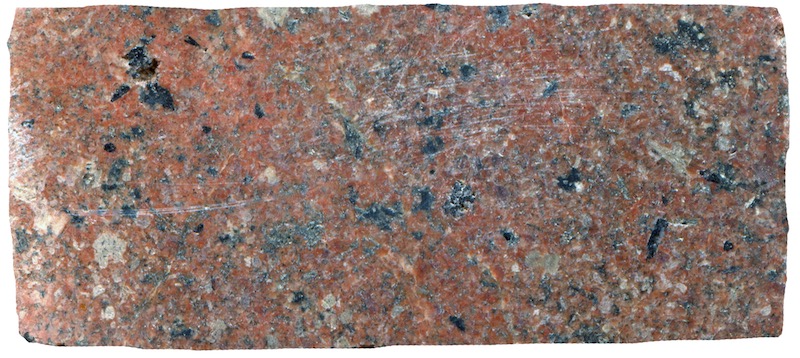
Prepared hand specimen in ordinary reflected light (46mm across)


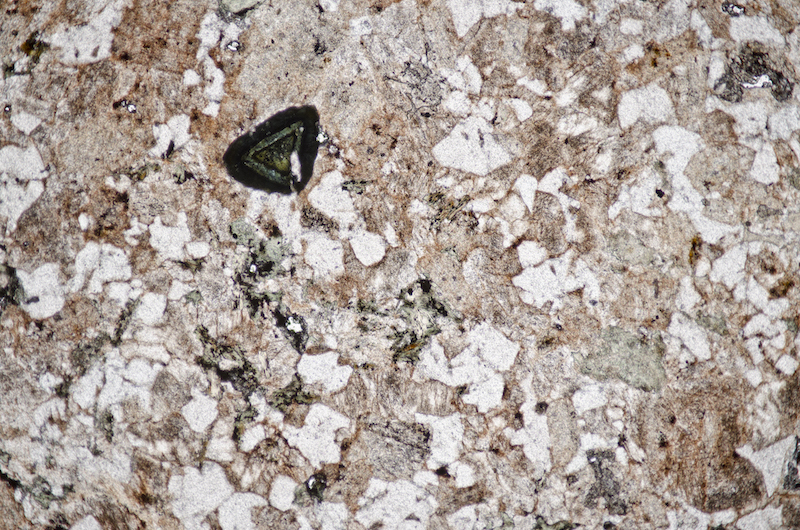
Section viewed in plane polarised light (FoV 4.6 x 3.0 mm)

Specimen 2

Prepared hand specimen in ordinary reflected light (44mm across)
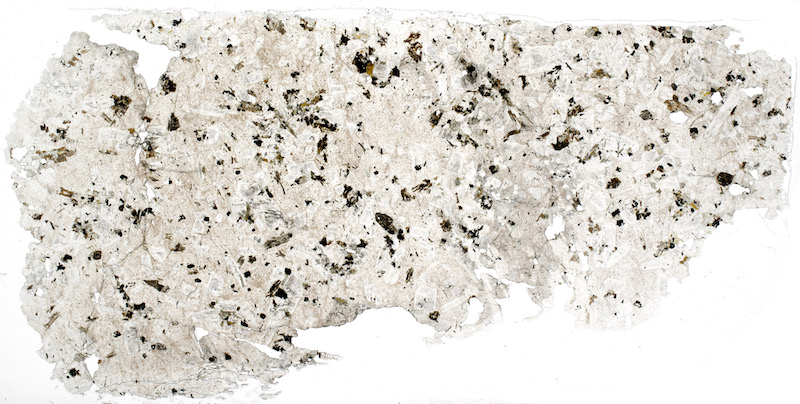
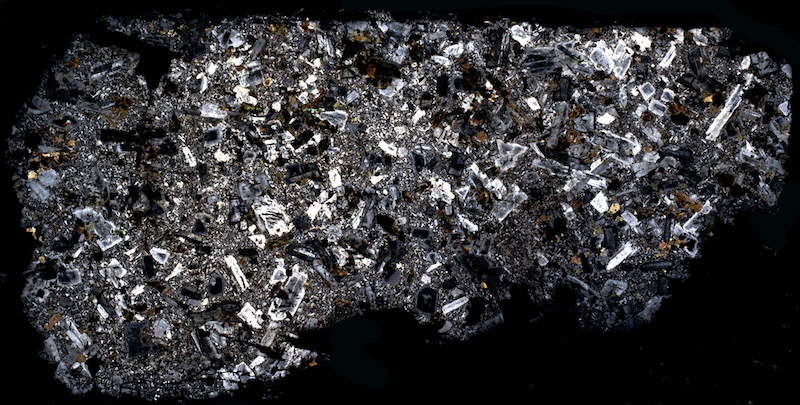
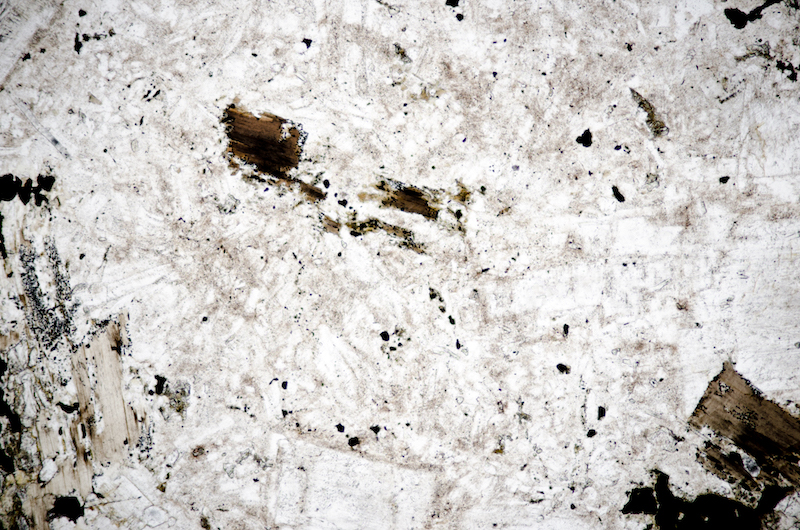
Section viewed in plane polarised light (FoV 2.3 x 1.5 mm)
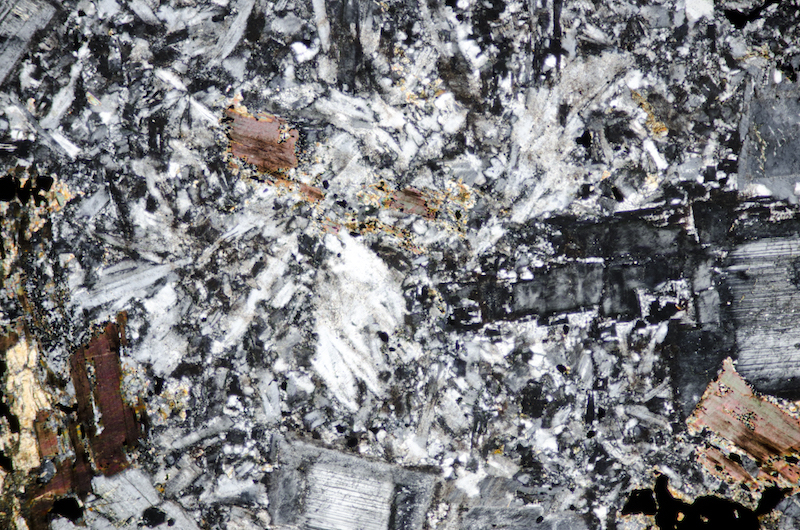
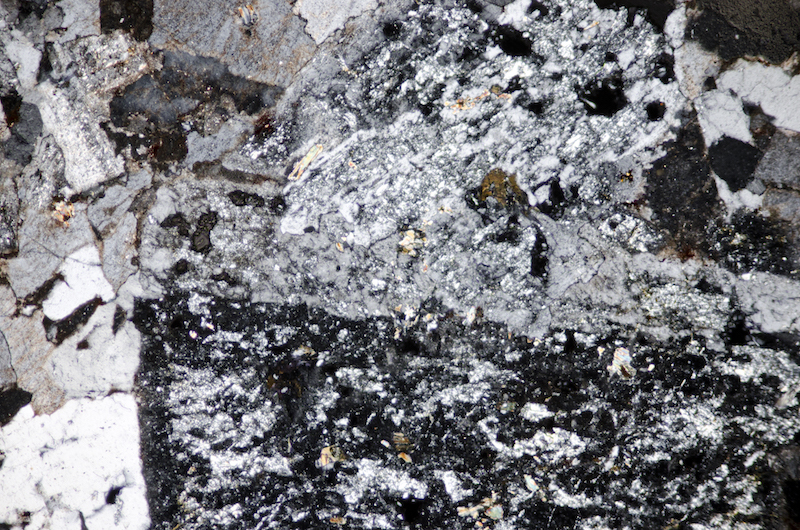
Section viewed with crossed polarising filters (FoV 2.3 x 1.5 mm)

Section viewed in plane polarised light (FoV 2.3 x 1.5 mm)

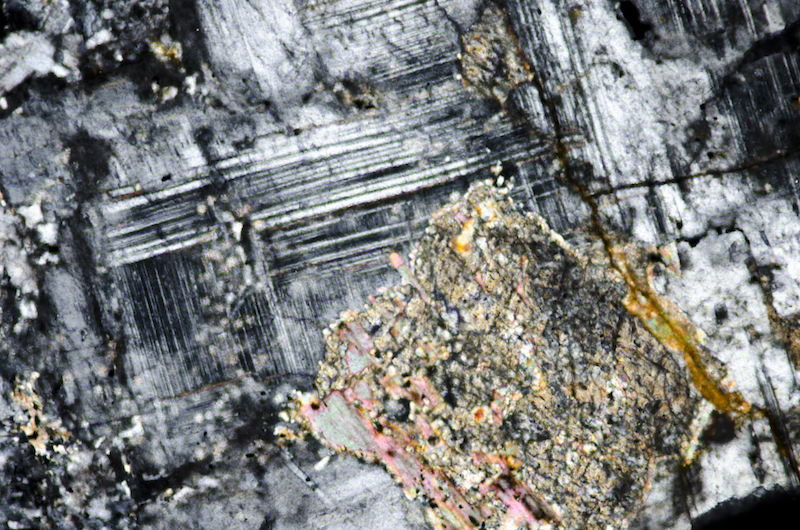
Section viewed with crossed polarising filters (FoV 1.2 x 0.8 mm)
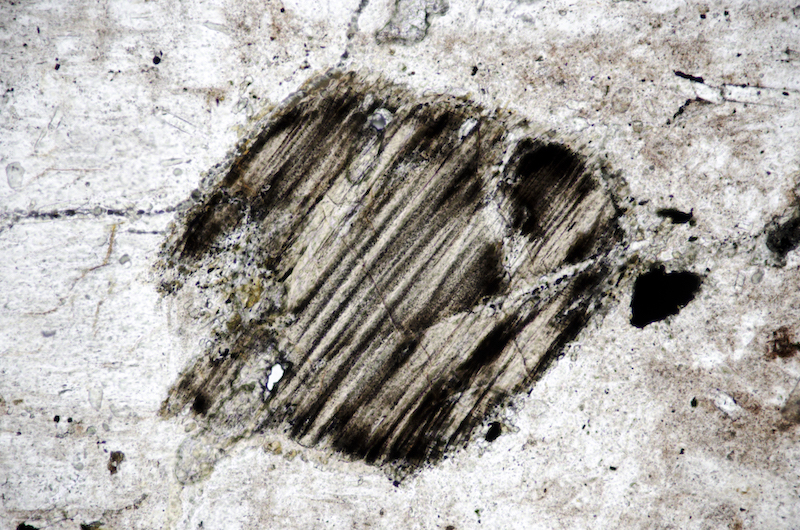
Section viewed in plane polarised light (FoV 1.2 x 0.8 mm)
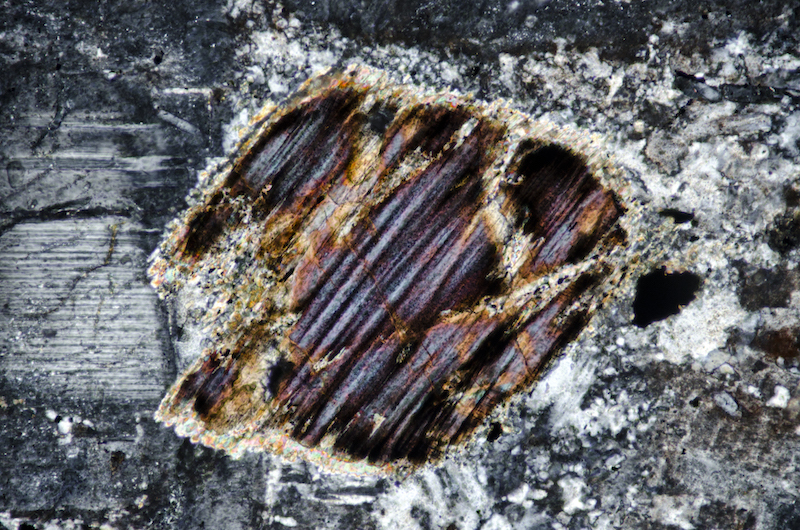

Section viewed with crossed polarising filters (FoV 1.2 x 0.8 mm)
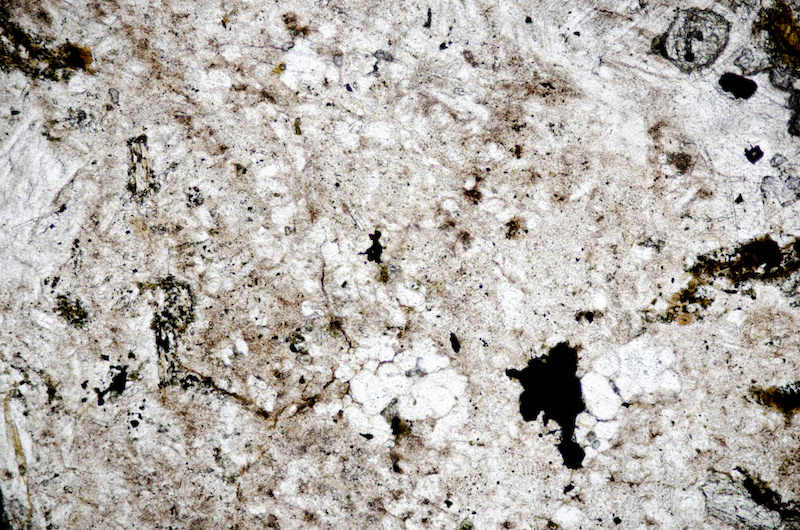
Section viewed in plane polarised light (FoV 2.3 x 1.5 mm)

As we walk over to the summit and then on to Scotsman’s Cairn on Cairn Hill, we appreciate the ecology and landscape and enjoy conversations with other walkers but there is little of petrological interest up here. Any loose pieces of rock we come across do tend to be of the felsic, non-porphyritic type.
Scotsman’s Cairn, an excellent place to shelter from the wind and eat lunch, is constructed almost entirely with this type of rock.
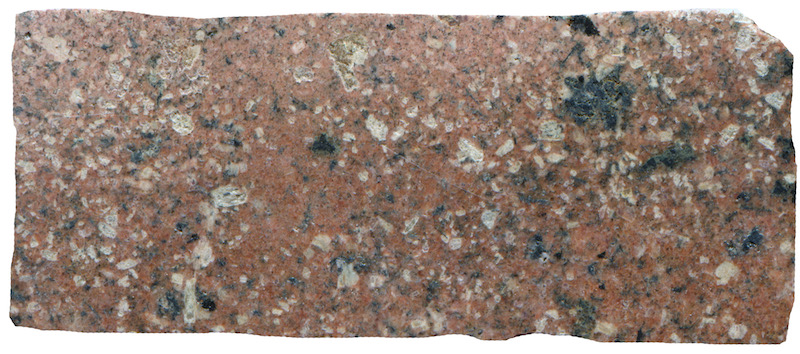
Thin section viewed with crossed polarising filters (47mm across)
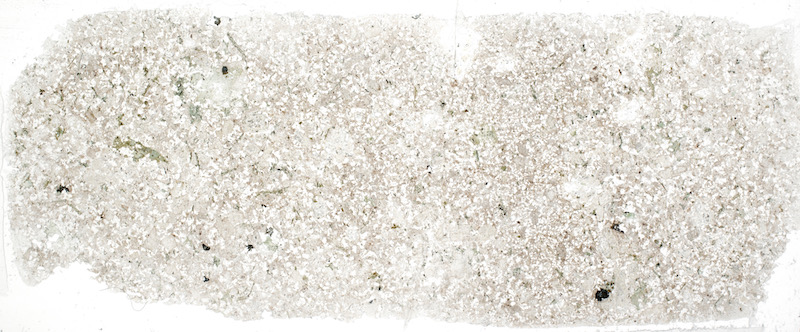
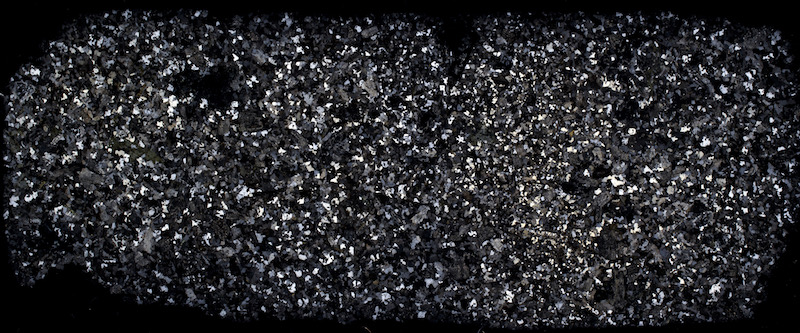
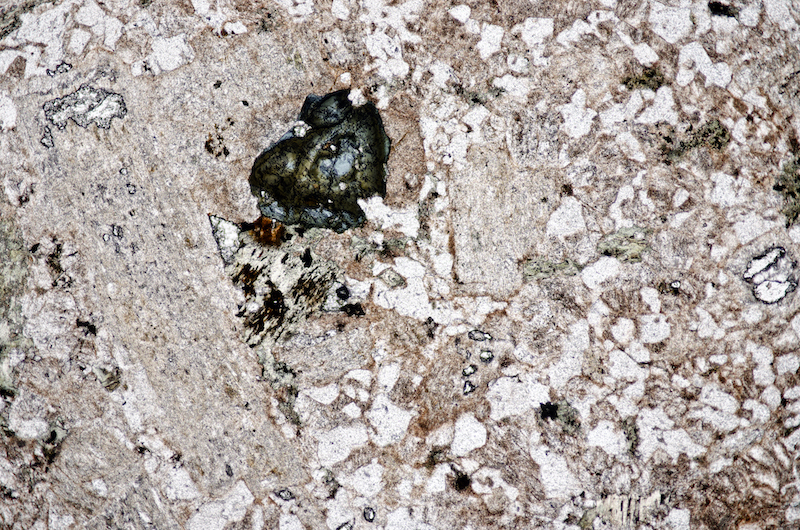
Section viewed in plane polarised light (FoV 4.6 x 3.0 mm)
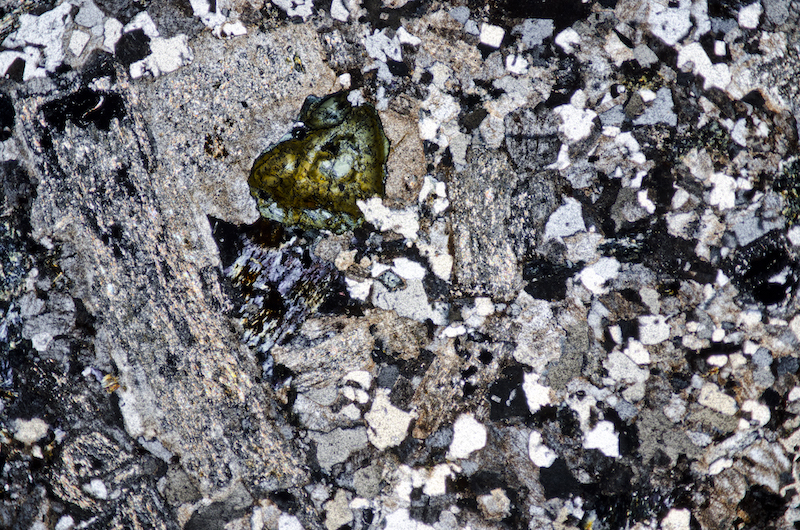
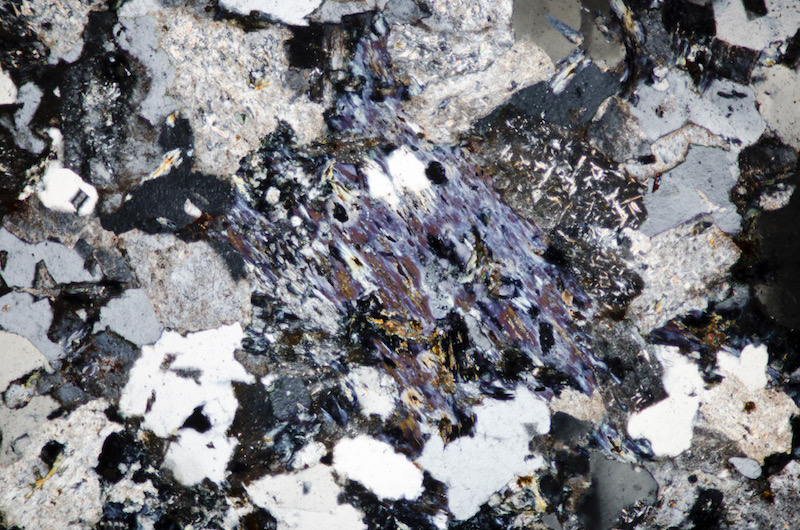
Section viewed with crossed polarising filters (FoV 2.3 x 1.5 mm)
The sub-equigranular alkali-rich granite predominates in the scree on the slope from Scotsman’s Cairn down to here. It then gives way to the outcropping Central Belt type that is described in the Harthope Valley excursion.


The line of the crag suggests its origin as a dyke but we have not seen evidence of chilling at its sides. Preston Hill is in the background to the left and Broadhope Hill to the right.
We return over the summit of Cheviot to where the path splits near location 2. We take the path heading north and then cut across rough ground to Woolhope Crag. This is one of the few outcrops of the most felsic of rock types in the Cheviot. The southern, higher end of the crag is lighter in colour than that lower down after the break at the crag – but both rocks are the much the same under the microscope.
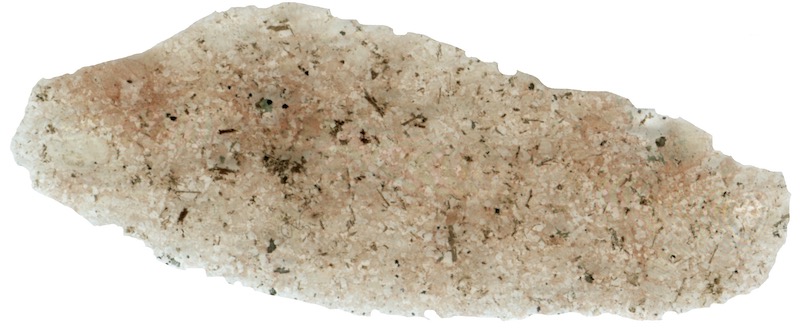
Al-Hafdh described the rock as having a ‘saccaroidal’ character and in thin section it is more equigranular than it is porphyritic. The overall crystal size is quite fine, however there are some larger, altered plagioclase crystals that measure around 2mm.
Mafic minerals make up only about 7% of the rock, biotite appearing as ragged ‘rods’ and flakes up to 1mm in length with magnetite at their rims and in cleavages. The biotite crystals have no inclusions. Tourmaline crystals are prismatic up to 0.6mm in length. There are small patches of magnetite in the rock and a dusting of haematite throughout.
There are fewplagioclase crystals – most of them heavily corroded but some still showing albite twinning. An approximate ratio of plagioclase to alkali feldspar is 1:3, some of the alkali feldspars show Carlsbad twinning.
The rock is relatively quartz-rich, much of it appearing with a micrographic texture resulting from rapid cooling in the final stages of the rock’s crystallisation or perhaps alteration processes. The inclusion of a patch of micrographic quartz in a Carlsbad twinned feldspar crystal in our sample could suggest the latter.

Prepared hand specimen in ordinary reflected light (36mm across)
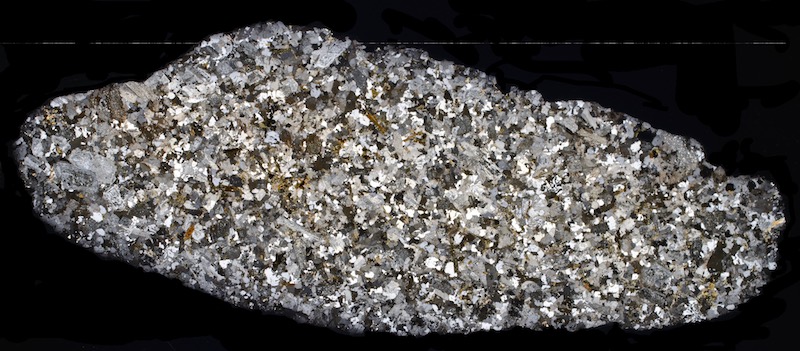

Section viewed in plane polarised light (FoV 4.6 x 3.0 mm)


Section viewed with crossed polarising filters (FoV 2.3 x 1.5 mm)

Section viewed in plane polarised light (FoV 2.3 x 1.5
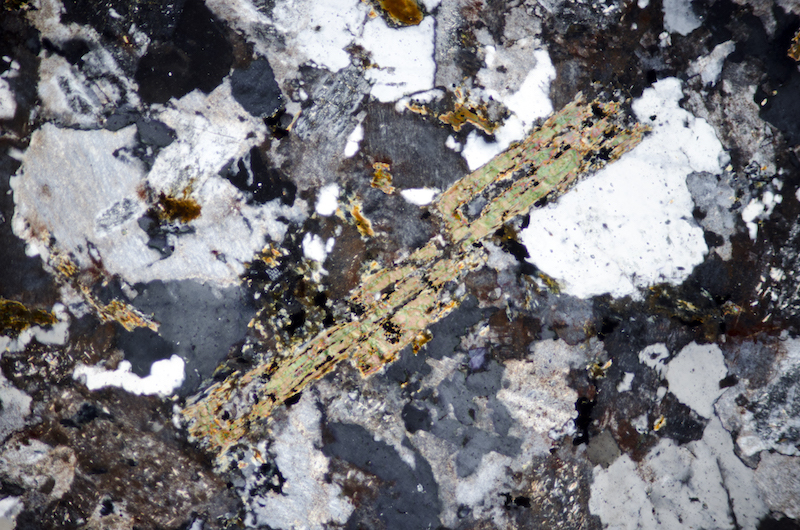
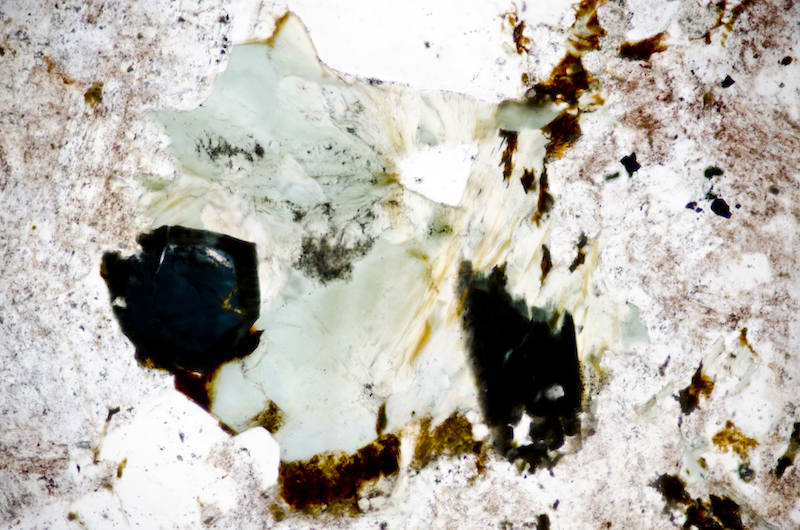
Section viewed in plane polarised light (FoV 1.2 x 0.8 mm)

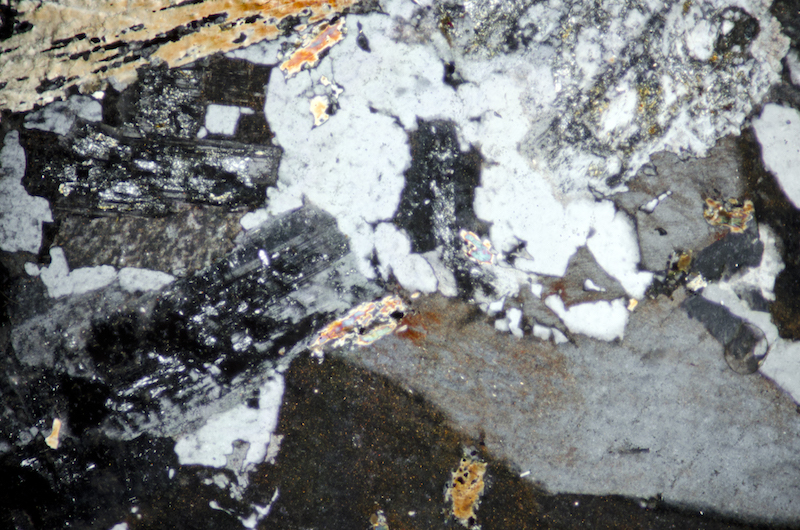
Section viewed with crossed polarising filters (FoV 2.3 x 1.5 mm)
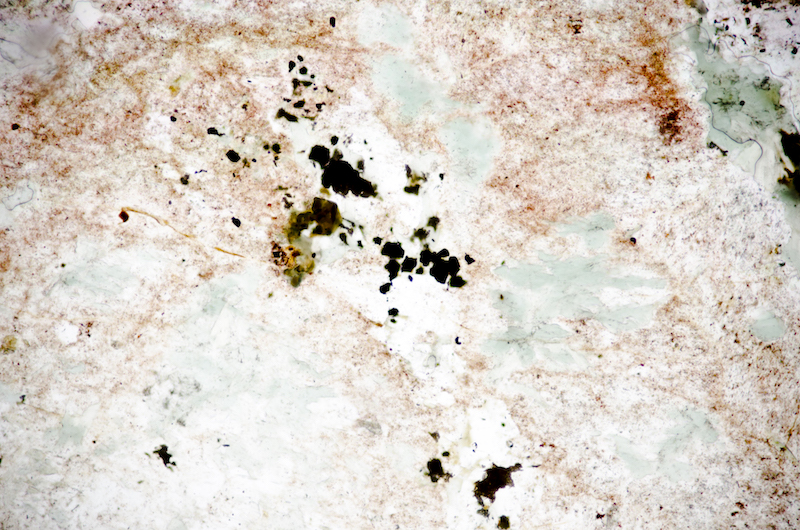
Section viewed in plane polarised light (FoV 1.2 x 0.8 mm)

Return to car
References
Carruthers, R G, Burnett, G A, Anderson, W, and Thomas, HH,1932. The Geology of the Cheviot Hills (Based on the work of C.T. Clough and W. Gunn) HMSO
Al-Hafdh N.M. 1985. The Alteration Petrology of the Cheviot Granite. Thesis submitted for PhD. at Newcastle University.
J. G. Mitchel, K. M. Storetvedt, D. A. Robson, M. C. Abranches, and P. R. Ineson, 1993, Evidence for Carboniferous thermochemical overprinting in the Cheviot Complex, Scottish Journal of Geology 29, (1), 55-68,
British Geological Survey Online geology map http://mapapps.bgs.ac.uk/geologyofbritain/home.html