Feldspar in Cheviot igneous rocks
Feldspar constitutes an important family of rock-forming minerals. It is an aluminium silicate combined with varying proportions of calcium, sodium and/or potassium. Large gem quality crystals of feldspar are rare but do occur as labradorite.
In the Cheviot pluton, feldspar forms small grains varying in size from microscopic to about 4mm in length.
Two main types occur in the Cheviot Hills, orthoclase/perthite and plagioclase (mainly andesine variety).
Plagioclase feldspar
The plagioclase series contains a variable ratio of sodium to calcium. A pure sodium feldspar is called albite; a pure calcium feldspar is called anorthite. Plagioclase is formed at high temperatures (usually over 1000 Celsius). It forms a ‘solid solution’ of variable albite and anorthite content.
The sodium and calcium molecules are compatible with each other when the mineral solidifies so that crystals contains a mixture of the two. Under equilibrium conditions, the content of the solidified plagioclase should be the same as the original liquid’s composition. In practice, the cooling process does not necessarily go smoothly so that some parts of a plagioclase crystal may be richer in anorthite than other parts.
As the anorthite comes out of solution first, this may make the centre of the crystal more calcic than the outer part. This can sometimes be seen under crossed polars as zoning.
Any feldspar can develop zoning, but a zoned feldspar is more likely to be plagioclase than an alkali feldspar.
Plagioclase forms multiple twins that provide a useful guide to the sodium:calcium ratio in the mineral by measuring the symmetrical extinction angle.
Alkali feldspar
The alkali feldspar series behaves quite differently. It solidifies at a much lower temperature (below 1000C) than plagioclase. In solution, the albite and orthoclase molecules are compatible with each other but they have to separate out as distinct minerals on crystallisation. Usually the process is too fast for completely separate crystals to develop.
As a result, orthoclase often contains strings of albite contained within itself which can often be seen under the microscope. The mineral is then called ‘perthite’.
Composition Diagram for Cheviot Feldspars

Identification
In plain polarised light, plutonic feldspars are usually dusty or turbid in appearance as a result of weathering or chemical alteration. This makes them relatively easy to distinguish from quartz.
All feldspars except for the more calcium-rich specimens, have refractive indices less than quartz. With decreasing calcium content the refractive index (RI) becomes smaller. With potassium feldspar, the RI is smaller than the slide mounting medium. This can provide a useful aid for distinguishing orthoclase from plagioclase because the surface relief looks different. A Becke test can usually verify this.
Twinning of feldspar crystals which is very common, provides a useful guide to identification. Orthoclase/perthite twins as simple double crystals (Carlsbad or Baveno twins). It never makes multiple lamellar twins. On the other hand, plagioclase very frequently develops multiple lamellar twins although it may also develop simple double ones as well.
Photomicrographs of Cheviot feldspars
Plagioclase

A mass of plagioclase with orthoclase around it. Section viewed with crossed polarising filters (FoV 2.3 x 1.5 mm)
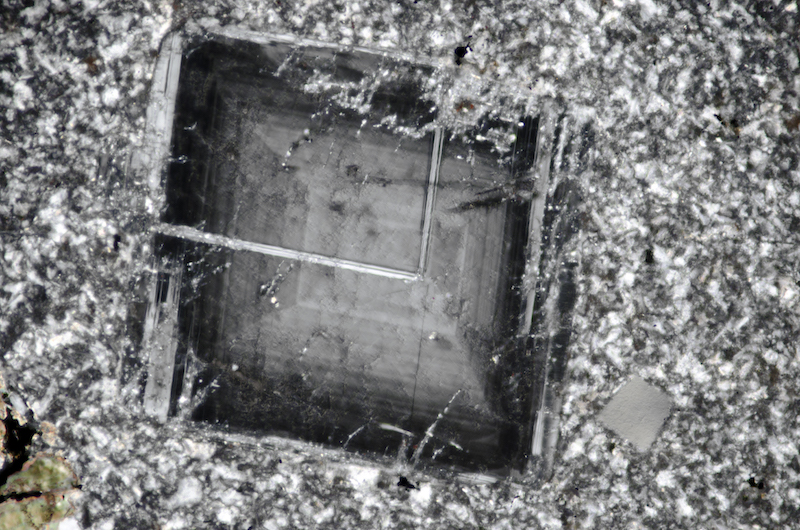
Section viewed with crossed polarising filters (FoV 1.2 x 0.8 mm)

Locality: Hartside Hill
Section viewed with crossed polarising filters (FoV 4.6 x 3.0 mm)
Alkali feldspar

Locality: Hawsen Burn
Section viewed in plane polarised light (FoV 2.3 x 1.5 mm)
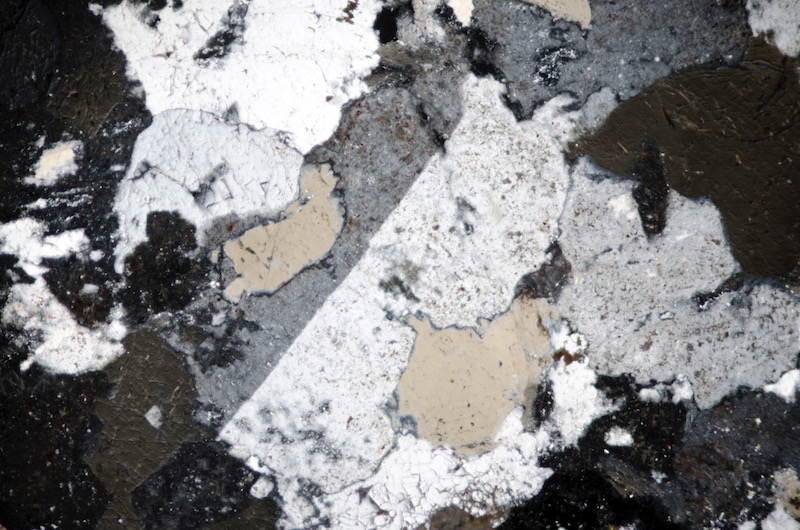
Location: Breamish Valley
Section viewed with crossed polarising filters (FoV 2.3 x 1.5 mm)

Section viewed with crossed polarising filters (FoV 2.3 x 1.5 mm)

Locality: Hedgehope Hill
Section viewed with crossed polarising filters (FoV 5 x 3.3mm)
Return to list of minerals in Cheviot rocks