Zircon in Cheviot igneous rocks
Zircon is a common accessory mineral in Cheviots rocks often occurring as inclusions within other minerals.
The comparative stability of zircon under different geological conditions means that zircon crystals, or at least their cores, can survive the processes of crustal reworking and hydrothermal alteration of the sort that happened when the Iapetus Ocean closed and the two ancient continents of Avalonia and Laurentia collided. Their survival, combined with the measurable and predictable decay products of their radioactive components, means they can provide professional geologists with insights into their geological histories.
In the years since Al-Hafdh’s 1985 thesis, advances in micro-analytical technologies and techniques have made zircon analysis a key tool in forging a better understanding of igneous rocks and processes.
Unfortunately for us, Al-Hafdh did not carry out electron microprobe analysis on Cheviot zircons.
Identification
Zircon crystals are too small to be seen in hand specimens of Cheviot rocks.
In thin section, it is easily identified in PPL by its extremely high relief that outlines the colourless crystal within. In long section, a well formed zircon crystal appears tabular with prismatic ends that may show feint parallel cleavage along its length. In cross section it will tend to a square shape with the possibility of two, feint intersecting cleavages that form lozenges.
When viewed with crossed polarising filters, zircon exhibits an intense complex of interference colours that range up to the third order.
It has straight extinction.
When zircon occurs as an inclusion, its radioactive thorium content may induce a pleochroic halo in the host mineral.
Photomicrographs of Cheviot Zircon

Locality: Hedgehope Hill, Northumberland.
The colourless zircon crystal to the right of centre stands out clearly against the dark surrounding magnetite, biotite and feldspar. It is 0.1mm in length.
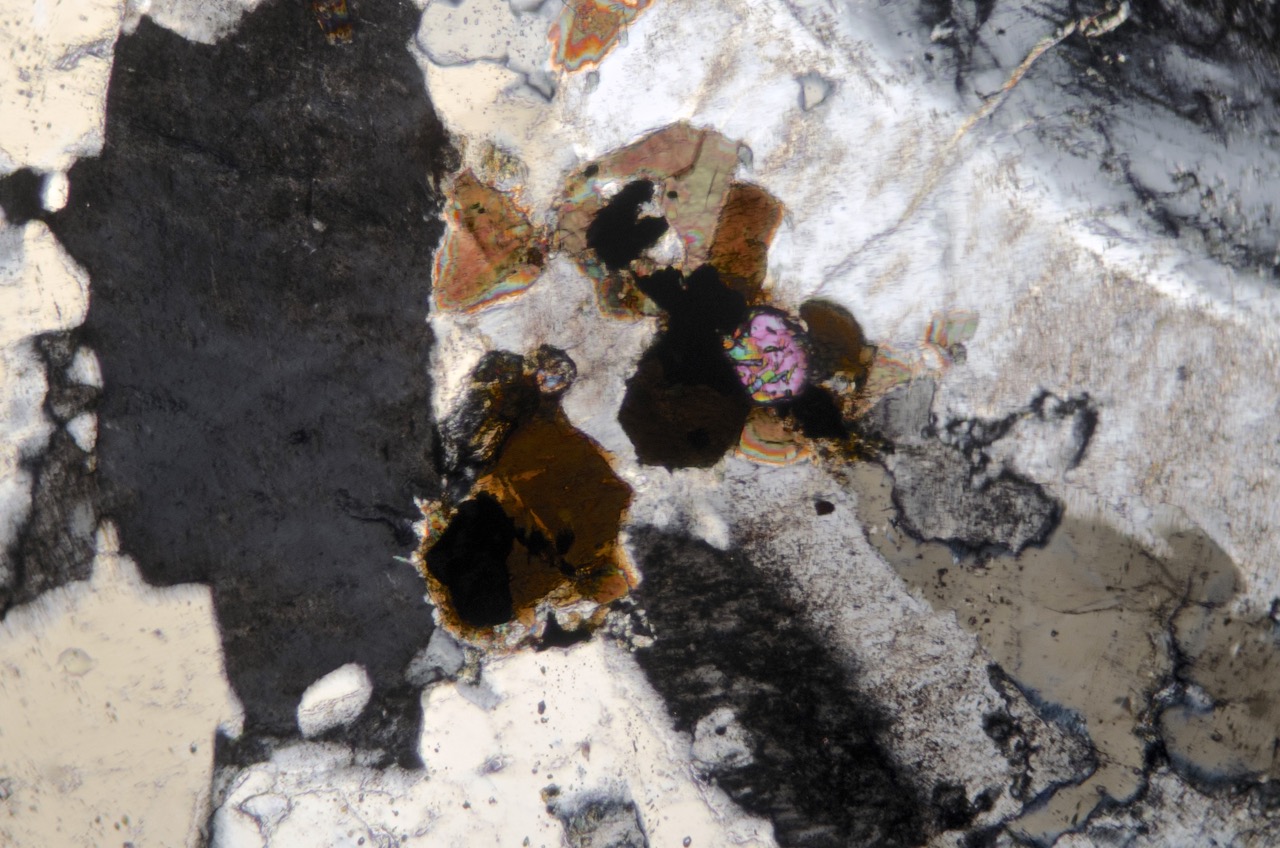
Locality: Hedgehope Hill, Northumberland.
Here the zircon displays a complex of interference colours that range up to the third order.

Locality: Hedgehope Hill, Northumberland.
The higher magnification reveals the many inclusions within this particular zircon crystal.

Locality: Hedgehope Hill.
The zircon crystal in the centre of view is included in chlorite. In this position the pleochroic halo is not so evident. The crystal is 0.1mm in length.

Locality: Hedgehope Hill.
The same zircon rotated on the microscope stage revealing the pleochroism of the halo.
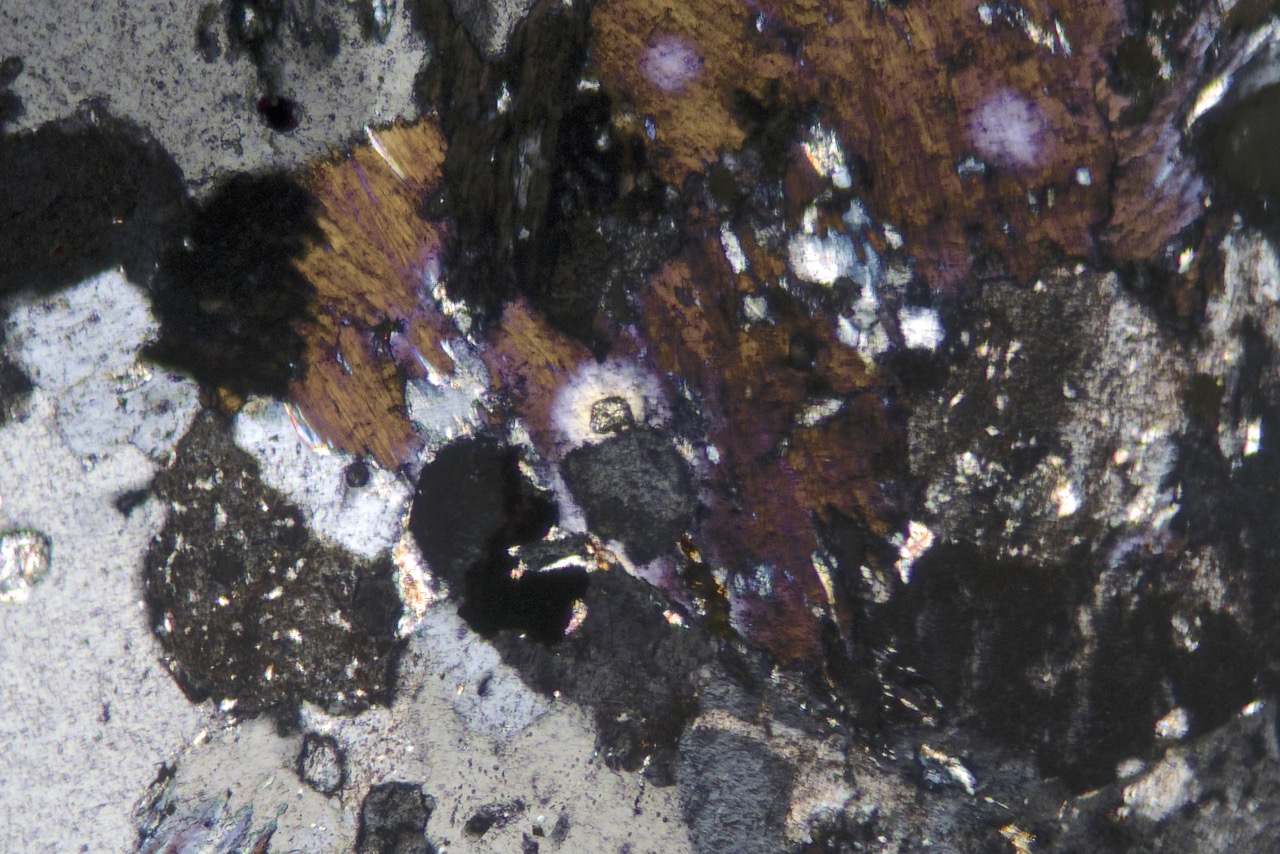
Locality: Hedgehope Hill, Northumberland.
Viewed with crossed polarising filters, the circle of damage caused in the chlorite is even more evident.
Return to list of minerals in Cheviot rocks