Iron-titanium oxides in Cheviot igneous rocks
Iron-titanium oxides occur in most Cheviot igneous rocks in varying quantity. There are copious amounts in the ‘Marginal’ group of rocks at the edge of the pluton and very little in the ‘High Cheviot’, evolved granite that we find up on Cheviot.
Magnetite occurs in such quantities in the Cheviots Hills as to introduce a magnetic anomaly over the area that is especially pronounced in the marginal granite and andesite areas.
Iron oxides readily combines with titanium to form minerals that constitute the iron spinel group. The group includes ilmenite and rutile which are both found in the Cheviots.
A.N. Al-Hafdh carried out four electron microprobe analyses on two members of the iron spinel group. Three were on ilmenite grains in samples taken from Kitty Crags, Threestone Burn and the Linhope Burn and one on was on a magnetite grain in the sample from Kitty Crags.
The results were in line with the ideal compositions of the two minerals.
H.W. Haslam’s analysed six grains of magnetite and ilmenite from samples of rock taken from Dunmoor Hill and near Gt. Standrop. He found a wide compositional variation within and between grains with no consistent pattern in the variation. As with the pyroxenes, Haslam concluded that evidence pointed to a sub-500oC temperature at which equilibrium took place leading to the view that present compositions do not provide information regardingcompositions at the time of consolidation.
The following diagram shows Al-Hafdh’s recorded magnetite and ilmenite compositions along with the ideal compositions of haematite and rutile. The solid lines with colour gradients represent the two solid solutions that exist between magnetite and ulvospinel, and haematite and ilmenite.
Composition Diagram for Cheviot Iron Oxides

Identification
In hand specimens of Cheviot rock, magnetite and ilmenite appear as black flecks or, when very fined grained, a black stain in the rock. Haematite can occur in thin strands and streaks as well as in larger masses that quite commonly impart a vermillion red stain across the rock. When rutile appears in quartz, it can be seen as distinct crimson brown patches.
In thin section viewed in transmitted plain parallel light, magnetite crystals are often opaque black with quite well defined edges. Ilmentite is difficult to distinguish from magnetite. Haematite is less well defined and patches vary from an opaque orange-brown at the centre to more transparent orange/red-brown at the edges. Rutile too varies from opaque to transparent but generally appears a rich, more transparent red.
Crossing the polarising filters has little effect on the appearance of these minerals.
However, when viewed in reflected light, differences between the iron-titanium oxides are more apparent.
Magnetite is highly reflective and does not change colour when polars are crossed and the stage rotated. Haematite and ilmenite are less reflective and, being anisotropic, they do show subtle changes of colour when polars are crossed and the stage is rotated.
We are always on the look out for rutile, TiO2, in our thin sections but we have only seen one instance of a mineral exhibiting its characteristic dark brown to orange-red brown pleochroism.
This was in what looks like a relict biotite crystal in an andesite dyke on Knock Hill. The rarity of rutile, or our inability to recognise it, might be surprising considering Al-Hafdh observation of an unusually high titanium content of most biotite in the Cheviots. Content ranged, ‘from 4.7% to 6.4%, reaching higher levels than the highest recorded in Deer, Howie and Zussman (1962) for granites or granodiorites, and higher than the highest value analysed from the Ben Nevis granite complex (4.65%) (Haslam, 1968, p.96).’
The mean Ti02 content of the granitic rock in the Cheviots was calculated at 0.7%.
Photomicrographs of Cheviot Iron/titanium Oxides
Magnetite
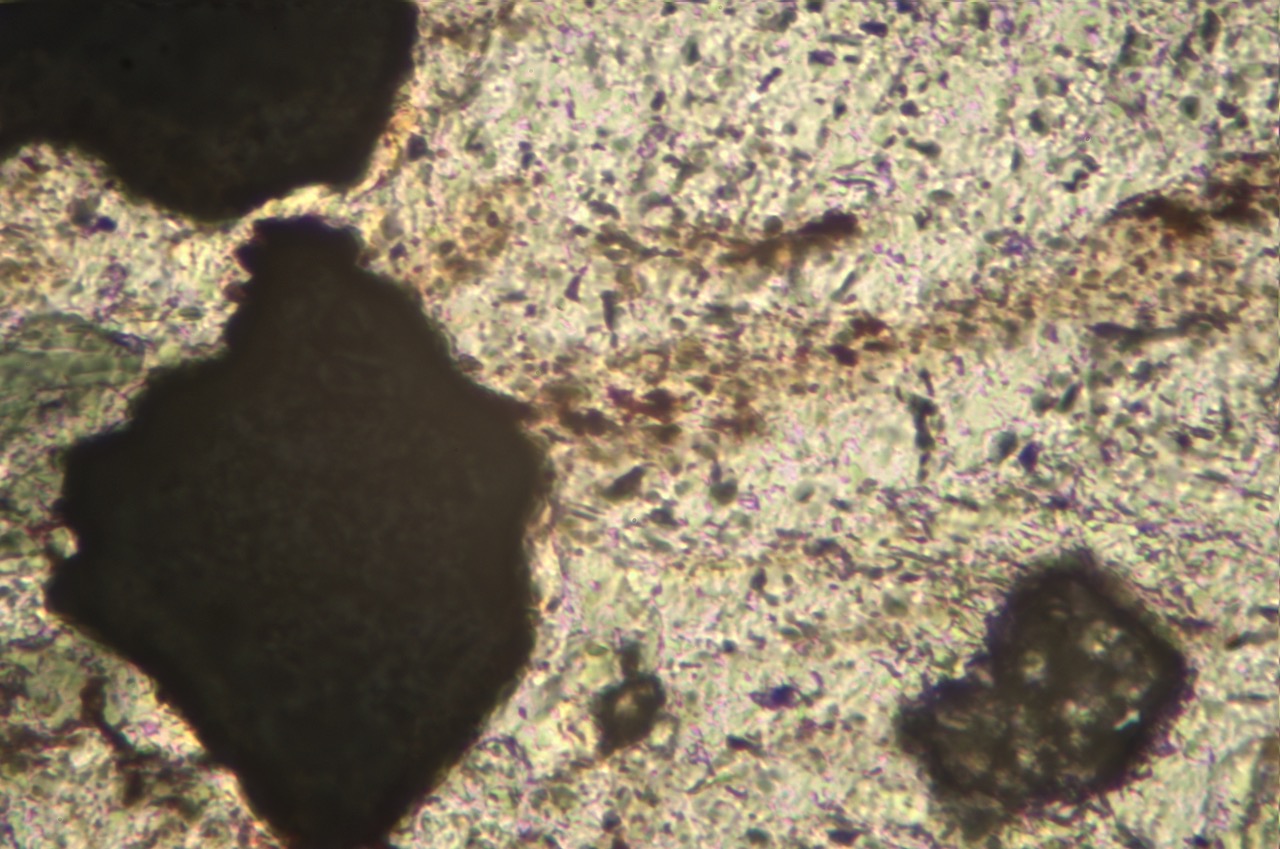
Locality: Hedgehope Hill, Northumberland.
The two grains of magnetite on the left appear black and opaque in plane polarised light. A thin dark red-brown streak of haematite is visible to the centre right.

Locality: Hedgehope Hill, Northumberland.
In plane reflected light, the same grains of magnetite are highly reflective. The haematite is still just visible to the right.
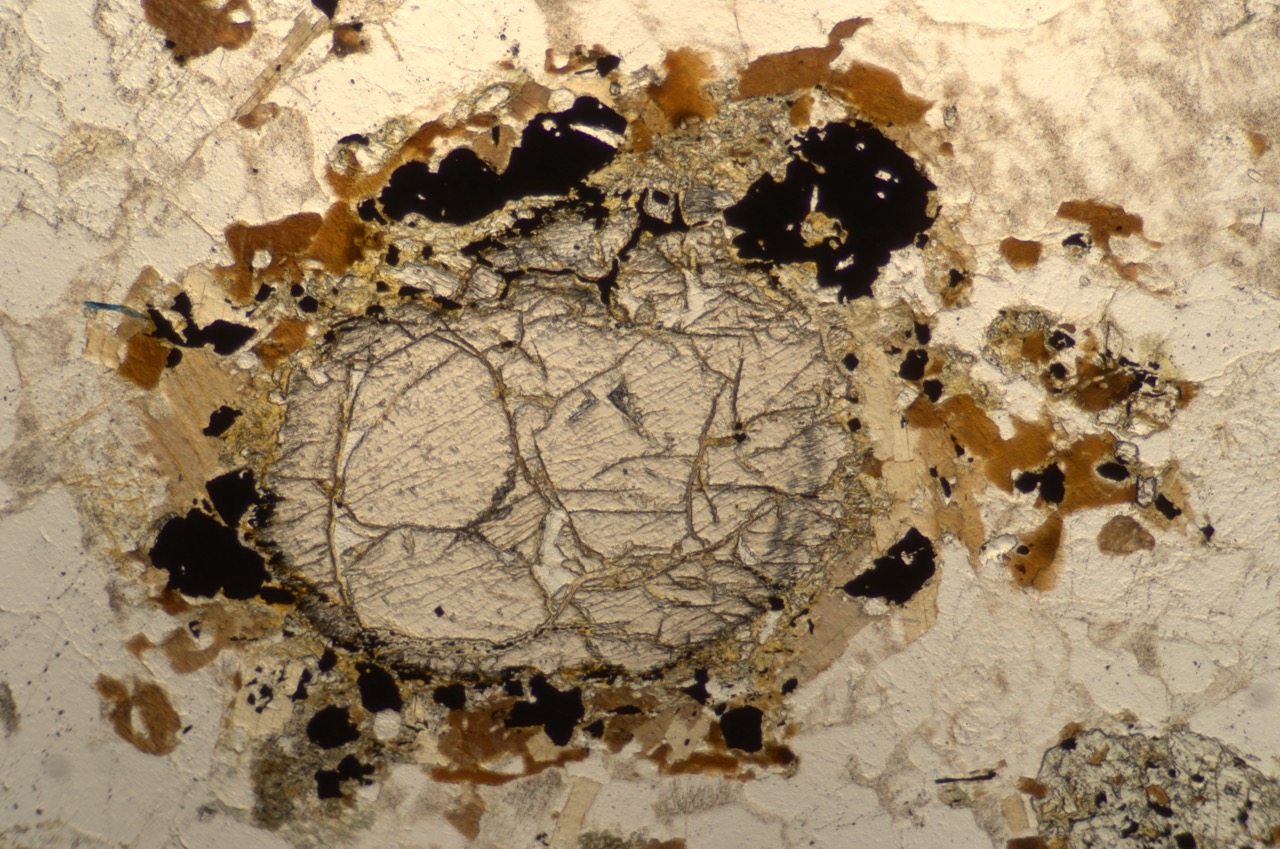
Locality: Hedgehope Hill, Northumberland.
Magnetite crystals are commonly found around altered ferromagnesian minerals. Here, together with secondary biotite, they surround a relict pyroxene crystal.

Locality: Hedgehope Hill, Northumberland.
Here, haematite is encroaching along cleavage lines in the magnetite and replacing it. The bright area in the centre of the mass is quartz.
The magnetite grain measures 0.9mm in length
Haematite
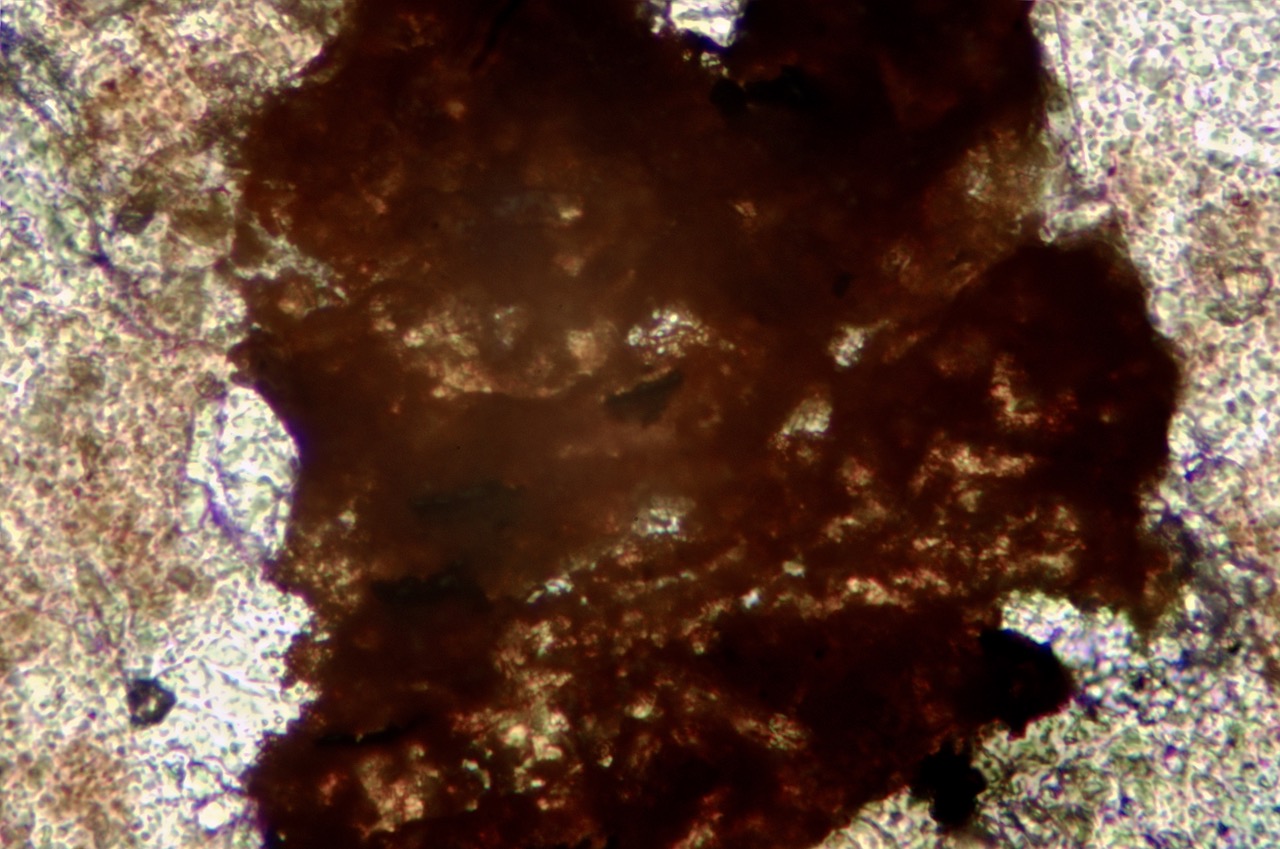
Locality: Carey Burn, Northumberland.
Hematite occurs here in an indistinct semi-opaque orange-brown mass. It measures 1mm in length.

Locality: Carey Burn, Northumberland.
Haematite is less reflective than magnetite when viewed in plane reflected light and its orange-brown colour helps in its identification.

Locality: Linhope Burn, Northumberland.
High relief, deep crimson haematite crystals appear in the quartz veins that appear to be associated with boundaries between two different varieties of granite e.g. in the Linhope Burn area, and also in fracture zones e.g. in the Hawsen Burn valley.

Locality: Linhope Burn, Northumberland.
With polars crossed, the crystals appear much the same as in plane light, but the quartz inclusions in the crystals can be distinguished from the holes that resulted in thinning the sample.

Locality: Linhope Burn, Northumberland.
Rutile
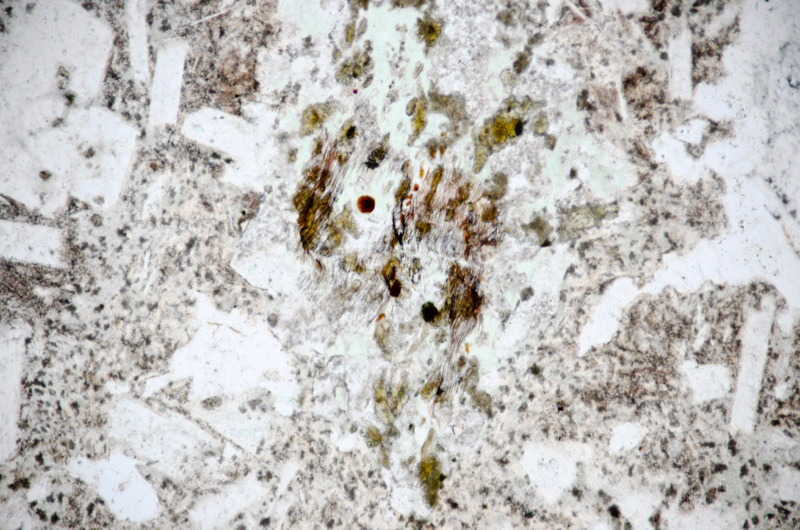
Section viewed in plane piolarised light (FoV 1.2 x 0.8 mm)

Section viewed in plane polarised light (FoV 0.5 x 0.3 mm)

The mineral reveals a rich orange-brown colour – a characteristic of rutile.
Return to list of minerals in Cheviot rocks